
Key facts
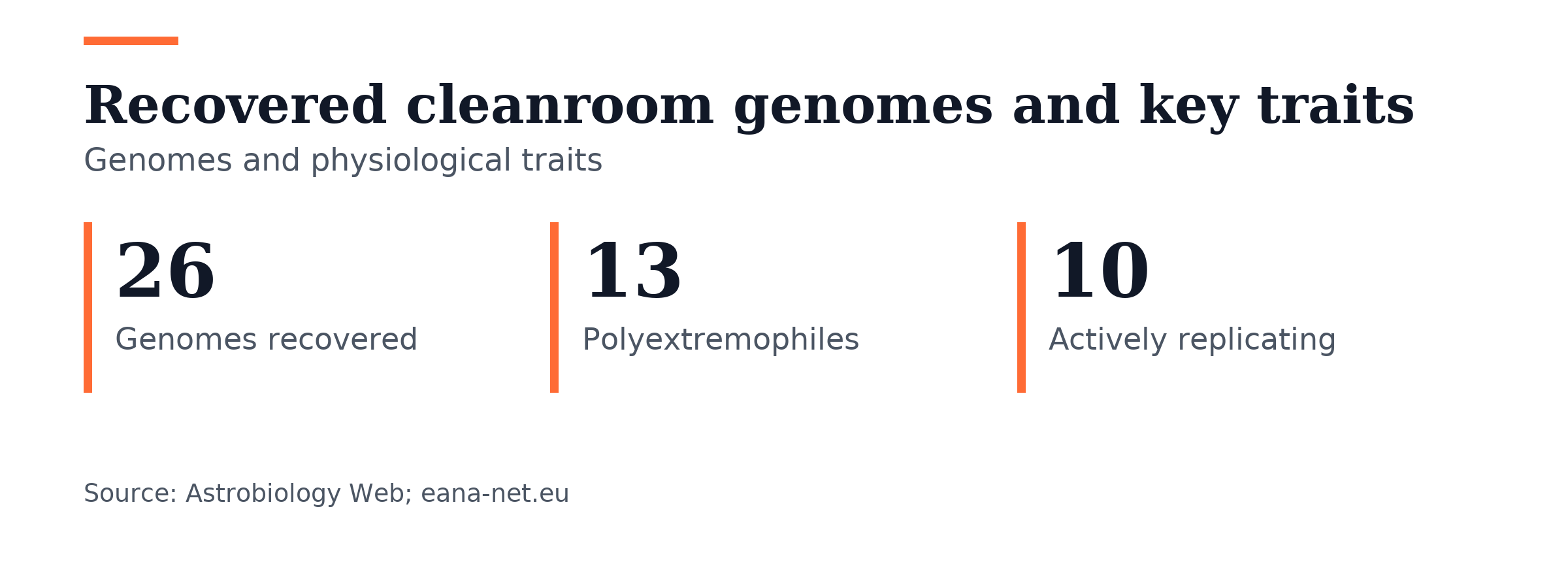
- Scientists recovered 26 non-redundant metagenome-assembled genomes of medium or high quality, representing six bacterial phyla.
- Some genomes encoded putative degradation pathways for the cleaning agents dodecylbenzene sulfonate and nonylphenol ethoxylate, and the researchers suggested these compounds could serve as carbon sources.
- Growth rate index (GRiD) analysis identified 10 genomes exhibiting replication signatures, indicating active replication within cleanroom environments.
- A peer-reviewed study in Philosophical Transactions A used ensemble binning to analyze functional microbial diversity in published metagenomic datasets from NASA spacecraft assembly cleanrooms.
A peer-reviewed study published Nov. 19, 2026, in Philosophical Transactions A used ensemble binning to analyze functional microbial diversity in published metagenomic datasets from NASA spacecraft assembly cleanrooms.
Ensemble binning, a method that combines multiple genome-binning tools, is intended to recover more genomes than any single algorithm could produce from low-biomass cleanroom samples. The pipeline ran three direct binning algorithms—Metabat2, MaxBin2, and CONCOCT—followed by dereplication and quality filtering with DASTool and dRep. A description published March 22, 2024, noted that the team also applied GenomeSPOT for physiological tolerance predictions alongside the GRiD pipeline for growth predictions. Gene functions were annotated with Prokka, DRAM, and BlastKOALA.
The team recovered 26 non-redundant metagenome-assembled genomes—genomes pieced together from mixed DNA in a sample—of medium or high quality, representing six bacterial phyla. These genomes form the main output of the ensemble binning pipeline and represent the cleanroom microbes whose functions the team analyzed.
The metagenomes came from 54 published datasets collected at cleanrooms at the NASA Jet Propulsion Lab, Kennedy Space Center’s Payload Hazardous Servicing Facility, and Lockheed Martin Aeronautics’ Multiple Testing facility. These three NASA-associated assembly sites provided the sequence data that the ensemble binning approach reassembled into genomes.
Growth rate index analysis identified 10 genomes exhibiting replication signatures, indicating active replication within cleanroom environments rather than survival only as dormant cells. Active replication means the microbes are growing under facility conditions rather than only surviving as dormant cells.
Annotations revealed widespread alcohol and aldehyde dehydrogenases across the genomes, enzymes tied to metabolic capabilities that may help microbes process chemicals present in assembly facilities. Some genomes encoded putative degradation pathways for the cleaning agents dodecylbenzene sulfonate and nonylphenol ethoxylate, and the researchers suggested these compounds could serve as carbon sources. Physiological predictions identified 13 genomes as polyextremophiles—organisms that tolerate extreme conditions—with proposed tolerances to at least 4 M NaCl, pH 9 or higher, and 40 °C or higher. These tolerance levels suggest the organisms can endure high salt, alkaline conditions, and heat, which are relevant to both cleanroom stress and space environments.
Some microbial taxa persisted across years and sampling sites, indicating established resident populations in the cleanroom network rather than one-time introductions. The researchers concluded that ensemble binning enhances genome recovery and functional insight in low-biomass environments such as spacecraft cleanrooms. Low biomass makes genome assembly difficult, so combining binning programs helps recover genomes more completely from limited DNA.
Finding microbes that replicate, use diverse metabolisms, and tolerate extremes affects planetary protection planning and future strategies to reduce bioburden, the microbial load on a spacecraft. Because these organisms can survive sterilization and potentially degrade cleaning agents, planetary protection teams may need to update how they assess and reduce microbial risk on spacecraft. Existing planetary protection methods depend mainly on spore-based tests created for Mars missions and might not fully measure contamination risks for icy ocean worlds like Europa. The limitation motivates the development of genome-based methods that look beyond spore counts to functional traits relevant for survival in different extraterrestrial environments.
For decades, ESA and NASA have used a colony-count assay including heat shock as the standard method under ECSS-Q-ST-70-55, exposing samples to 80 °C for 15 minutes before plating on nutrient-rich agar and incubating aerobically at 32 °C for 72 hours.
Since 2016, cleanroom monitoring has used amplicon sequencing of 16S rRNA genes, a genetic marker used to identify bacteria and archaea, as a cultivation-independent technique. The method offers high-throughput and low-cost community structure insights but faces challenges in low-biomass environments where background contamination can overwhelm true signals. Researchers comparing 205 samples found that biological specimens and controls overlapped extensively, that controls made up more than half the data, and that alpha and beta diversity did not differ significantly.
Analysis indicated that almost 7 percent of sequencing reads came from contaminants, and machine-learning models could not tell sample types apart from controls. These findings show that amplicon sequencing alone may not reliably identify which microbes are actually associated with spacecraft hardware.
ESA has run successive planetary protection projects and campaigns since 2003, including MiDiv from 2003 to 2005, BioDiv from 2006 to 2010, and currently 36 planetary protection campaigns under PP-VERI from 2011 to 2026. Researchers call whole-genome shotgun metagenomics, which sequences every DNA fragment in a sample, a promising alternative because it enables taxonomic and functional profiling at genome scale. The approach can recover metagenome-assembled genomes from uncultured taxa and resolve strain-level diversity, though it requires more DNA, costs more, takes longer, and depends on reference databases.
The Philosophical Transactions A cleanroom study is part of the theme issue titled “Planetary Protection for sustainable space exploration.” The work appears alongside related contributions addressing how tolerant microbes survive stringent cleanroom sterilization, positioning the findings among related contributions to that issue.
A preprint from Mahnert and coauthors presents a genome-based method that uses deep shotgun metagenomics and supervised machine learning to forecast survival traits in ESA JUICE launch-site cleanrooms. The Mahnert et al. preprint was posted on bioRxiv on August 28, 2026, and states it was not certified by peer review. This preprint is separate from the peer-reviewed Philosophical Transactions A ensemble binning study and concerns ESA’s JUICE launch-site cleanrooms rather than the NASA datasets.
The team drew 25 representative genomes from 183 genome bins and tested them for traits such as cryotolerance, desiccation tolerance, salt resilience, anaerobic metabolism, autotrophy and sporulation. A meta-analysis of 1,868 genomes found that trait profiles differ strongly within taxa, leading the authors to argue that risk assessment cannot rely on taxonomy alone. Microbes associated with skin carried survival-relevant traits in the JUICE cleanroom analysis, and some of them appeared to replicate actively.
The preprint links its framework to ESA’s JUICE mission to the Jupiter system and the Colman-Sagan Equation, assigning genome-centric metagenomics to step 1 for bioburden at launch and phenotype prediction to step 2 for survivability under stressors. Steps 3 and 4 cover transport and release during trajectory, while step 5 covers colonization of an icy ocean world depending on transport timescales and microbial establishment.
The ESA Kourou sampling campaign covered about 87.25 m2 of floor in cleanroom S5C and 75 m2 in cleanroom S5A, with each floor quartered to create replicate samples. All samples from the Kourou cleanrooms showed DNA concentrations below the detection limit when measured with the Qubit HS assay. The Kourou samples yielded an average of 2.24*108 raw shotgun sequences per sample, sequenced on a NovaSeq SP500 flowcell intended to produce 1.3-1.6 billion reads.
Library preparation used NEBNext Ultra II FS DNA Library Prep at the Medical University of Graz Core Facility, and sequencing took place at VBCF. The bioinformatics workflow ran metagenome-atlas 2.18.0 with metaSpades assembly, Metabat2 binning, CheckM2 and GUNC quality assessment, DASTool refinement, dRep and Skani dereplication, GTDB classification, inStrain strain analysis, and eggNOG and DRAM functional annotation. Kraken2 and bracken handle taxonomic profiling, and reconstructing a genome from a metagenome requires sufficient coverage.
The team built three machine-learning classifiers for halo resilience, cold resistance and desiccation resistance; the halo model, called ‘haloresilient,’ defined the positive set as species able to grow above 10% NaCl and the negative set as species growing only below 3%. The desiccation classifier used a desert trait predictor based on whether an organism exists in desert environments.
The authors describe the work as part of the ProConTra project and say the framework complements current planetary protection assays, predicts survival in a new biotope, and supports functional, risk-informed contamination monitoring to lower the risk of costly false negatives. For each Kourou cleanroom, the team took a field blank by touching a sterile sampling wipe with gloved hands, and the team processed extraction blanks in the laboratory alongside the samples. Field, extraction and library controls went through the same workflow as the study samples.




Join the discussion