Key facts
- Fermi-LAT was launched by NASA in 2008 and detects photons from 20 mega-electron volts to beyond 1 teraelectronvolt.
- NASA's Compton Spectrometer and Imager, known as COSI, targets gamma rays from 0.2 to 5 mega-electron volts using a germanium detector and is set to launch in August 2027.
- Of the catalogued objects, 325 lie outside the Milky Way and 52 are inside the Milky Way.
- Most of the 52 Milky Way sources are pulsars, the spinning leftovers from supernova explosions of massive stars.
The Fermi Large Area Telescope Collaboration published the Second Catalog of Low-Energy Fermi-LAT Sources, or 2FLE, on Nov. 18, 2026, in The Astrophysical Journal Supplement Series, listing around 450 statistically significant cosmic sources in the 20 to 200 mega-electron volt range (a unit of particle energy) based on 14 years of data.
The Fermi-LAT team says the catalog doubles the known population in the 20 to 200 mega-electron volt range and will stay the most sensitive catalog there for years. Authored by A. Adelfio et al., the study appeared in The Astrophysical Journal Supplement Series under DOI 10.3847/1538-4365/aeb54d. The catalog is public alongside the paper, offering spectral energy distributions to test models of the processes that produce high-energy radiation and to compare catalogued objects with observations from other telescopes. Universe Today says the team combined 14 years of Fermi-LAT data with advanced statistical modeling to identify the sources.
Of the catalogued objects, 325 lie outside the Milky Way and 52 are inside it. Almost half of the roughly 450 objects are flat-spectrum radio quasars, blazars in which supermassive black holes aim one twin plasma jet at Earth, and the catalog confirms they release most of their energy in the 20 to 200 mega-electron volt window. Most of the 52 Milky Way sources are pulsars, the spinning remnants of massive stars that exploded as supernovae. The catalog also detects gamma rays from M2, a globular cluster, the first time researchers have observed that object at gamma-ray energies.
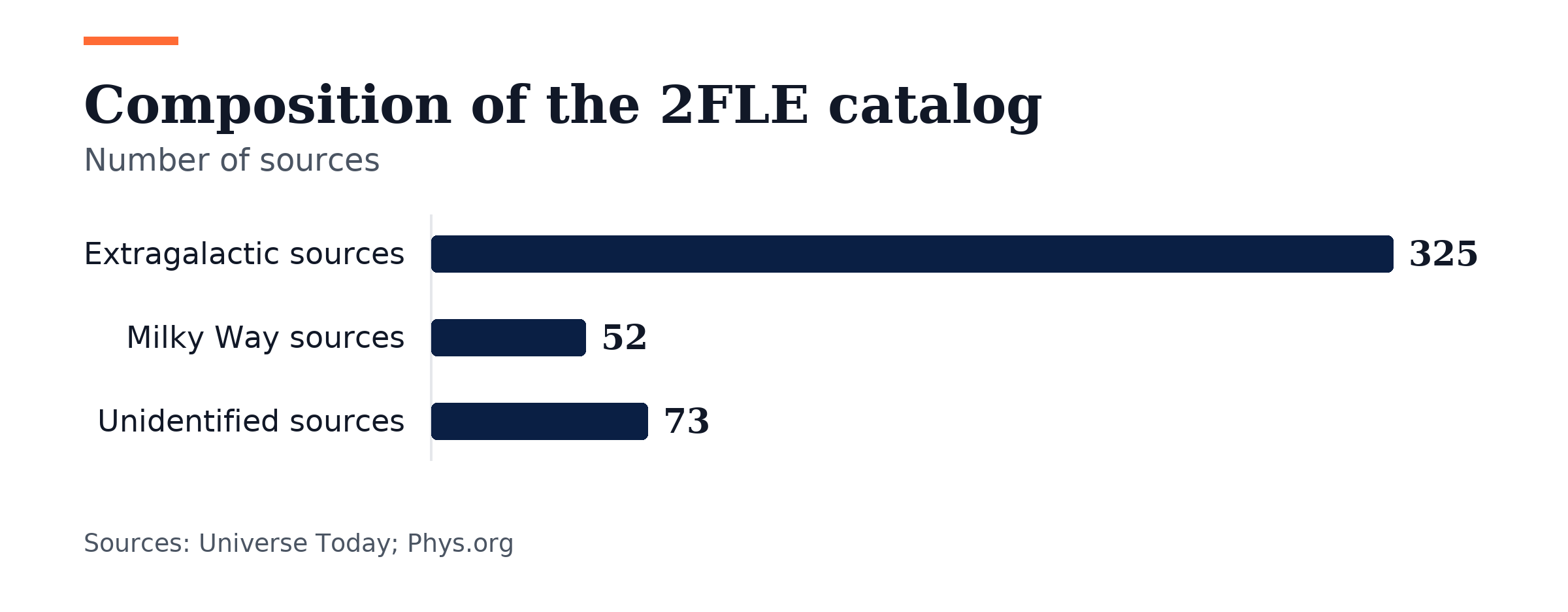
Comparisons with radio, optical, and X-ray data identified known counterparts for 377 of the catalogued objects, leaving others without identified counterparts at other wavelengths. 73 catalogued sources lack clear counterparts at other energies, and 60 of those appear to be brand new gamma-ray discoveries. Some of the signals might be overlapping emission from neighboring objects, while at least some are likely new exotic cosmic accelerators awaiting follow-up observations. One mystery source aligns with 2FLE J0340.8+5258, which was also detected by an observatory in China and appears capable of generating light across nine orders of magnitude in energy.
Around 15% of gamma-ray signals in the catalog cannot be linked to any known astronomical object. Lea Marcotulli, a Helmholtz investigator group leader at DESY, says the catalog provides another piece of the puzzle for understanding how the universe works and how particles are accelerated. She says the first step for interpreting unknown signals is to establish whether they truly originate from astrophysical objects. Phys.org says that if confirmed, the unknown objects could be black holes with powerful jets, or young pulsars and supernova remnants in our galaxy.
Marco Ajello, co-lead researcher of the work and a professor at Clemson University, says mapping this unexplored gamma-ray sky charts a part of the universe eyes cannot see and builds a foundation for future discoveries. Much of the testing meant to confirm that the catalog results were genuine fell to Scott Joffre, a lead researcher on the analysis. The team used extensive simulations and repeated checks to confirm that the identified signals were not artifacts of the analysis. Researchers had to account for the unusual shape of positional uncertainties at low energies and for blending of MeV signals from two separate objects.
NASA launched Fermi-LAT in 2008, and the instrument detects photons from 20 mega-electron volts to beyond 1 teraelectronvolt. After almost two decades of operations, researchers say they have likely extracted everything possible from the satellite’s data in this range. Because gamma rays pass through mirrors and all other reflective surfaces, Fermi-LAT functions more like an orbiting particle detector than a traditional telescope. It locates sources by tracking what happens when a photon strikes layers of tungsten and silicon inside the instrument.
Universe Today reports that researchers can locate a single 20 mega-electron volt photon only within a sky patch roughly 20 degrees across, an area more than forty times larger than the full moon. Background radiation from the Sun and distant galaxies makes isolating individual MeV sources difficult. At around 1 giga-electron volt, particle-shower damage in detector layers is distinct enough to trace a gamma ray back to its source. The Chandra X-ray Observatory captures radiation at the lower-energy X-ray end, leaving the MeV band as a technological blind spot between X-ray and higher-energy gamma-ray observatories.
Phys.org reports that detecting mega-electron volt photons is difficult because they most often interact with matter through Compton scattering, in which a photon collides with a particle and is deflected, making it difficult to pinpoint the origin of the original photon. The technology needed to overcome sensor limitations for MeV detection has only recently become available. Radiation from different astronomical objects overlaps with diffuse background emission, so weak signals can merge with one another or disappear into the background. Studying the MeV range can provide clues about how processes accelerate particles and how they release their energy as radiation.
NASA’s Compton Spectrometer and Imager, known as COSI, will launch in August 2027. The mission targets gamma rays from 0.2 to 5 mega-electron volts using a germanium detector, a semiconductor sensor material, and will measure characteristic lines in gamma-ray emission to reveal which elements energetic processes produce and where energetic processes accelerate particles. Phys.org says proposed larger MeV mission concepts include newASTROGAM and AMEGO-X, and that the 2FLE catalog will connect with these upcoming missions as a reference for future research.




Join the discussion