Key facts
- NASA's Fermi Gamma-ray Burst Monitor first detected a powerful radiation surge from GRB 250702B on July 2, 2025, and the burst emitted gamma rays continuously for about 25,000 seconds, or nearly seven hours.
- Huei Sears led Webb NIRCam follow-up imaging several months after the event and said the explosion remnant, if anything remains, is really faint.
- The James Webb Space Telescope is supported by the European Space Agency and the Canadian Space Agency.
- GRB 250702B defied existing theoretical models entirely because neither massive-star collapse nor neutron-star merger could sustain jets for seven hours.
NASA’s Fermi Gamma-ray Burst Monitor detected GRB 250702B on July 2, 2025, and the burst emitted gamma rays continuously for about 25,000 seconds, or nearly seven hours.
Typical gamma-ray bursts last seconds to a few minutes and result from the collapse of a massive star or merger of neutron stars, both forming stellar-mass black holes that drive relativistic jets, which are streams of matter moving at nearly the speed of light. GRB 250702B’s roughly seven hours nearly doubled the previous record held by GRB 111209A, which lasted 15,000 seconds, making the new event about 67% longer. The seven-hour duration defied existing theoretical models because neither massive-star collapse nor neutron-star merger could sustain jets for seven hours.
Huei Sears, a postdoctoral researcher in physics and astronomy at Rutgers, said these bursts end in less than a minute, but GRB 250702B lasted for hours and showed signs of X-ray activity a day before the main burst. Eliza Neights, an astronomer at NASA’s Goddard Space Flight Center in Maryland, called the outburst unlike anything seen in the past 50 years.
Eric Burns, an astrophysicist at Louisiana State University, said understanding GRB 250702B required the combined power of instruments on several spacecraft. NASA’s Fermi Gamma-ray Space Telescope first detected the burst on July 2, 2025, triggering rapid follow-up; scientists combined gamma-ray, X-ray, infrared and radio data from space- and ground-based observatories, and the explosion was not visible in ordinary light.
An international team led by Jonathan Carney at the University of North Carolina Chapel Hill coordinated comprehensive observations after Fermi’s detection on July 2, 2025. Gamma-ray data came from Fermi, Konus-Wind, Swift and other detectors; X-rays from Swift, XMM-Newton and Chandra; infrared from the Very Large Telescope, Gemini and Hubble, plus JWST and ground-based observatories. Ground-based observations pinpointed the burst in the constellation Scutum.
Hubble and Webb observations place the host galaxy about 8 billion light-years away, so the explosion occurred long before Earth formed, and Webb showed one very large galaxy with a dust lane rather than a merging pair. The host galaxy is roughly twice the mass of the Milky Way and has a thick dust lane dividing it almost edge-on, placing the burst in a dust-obscured environment that blocked visible light completely. Hubble could not determine whether the system was a merger or a single galaxy, but Webb’s NIRCam resolved the uncertainty.
The James Webb Space Telescope is supported by the European Space Agency and the Canadian Space Agency. The peer-reviewed report is Jonathan Carney et al., Optical/Infrared Observations of the Extraordinary GRB 250702B, published in The Astrophysical Journal Letters, 2025, volume 994, issue 2, L46, DOI 10.3847/2041-8213/ae1d67.
No obvious supernova was detected 25.5 days after the burst in the galaxy frame because dust blocked optical confirmation. X-ray monitoring continued for 65 days to track the afterglow’s decline. Spectrum analysis indicates the relativistic jet moved at least 99% of the speed of light, with Doppler boosting greatly enhancing the apparent brightness. The burst showed multiple distinct gamma-ray emissions separated in time with roughly one-second flickers, pointing to a compact stellar-mass black-hole engine rather than a supermassive one, and its spectrum lacked a clear hard-to-soft photon delay.

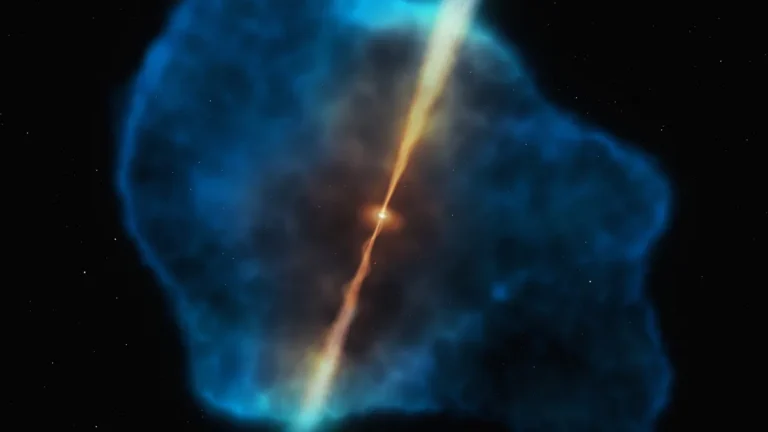
Proposed explanations include an extreme gamma-ray burst, a tidal disruption event in which a black hole thousands of times the Sun’s mass tears apart a star, or a smaller black hole merging with and consuming a stripped helium star from within; in each case the black hole produced powerful energy jets. NASA released an animation of one possible scenario in which a black hole about three times the Sun’s mass, with an event horizon 11 miles (18 kilometers) wide, orbits and merges with a companion star.
Leading explanations include a black hole about three solar masses orbiting a companion star with a slow-accretion disk sustaining the jet, a tidal disruption event, an intermediate-mass black hole supplying sustained jet power, or an accretion-powered jet from slow feeding.
The seven-hour duration implies a fundamentally different mechanism from known processes; jet sustainability at high power for that long is poorly understood, black-hole spin may be crucial, and accretion-rate variations might create the several observed emission episodes, so theoretical models need major revision. Researchers have not reached a definitive conclusion about whether GRB 250702B was a gamma-ray burst or a tidal disruption event; Sears said only a few such tidal disruption events have occurred, studies offer different and sometimes contradictory explanations, and understanding is still early.
Several theoretical scenarios remain viable and a definitive answer awaits future detections; dust obscured the crucial supernova detection, and possible mechanisms span stellar collapse to black-hole mergers. Sears said the event offers a unique chance to study the extremes of stellar and black-hole evolution and could be the discovery of something unexpected and new.
Huei Sears led Webb NIRCam follow-up imaging a few months after the event and said the explosion remnant, if anything remains, is faint. Future similar events will serve as benchmarks; such ultralong bursts appear rare; GRB 250702B offers a rare testing ground for extreme physics.
Jonathan Carney stressed that rapid telescope response and large-aperture rapid-slew capability were crucial, that ground-based observatories complement space detectors, and that coordinated international networks worked; he said scientists will compare future similar explosions to GRB 250702B or judge them something entirely different. “When astronomers discover similar explosions, they’ll ask whether they match GRB 250702B’s properties or represent something entirely different” — Jonathan Carney, University of North Carolina Chapel Hill
Join the discussion