Key facts
- The study suggests that over‑luminous Type Ia supernovae, such as the 2003 Supernova Legacy Survey event, could arise from the explosion of magnetized white dwarfs that have exceeded the Chandrasekhar limit.
- Magnetized white dwarfs can have larger radii than expected for their mass because the magnetic field inflates the star, making them appear bigger than a non‑magnetized counterpart of the same mass.
- Strong internal magnetic fields interact with electrons in a white dwarf, giving them an extra boost that prevents them from settling and increases the pressure opposing gravity.
- As a dying star sheds its outer layers to become a white dwarf, its magnetic field stays with the core and becomes concentrated there, enabling a typical star to produce a highly magnetized white dwarf.
Researchers reported that highly magnetized white dwarfs—the dense remnants of low‑mass stars such as the Sun—can exceed the Chandrasekhar limit—the maximum mass a white dwarf can support against gravity via electron pressure (the outward pressure from electrons due to quantum mechanics)—with theoretical masses approaching nearly three solar masses, according to findings covered by Universe Today and Eurasia Review in October 2026.
Strong internal magnetic fields—regions where the magnetic influence concentrates in the star—interact with electrons in a white dwarf, giving them an extra boost that prevents them from settling and increases the pressure opposing gravity.
This magnetic pressure (the pressure exerted by the magnetic field) helps support the star against gravity, allowing it to exceed the non‑magnetized mass limit (the greatest mass a white dwarf can have without magnetic field support), as seen in binary systems (a system of two stars orbiting each other) where an initially weak field strengthens as the white dwarf contracts.
For a carbon‑oxygen white dwarf (a white dwarf made primarily of carbon and oxygen) that starts at 1.02 solar masses and accretes matter at 10^{-9} solar masses per year—meaning it gains about one‑billionth of a solar mass each year from a companion—magnetization lets it grow to about 2.4 solar masses, while a non‑magnetized counterpart (a white dwarf without magnetic field support) stalls near 1.4 solar masses.
The field also inflates the star (makes the star larger), making magnetized white dwarfs larger than expected for their mass and altering the usual mass‑radius relation (the relationship between a star’s mass and its size). As a dying star sheds its outer layers to become a white dwarf, its magnetic field stays with the core (the central region of the star) and becomes concentrated there, enabling a typical star to produce a highly magnetized white dwarf.
Even though the star loses its envelope (the outer layers of gas) during the red giant phase—a late stage when the star expands after exhausting its core hydrogen—the magnetic field remains bound to the stellar core. The simulations show that a sun‑like star (a star similar in mass and composition to the Sun) does not need to be highly magnetized from the start; a modest initial field can grow strong enough by the time the star becomes a white dwarf.
To track this evolution, the team modified the STARS code—a computer code developed at the University of Cambridge to model how stars evolve—adding magnetic field effects and white dwarf cooling. They followed magnetized stars from the main sequence (the stage when stars fuse hydrogen in their cores) through their later evolution into white dwarfs.
In a binary, as matter accumulates (gathers material) the white dwarf contracts, strengthening its magnetic field; the stronger field provides extra internal pressure (pressure from inside the star) that helps the star withstand gravity and support more mass. The researchers also traced a main‑sequence to binary mass‑transfer pathway (the process of transferring mass from one star to another) showing that an initially weak field becomes increasingly important as the white dwarf gains mass and contracts.
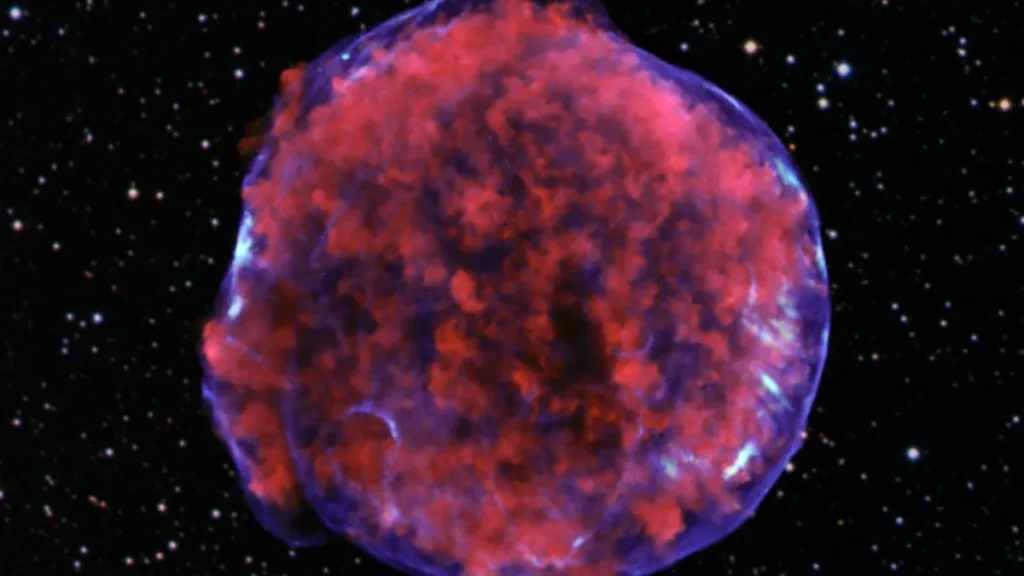
The team ran simulations using a modified version of STARS, added magnetic field effects, and modeled how a magnetic star (a star with a significant magnetic field) evolves from the main sequence to a white dwarf. The study suggests that over‑luminous (brighter than typical) Type Ia supernovae—a thermonuclear explosion used as a standard candle for measuring cosmic distances—for example, the 2003 Supernova Legacy Survey event (a project that searched for supernovae), could arise from the explosion of magnetized white dwarfs that have exceeded the Chandrasekhar limit.
Magnetized white dwarfs also help explain some larger‑than‑expected white‑dwarf radii (the plural of radius, indicating the star’s size), because the magnetic field inflates the star. Observations of unusually over‑luminous Type Ia supernovae have hinted that progenitor white dwarfs (the predecessor star that eventually becomes the white dwarf) may be heavier, with possible masses up to 2.8 times the solar mass.
If some of these explosions come from progenitors with different masses and magnetic properties, understanding this diversity becomes important for using Type Ia supernovae as standardizable candles (objects used to measure cosmic distances because of their uniform brightness) to measure cosmic distances (distances across the universe). This challenges the idea that all such supernovae release the same energy and shine with the same brightness, a premise that has underpinned measurements of the universe’s expansion (the increasing distance between galaxies over time).
Chandrasekhar demonstrated in the 1930s that relativistic electron pressure (electron pressure taking into account the effects of relativity) balances gravity only up to about 1.44 solar masses, a limit long regarded as firm. For decades, theorists thought the Chandrasekhar limit was rock solid, while imagining ways to exceed it, though observational evidence generally supported the limit. In 2003 the Supernova Legacy Survey observed a supernova that seemed to defy the limit, and similar events have since chipped away at confidence in its absoluteness.
Theoretical work has long predicted the possibility of super‑Chandrasekhar white dwarfs (white dwarfs above the Chandrasekhar limit), and the idea to test whether a magnetic field could violate the limit began in 2011 when a summer student suggested the problem to Banibrata Mukhopadhyay. Zenia Zuraiq emphasized that the key issue is not just whether such a white dwarf can exist, but whether a star can truly evolve into one. The study shows that magnetized white dwarfs may be more common than thought.
White dwarfs are the remains of smaller stars such as the Sun. When a Sun‑like star exhausts its fusable hydrogen (hydrogen that can undergo fusion), it swells to a red giant in a mad race to burn heavier elements. Without enough mass to reliably burn heavier elements, the star soon collapses into a nuclear shell (a layer where nuclear burning occurs).
Gravity wins, and the star can burn no more; without nuclear pressure (pressure from nuclear reactions), the core collapses under its own weight until electron quantum pressure (pressure from electrons due to quantum mechanics) pushes back. The stable balance between gravity and electron quantum pressure keeps the core from collapsing into a neutron star—a dense remnant of a massive star after a supernova.
A carbon-oxygen white dwarf that nears the Chandrasekhar limit may see its core grow dense enough to ignite carbon, setting off a thermonuclear explosion seen as a Type Ia supernova. Type Ia supernovae are also thought to arise from the collision of two white dwarfs (when two white dwarfs merge), a different path to explosion that does not rely on a single star’s mass limit.
The key question remains whether a Sun‑like star can generate the strong magnetic field needed for a super‑Chandrasekhar white dwarf while still ending its life as a white dwarf. Neutron stars can be highly magnetized as magnetars (highly magnetized neutron stars), but they form from much larger stars, contrasting with the lower‑mass progenitors (predecessor stars with less mass) of magnetized white dwarfs.





Join the discussion