Key facts
- Dark matter and dark energy make up about 95 percent of the universe and cannot be measured directly, though dark energy drives the accelerating expansion and dark matter acts as cosmic glue.
- Andy Taylor, an astrophysicist at the University of Edinburgh and Euclid team member, said Euclid's technological leap is keeping high resolution while being able to map huge volumes of the sky and universe.
- Euclid carries a wide-angle, 600-megapixel camera for visible-light imaging.
- Dark matter does not interact with any light and is some form of mass whose nature is unknown, while dark energy is a placeholder term for the force driving the universe's expansion.
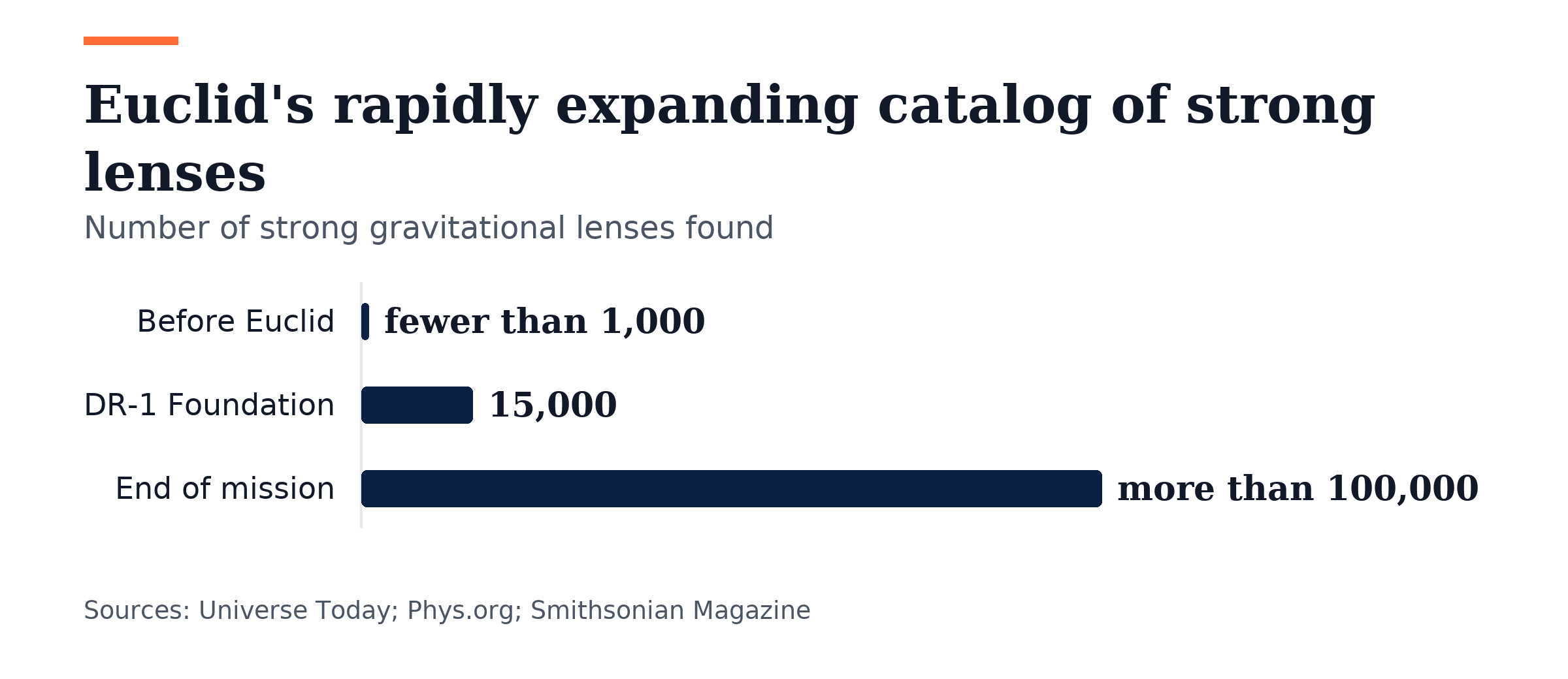
The European Space Agency’s Euclid space telescope delivered its first data release, called DR-1 Foundation, on November 12. The release contains about 15,000 candidate strong gravitational lenses, forming the largest catalog of the phenomenon and exceeding all previous databases combined. It comprises 1.7 million gigabytes gathered over 13 months of observation and reveals almost 5 percent of the night sky, including more than 900 million galaxies and 60 million quasars. Euclid orbits the Sun-Earth Lagrange point 2 roughly 1.5 million kilometers from Earth on a six-year mission to create a 3D map of the sky.
Before Euclid, researchers had fewer than 1,000 confirmed strong gravitational lenses, and the odds of finding one were about one in 10,000, according to Hrishabh Srivastava of the UBC department of physics and astronomy. Euclid is expected to find more than 100,000 strong lenses over its nominal six-year mission, increasing the number of known strong lenses by two orders of magnitude in what the source describes as a transformational advance for dark matter science.
“Strong lenses have been difficult to find – the odds were about 1 in 10,000,”
The data release includes spectra from more than 160 million sources, which scientists can use to determine distances to galaxies and place them into the 3D structure of the universe. A spectrum is produced by splitting light from galaxies into rainbows and can reveal distance and sometimes elemental composition. The Euclid first data release is described in 26 papers submitted to the journal Astronomy & Astrophysics. All observations came from one telescope and one analysis method, so researchers can compare the catalog more reliably than before.
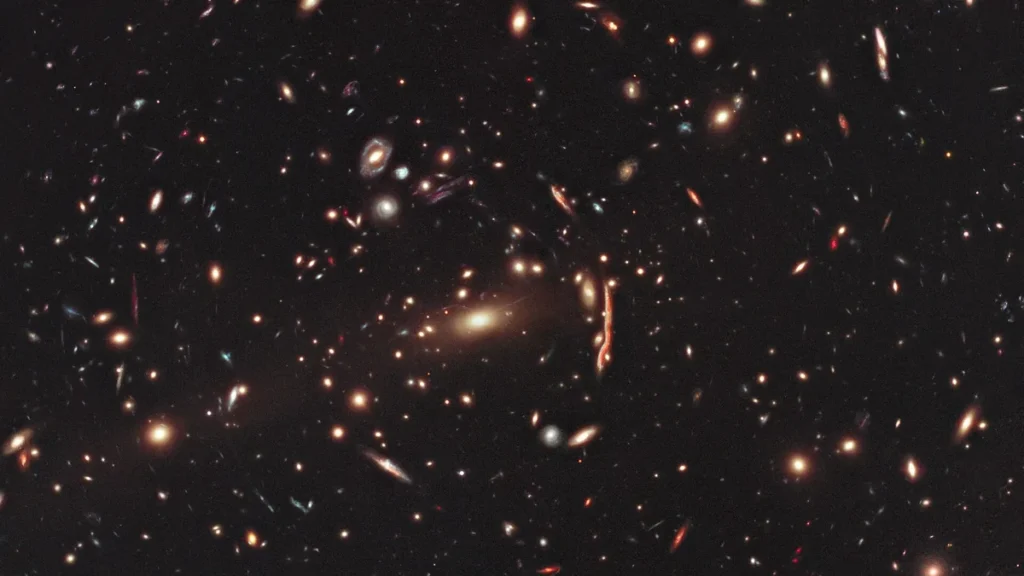
Strong gravitational lenses are massive objects such as galaxies, galaxy clusters, and dark matter halos that magnify background objects. Because their lensing effect depends on total mass rather than visible mass alone, they are a way to measure dark matter. Dark matter and dark energy make up about 95 percent of the universe and cannot be measured directly, though dark energy drives the accelerating expansion and dark matter acts as cosmic glue.
Gravitational lensing occurs when light from a distant galaxy is bent by a foreground galaxy acting as a lens, sometimes appearing as an Einstein ring, and the way the light is warped reveals the composition and distribution of matter including dark matter. Einstein predicted the phenomenon in 1936, and it took many decades to verify.
Identifying lens candidates uses a four-part process. Machine learning parses the data for likely lenses, thousands of citizen scientists refine the pool, experts including Srivastava check about 6,000 to 10,000 galaxies each, and follow-up data from other telescopes verifies the candidates. Srivastava plans to estimate how dark matter is spread across the universe and to create a machine-learning model that can spot strong lenses without needing verification.
“How strongly the light is bent tells us how much matter a galaxy contains,”
Euclid will slowly build a 3D map of the universe covering greater than one-third of the sky to show how matter is distributed. The map can be tested against the Lambda-Cold Dark Matter model, with dark energy tested directly and dark matter tested more indirectly. The current dataset covers about 14 percent of the total sky area Euclid will survey during its six years of service, and the full Data Release 1 is expected to drop in mid-2027. Euclid’s test of Lambda-CDM will not be one grand finale; it is ongoing, with each new data release generating rounds of new research as physicists and cosmologists dig into it.
Euclid launched in July 2023 at a cost of more than $1 billion and carries a wide-angle, 600-megapixel camera for visible-light imaging. Its photometer and near-infrared spectrometer measure redshift for roughly 10 billion sources, reaching redshift 2, which equals about 10 billion years ago or 3.7 billion years after the Big Bang. Operating above Earth’s atmosphere, which blurs astronomical images, the telescope can spot faint and distant features that would otherwise be difficult or impossible to detect, and the observations cover an area of the sky roughly equal to 9,500 full moons as viewed from Earth. Euclid orbits the Sun-Earth Lagrange point 2, a spot nearly one million miles from Earth, where it joins NASA’s James Webb Space Telescope, and since July 2023 it has documented nearly a billion objects in total.
Euclid’s Early Release Observations imaged the Messier 78 star formation region about 1300 light years away in Orion, the first time Messier 78 has been imaged with such width and depth. Galaxy clusters feature heavily in the release, and studying how galaxies group together may reveal how matter first formed and organized soon after the big bang.
The Nancy Grace Roman Space Telescope is en route to the second Lagrange point and will use infrared instruments and gravitational lensing to search for exoplanets and study dark matter and dark energy, complementing Euclid’s optical wide-area approach. Scott Gaudi, an astronomer at Ohio State University who is not involved in the Euclid program, said the joint approach is powerful because Roman can vet Euclid’s big statistics with a careful controlled system. Roman focuses on infrared and repeats observations of the same area with different roll angles and filters, while both missions will harness gravitational lensing to study dark energy and dark matter.
Scott Gaudi called the 15,000 strong lens candidates bonkers and said gravitational lenses are one of nature’s toolboxes for measuring dark matter mass by looking for distortions of background quasars and galaxies due to foreground structures. Valeria Pettorino, ESA’s Euclid project scientist, said so much discovery is yet to come.
“largest space-based survey of its kind, laying the foundation of future discovery in a new regime for astronomy”
Andy Taylor, an astrophysicist at the University of Edinburgh and Euclid team member, said Euclid’s technological leap is keeping high resolution while being able to map huge volumes of the sky and universe. Barbara Sartoris, an astrophysicist at France’s Joseph-Louis Lagrange Laboratory, said Euclid does not just look far back in time but does so across huge areas of sky, giving a view of large samples of ancient galaxy clusters previously out of reach.
The Euclid collaboration includes a global consortium of more than 2,000 scientists, including more than 30 Canadians from organizations such as UBC, the University of Waterloo, NRC’s Herzberg Astronomy and Astrophysics Research Center, and the Canada-France-Hawaii Telescope. UBC researchers helped uncover the 15,000 new potential strong gravitational lenses.
Dark matter does not interact with any light and is some form of mass whose nature is unknown, while dark energy is a placeholder term for the force driving the universe’s expansion. Weak gravitational lensing extends beyond a cluster’s virial radius and can help constrain a cluster’s overall mass, complementing strong lensing. Researchers can probe dark energy by running lens parameters through the current cosmological model and checking whether the figures align, while the lenses also magnify distant galaxies to make them easier to see. Researchers can use thousands of strong lenses to map dark matter through galaxies and learn how galaxies form and change across cosmic time, though lensing works only when objects line up exactly, making these lenses extremely rare.


Join the discussion