Key facts
- UK government policy on the space sector and the Education and Future Workforce Programme will both be informed by the survey results.
- The previous Space Sector Skills Survey was conducted in 2023.
- The 2023 Space Sector Skills Survey by the Space Skills Alliance found that 52 percent of UK space organisations had skills gaps in their existing workforce.
- Among organisations reporting gaps in 2023, 72 percent identified software and data skills as the most prominent shortage.
The UK Space Agency opened its Space Sector Skills Survey 2026 on Nov. 23, 2026, inviting UK employers to report workforce challenges and skills shortages.
Baroness Lloyd, the UK’s Minister for Space, Cyber and Regulatory Reform, told UK space sector organisations to fill out the survey and share their insights. She cited £7.8b of investment under the UK Space Strategy and said space activity depends on the right people with the right skills.
The survey takes about 15 to 20 minutes to complete, and results will be published in anonymised, aggregated form. The agency calls the improved and expanded 2026 survey a critical chance to pinpoint workforce issues and their causes.
UKSA wants responses from businesses and academic institutions whose everyday work concerns the space sector, including firms that build and launch satellites, use Earth observation data, or develop space-sector software. Multi-site organisations should answer for each individual site rather than the whole organisation.
Results will inform UK government policy and the Education and Future Workforce Programme. The agency will pass survey data to teams at the Department for Business, Innovation, Science and Trade, with other government departments receiving it too.
The previous Space Sector Skills Survey ran in 2023 and was conducted by the Space Skills Alliance. It found skills gaps in the existing workforce of 52 percent of UK space organisations, in a study UKSA and the Department for Science, Innovation and Technology commissioned to inform the government about sector skill gaps.
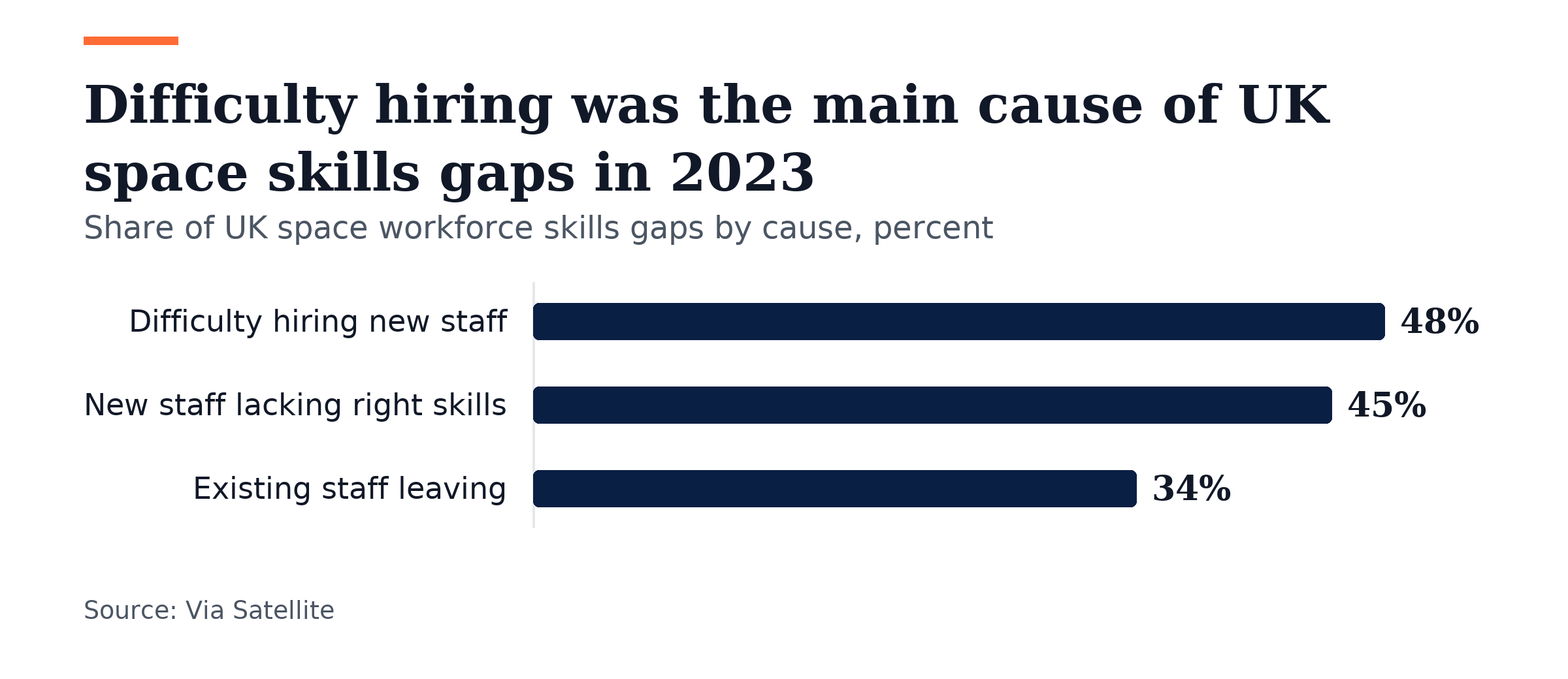
Among organisations reporting gaps in 2023, 72 percent identified software and data skills as the top shortage. Difficulty hiring new staff caused 48 percent of gaps, lacking the right skills 45 percent, and existing staff leaving 34 percent; 72 percent of respondents reported heavier workloads for current staff and 65 percent product-development delays, mostly unchanged since 2020.
The alliance is collecting feedback for a follow-up report on the UK skills gap, as described June 2, 2026. Heidi Thiemann of the alliance said a review of the UK Space Agency’s 10-year workforce plan, published in 2016, found most things achieved; women entering the industry remain the main gap.
Thiemann said more graduates are applying for UK space sector jobs than there are graduate jobs, so roles rather than applicants are in short supply. Space Partnership’s Joanna Hart said STEM outreach requires more early career roles, or applicants will end up disappointed.
Key skills missing include electrical and electronic engineering, software skills and radio frequency (RF) skills. The largest problem is the mid-level gap, as rapid growth outpaces experienced insiders with the right skills.
Companies hiring mid-level staff expect new recruits to know the job already, so the sector should look to other industries for people with transferable skills and fund training. Thiemann said that recruiting mid-level staff from other industries lacks clear pathways, since most initiatives target younger people instead of mid-level entrants.
Many UK space firms are based in costly, hard-to-reach locations and pay less than other sectors, which makes staff hard to attract. Thiemann called the UK’s approach to skills gap initiatives





Join the discussion