Key facts
- In September, NASA engineers completed the "Big Bang" on Voyager 1 by powering down three devices and installing three lower-power replacements, finishing the swap about six weeks after the same work on Voyager 2.
- Both Voyager probes lose about 4 watts of electrical power every year as their plutonium fuel decays.
- Voyager 1 launched in 1977 carrying 10 dedicated science instruments.
- Without the "Big Bang" power swap, mission planners would have had to turn off another Voyager 1 instrument as early as summer 2027.
NASA engineers completed the Big Bang power swap on Voyager 1 in September, and the spacecraft ended a 48-hour communications dropout on Oct. 20 before controllers sent troubleshooting commands, while flying about 24 billion kilometers from Earth.
NASA’s Deep Space Network could not detect a radio signal from Voyager 1 during two scheduled communications attempts 24 hours apart on Oct. 18 and 19. The network uses large antennas at three facilities around the globe to communicate with spacecraft at the Moon and beyond. Contact returned on Oct. 20 after 48 hours, and engineers later determined that one group of the spacecraft’s thrusters went offline while its backup thrusters turned on during the loss.
Fault protection on Voyager 1 puts the spacecraft into a safe, stable configuration and pauses normal operations when computers detect a problem. Kareem Badaruddin, Voyager mission manager at NASA’s Jet Propulsion Laboratory, said the October event was the first time the team had seen the spacecraft do something like this, though they expect the unexpected at this stage of the mission. Badaruddin said the team felt relieved to be back in contact and eager to understand what happened.
In September, NASA engineers completed the swap on Voyager 1 by powering down three devices and installing three lower-power replacements, finishing the work about six weeks after the same swap on Voyager 2. The devices also regulate heat, so all three substitutions had to occur at the same time.
Voyager 1 and Voyager 2 draw electricity from radioisotope thermoelectric generators that turn heat from decaying plutonium into power, and both probes lose about 4 watts of electrical power every year as the fuel decays. Dwindling power had already forced the Voyager team to turn off two science instruments in recent years, and the mission began in 1977 with 10 dedicated science instruments.
The swap will let Voyager 1’s remaining science instruments operate longer than anticipated, and without it mission planners would have had to turn off another Voyager 1 instrument as early as summer 2027. NASA says the Big Bang strategy should keep the Cosmic Ray Subsystems, Magnetometers, and Plasma Wave Subsystems running for at least one more year.
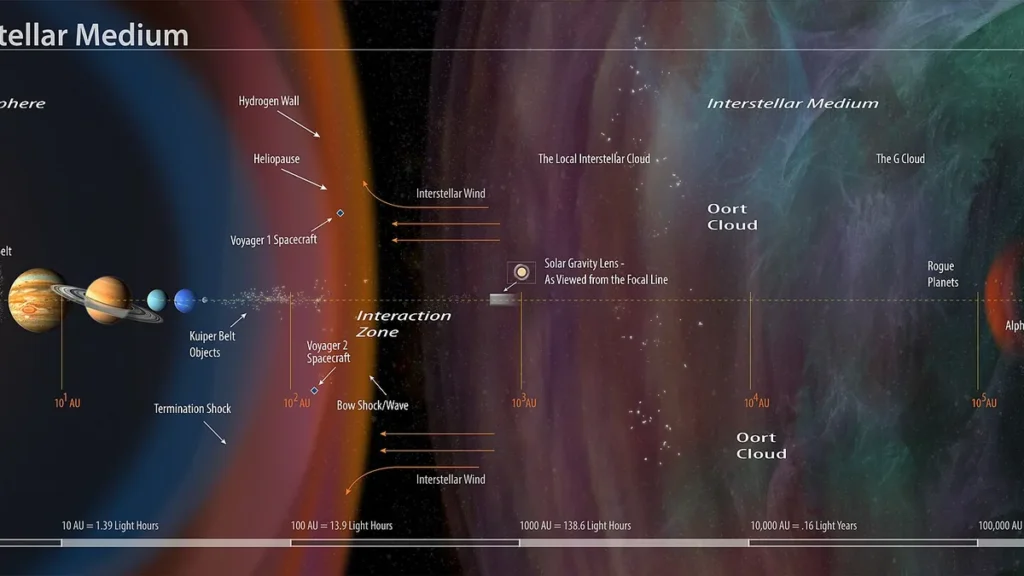
Voyager 1 and Voyager 2 are traveling through interstellar space, the area outside the heliosphere, and are the only spacecraft to study that region directly. Voyager 1 became the farthest human-built object from Earth when it overtook Pioneer 10 in 1998, and it crossed the heliopause on Aug. 25, 2012, when it was about 18 billion kilometers away.
Beyond the heliopause, dust particles are about half as abundant as inside the heliosphere, and particle speeds and gas temperatures have dropped. Scientists observed four spikes in magnetic field strength and particle density around Voyager 1, and after the fourth spike in mid-2020 those numbers remained high; physicist Jeewoo Park suggested the craft might be riding aftershocks of solar eruptions. Scientists also do not know exactly where pure interstellar space begins, and the shape of the heliosphere remains an open question.
Before reaching interstellar space, Voyager 1 and Voyager 2 explored four planetsJupiter, Saturn, Neptune, and Uranusalong with 48 moons and planetary magnetic fields and rings. Voyager 1’s cameras were turned off after the 1990 family portrait, which showed Earth as a pale blue dot from about 6 billion kilometers from the Sun, and Voyager 2’s cameras were shut off in 1989 to save power. Voyager 1 also discovered active volcanism on Jupiter’s moon Io, including a plume extending 250 kilometers above the surface.
Voyager 1 is traveling at 38,000 mph and will reach 16.09 billion miles, or 25.89 billion kilometers, from Earth on Nov. 18. On that date at 5:16:07 a.m. Eastern Standard Time, it will become the first spacecraft to reach one light-day from Earth, a distance more than four times the distance from the Sun to Pluto.
At one light-day, signals from Earth take 24 hours to reach Voyager 1, and the spacecraft’s return message takes another 24 hours. Voyager 1 will not detect any change in its environment when it passes the milestone, and nothing will change aboard.
Scientists estimate Voyager’s onboard power sources will dry up in 10 to 15 years, after which the probes cannot send data back to Earth. Voyager 1 will next encounter the star Gliese 445 in 44,000 years.
Voyager is a multi-generational mission, with two scientists having worked on it since the beginning and others not yet born when the spacecraft launched. Linda Spilker, a planetary scientist at NASA’s Jet Propulsion Laboratory, began working on Voyager shortly before the probes launched in 1977 and is now back as Voyager head scientist. Spilker said she never imagined the mission would last as long as it has.
No communication outages have occurred with Voyager 1 since it signaled back on Oct. 20. Voyager 1’s thrusters are small engines that point and steady the spacecraft.



Join the discussion