NASA selected eight companies to compete for a decade of lunar cargo deliveries under the new CLPS 2 contract, Administrator Jared Isaacman announced on Nov. 7, 2026, at the MAX POWER aerospace expo at Kennedy Space Center in Florida. The firms are Blue Origin, Firefly Aerospace, Intuitive Machines, ispace-U.S., Lockheed Martin Space, Northrop Grumman Space Systems, SpaceX and Voyager Technologies. The contract is an indefinite-delivery, indefinite-quantity vehicle with a combined ceiling of $10 billion, and each delivery is competed.
Voyager Technologies says it is eligible to compete for CLPS 2 task orders through 2036 under a $10 billion base ceiling with an option to extend to 2041 at a $15 billion ceiling. SpaceQ Media Inc., SpacePolicyOnline.com and Yahoo Tech describe CLPS 2 as a ten-year, $10 billion architecture without mentioning 2036, 2041 or $15 billion. The discrepancy is unresolved in the sources.
NASA raised the value of the first CLPS contract pool to $4.2 billion from $2.6 billion to cover the first phase of Moon Base. The pool will stay open for new orders until November 2028, and the companies have until November 2033 to fly them. The increase supports Phase One Moon Base objectives.
NASA ordered a nuclear-powered rover, PROMISE, to explore the lunar South Pole, targeting a late 2028 launch and an 18-month mission. JPL will assemble it from spare flight parts and engineering test models left over from the Curiosity and Perseverance Mars rovers. The rover will run on a spare multi-mission radioisotope thermoelectric generator that converts heat from decaying plutonium into electricity, allowing operation through two-week lunar nights and entry into permanently shadowed craters where water ice is thought trapped.
Under a $94 million base contract with a $140 million performance option, Blue Origin will carry PROMISE on its Mark 1 lander. The award extends the May task order under which Blue Origin was selected to transport NASA’s two lunar terrain vehicles. Honeybee Robotics, a Blue Origin subsidiary, built the drill for PROMISE, which reaches about a metre deep. The rover carries a mass spectrometer, neutron spectrometers and infrared spectrometers, along with a radiation detector and a laser reflector used for navigation. PROMISE shares four instruments with NASA’s VIPER rover.
Isaacman said, “When our astronauts return to the Moon, they will arrive with the first elements of the Moon Base already waiting for them on the surface.” The quote summarizes the rationale for pre-deploying cargo, landers and infrastructure through CLPS before Artemis crews reach the lunar surface.
NASA issued six task orders worth about $1.3 billion combined to Arrow Science and Technology, Blue Origin and Impulse Space under the VADR contract, which has a $5 billion ceiling. The task orders fund missions including CAPSTONE 02 deep-space flights, JPL MoonFall drone surveys of the South Pole, and navigation and orbital-transfer demonstrations between Earth and the Moon, launching aboard New Glenn, Terran R and Falcon 9.
SpaceX, under an existing lunar logistics contract, will launch communications satellites on a Starship to cislunar space in 2028, helping establish a future lunar communications network with spacecraft similar to Starlink. miniCAST, a small solar tower designed to power and link surface equipment, will draw on Honeybee Robotics for energy storage and Redwire for power generation, while Yank Technologies handles wireless power transfer. NASA’s Marshall Space Flight Center will handle assembly and testing.
In early 2027, NASA plans to issue a solicitation for fully integrated surface power systems. A separate call will request information NASA still needs about Moon Base sites, drawing on small spacecraft, instruments flown on future missions or data purchased from companies.
Two CLPS 2 companies’ machines have already carried Canadian hardware: Canadensys Aerospace technology flew on Intuitive Machines’ Odysseus in February 2024, and coatings from Markham’s Integrity Testing Laboratory rode on a NASA dust experiment aboard Firefly’s Blue Ghost in March 2025. Canadian instruments will have another chance to ride along on each CLPS 2 flight across the next decade. As part of federal spending cuts, the Canadian Space Agency cancelled its small Lunar Rover Mission in March after the Canadensys-built rover had been set to fly on a Firefly lander in 2029.
Ottawa set aside $1.2 billion for the Lunar Utility Vehicle across 13 years, funding a larger rover meant to haul cargo and support astronauts with delivery due no earlier than 2033. Concept studies are underway from Canadensys, MDA Space and Mission Control before a prime contractor is chosen.
To date, the Government of Canada has committed $1.68 billion to the Lunar Gateway / Canadarm3 program, a sum equal to 91 per cent of the $1.85 billion pledged for Canada’s Moon program starting in 2019.
NASA awarded Lunar Outpost one of two terrain vehicle contracts in May for its Pegasus rover, which is being built by a team that includes MDA Space. Blue Origin’s Mark 1 lander, which is also booked to carry PROMISE, would transport the vehicles to the surface. That team is receiving infrastructure expertise from MDA.
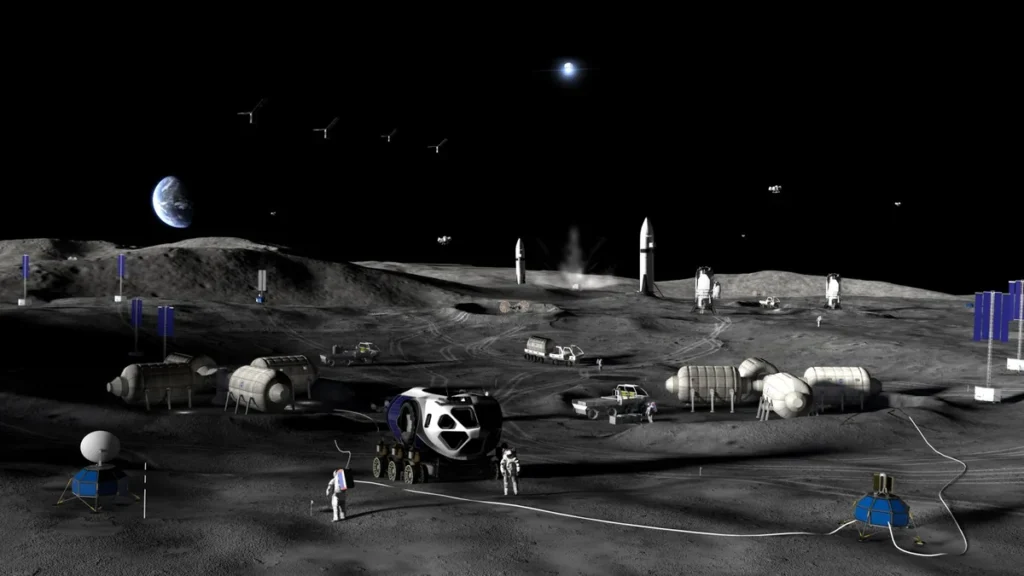
NASA’s Moon Base will be a resilient outpost near the Moon’s South Pole for science, technology and eventual human operations. Phase I, now through 2029, includes more than twenty robotic landings to incrementally advance capabilities and validate components. Phase Two runs from 2029 to 2032 and continues building infrastructure, with the base getting up and running during Phase 3.
The three CLPS missions expected to launch in 2026 have all slipped to 2027, and hopes for another ten in 2027 will wait until 2028. Endurance and Trinity slipped earlier, and García-Galán said Griffin will not launch until January at the earliest because of lunar launch windows and ongoing engine testing. At the March Ignition event NASA said it would launch 10 CLPS missions per year in 2027, 2028 and 2029, but at a November 9 MEPAG meeting Lori Glaze, Associate Administrator for the Human Spaceflight Mission Directorate overseeing Artemis, said only four CLPS missions are now anticipated in 2027.
At the Von Braun Symposium last month, Nicky Fox said the 10-per-year target now starts in 2028. Isaacman said the current CLPS contract is all-or-nothing, which works for one or two missions a year but not for scaling up, so NASA wants flexibility to move pieces around. CLPS 2 aims to pre-position materials and equipment on the Moon so crews can begin constructing the base as soon as they land.
CLPS began in 2018 and four commercial landers have launched so far: Astrobotic did not reach the Moon, both Intuitive Machines landers tipped over, and Firefly’s Blue Ghost Mission-1 was a complete success. Max Power was NASA’s first-ever aerospace technology expo, running Wednesday through Sunday at Kennedy Space Center in Florida. The biggest part of the event was the update on the Ignition initiative, which promises to put a base on the Moon by 2032.



Join the discussion