Key facts
- NASA Administrator Jared Isaacman said the agency is building the Moon Base mission by mission using a playbook of flying often, learning, applying lessons, and becoming more capable with every flight.
- Carlos García-Galán, manager of the Moon Base Program, said that in the eight months since Ignition the program consolidated efforts into a streamlined campaign and awarded new contracts to accelerate development.
- NASA is moving forward with PROMISE, the Polar Rover for Observation, Mapping, and In-Situ Exploration, a nuclear-powered six-wheeled rover targeted for a late 2028 launch to the Moon's South Pole on an 18-month mission.
- Long before astronauts arrive, robotic spacecraft will deliver scientific instruments, test new technologies, and begin placing infrastructure needed for future human habitation.
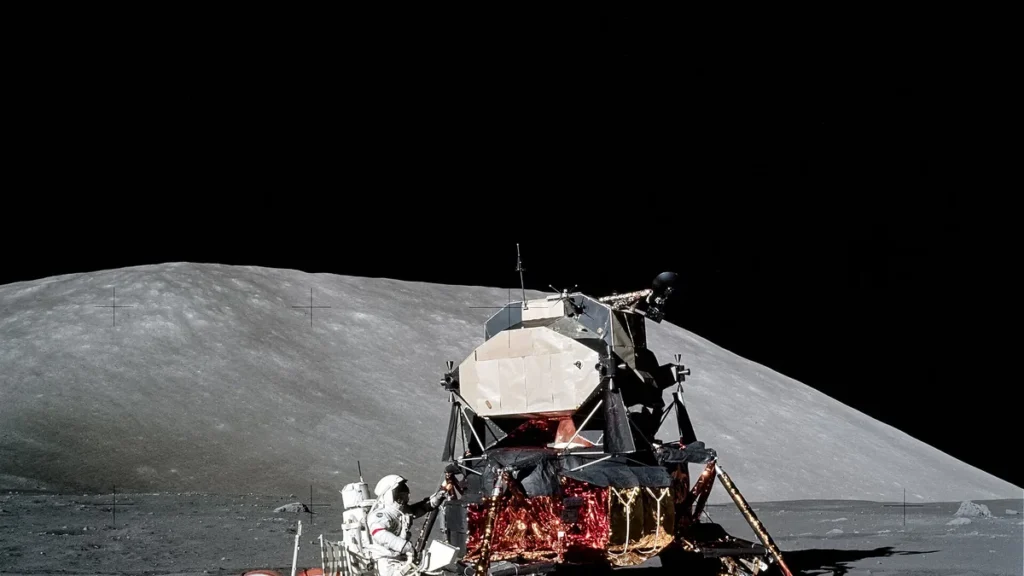
NASA announced a suite of Moon Base awards on Nov. 7, 2026, at the MAX POWER aerospace expo and air show at Kennedy Space Center in Florida, selecting companies for commercial lunar deliveries and announcing plans for a nuclear-powered rover at the Moon’s South Pole.
The agency is building the Moon Base mission by mission using a playbook of flying often, learning, applying lessons, and becoming more capable with every flight, NASA Administrator Jared Isaacman said. Carlos García-Galán, manager of the Moon Base Program, said that in the eight months since Ignition the program consolidated efforts into a streamlined campaign and awarded new contracts to speed development.
On Aug. 11, 2026, NASA said it plans more than 20 robotic landings through 2029 as part of Phase I of the Moon Base architecture plan, with each landing intended to build on previous flights and confirm systems before later missions arrive. Long before astronauts arrive, robotic spacecraft will deliver scientific instruments, test new technologies, and begin placing infrastructure needed for future human habitation. NASA expects regular cargo deliveries through its CLPS initiative to help establish a reliable lunar supply chain central to maintaining a long-term robotic and human presence.
NASA is moving forward with PROMISE, the Polar Rover for Observation, Mapping, and In-Situ Exploration, a nuclear-powered six-wheeled rover targeted for a late 2028 launch to the Moon’s South Pole on an 18-month mission. PROMISE will carry science instruments and technology demonstrations to characterize the lunar surface and subsurface, assess resource potential, and provide data for landing site selection and future infrastructure. PROMISE can keep working through lunar nights and inside permanently shadowed areas where ice may exist, supporting NASA’s goal of long-term human operations at the pole.
JPL in Southern California, a division of Caltech, will manage and build PROMISE using spare flight components and engineering test models from NASA’s Curiosity and Perseverance Mars rovers to reduce cost and shorten integration and testing. PROMISE will carry a drill to extract regolith, or lunar soil, from approximately 3 feet (1 meter) below the surface, spectrometers, temperature and radiation sensors, visible-light cameras, a radiation-tolerant High Performance Spaceflight Computing system, and advanced autonomy sensors and algorithms. NASA assessed PROMISE hardware compatibility with the lunar environment and determined it can tolerate harsh conditions near the Moon’s South Pole.
NASA awarded Blue Origin a $94 million base contract with a $140 million performance-based option to deliver PROMISE to the lunar South Pole using its Mark 1 lander. The award expands a May 2026 task order for two lunar terrain vehicles.
NASA selected eight companies for the next CLPS phase under the new CLPS 2 contract, making them eligible to compete for future lunar surface delivery missions: Blue Origin, Firefly Aerospace, Intuitive Machines, iSpace US, Lockheed Martin Space, Northrop Grumman Space Systems, SpaceX, and Voyager Technologies. The companies will manage, build, and operate landers under CLPS 2, delivering NASA payloads for science, technology, and infrastructure work at the Moon.
The CLPS 1.0 contract ceiling rose from $2.6 billion to $4.2 billion to fund the first phase of Moon Base work. The original CLPS contract remains in place through November 2028, followed by a five-year period to complete awarded lunar deliveries through November 2033.
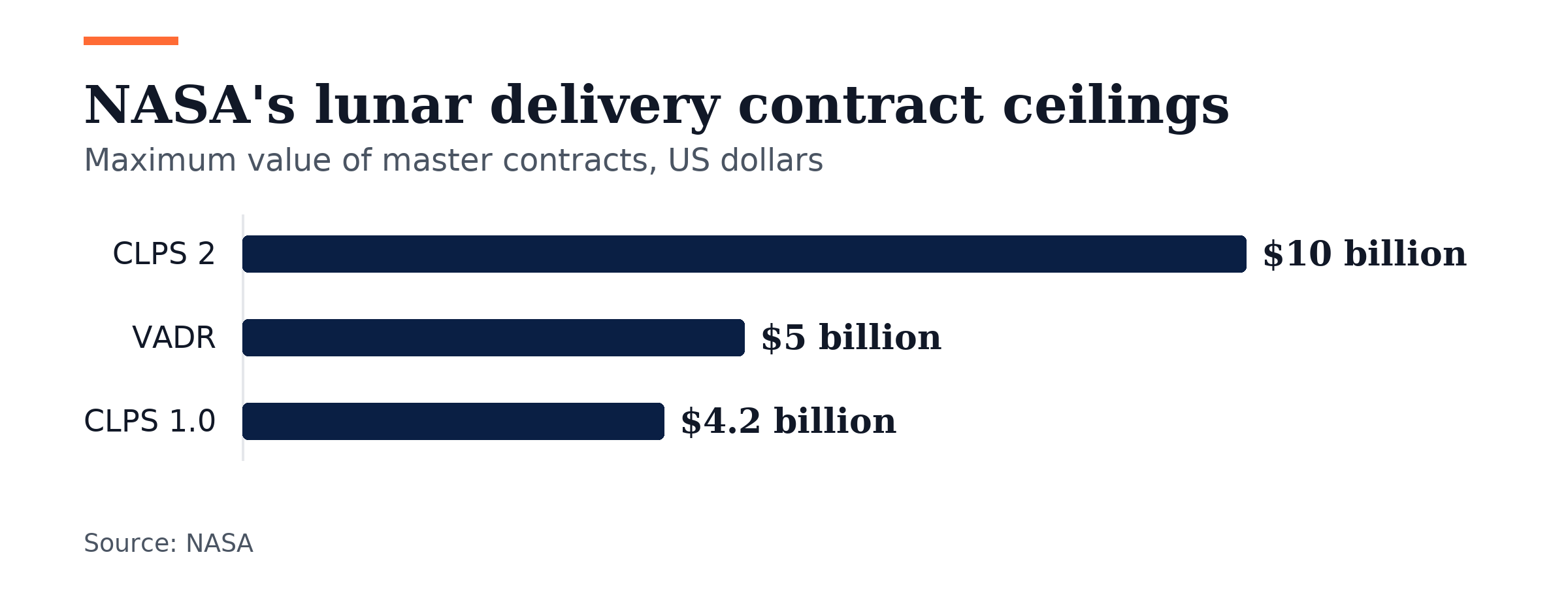
NASA awarded six task orders worth approximately $1.3 billion combined under the 10-year VADR contract, which has a total value of $5 billion, to Arrow Science and Technology, Blue Origin, and Impulse Space to integrate and transport Moon Base cargo. NASA’s Launch Services Program Office at Kennedy Space Center manages the VADR contracts as part of the Commercial Access to Space Program. Three VADR mission types will provide flexibility: reducing risks for long-term human spaceflight including delivery of CAPSTONE 02 to deep space; preparing the lunar South Pole with MoonFall drones and assets; and testing cislunar navigation and orbital transfer to increase future lander cargo capacity.
Some VADR missions will launch aboard Blue Origin’s New Glenn, Relativity Space’s Terran R, and SpaceX’s Falcon 9 rockets, with in-space transportation spacecraft from Blue Origin, Firefly Aerospace, Impulse Space, and Quantum Space. NASA also selected SpaceX for the Cislunar Communications Deployment Demonstration under an existing lunar logistics contract to launch communications satellites aboard Starship to cislunar space in 2028.

NASA plans to buy commercial components for a mini-Communications and Solar Tower including solar arrays, batteries, and wireless power-transfer hardware, awarding Honeybee Robotics for energy storage, Redwire for power generation, and Yank Technologies, Inc. for wireless power transfer. Engineers at NASA’s Marshall Space Flight Center in Huntsville, Alabama, will assemble and test miniCAST systems before lunar delivery, with work expected to begin within months on components rather than a major integrated system, and NASA plans a separate solicitation for fully integrated power systems anticipated in early 2027.
The agency intends to release a directed call under NextSTEP-3 B to close architecture-driven data gaps for Moon Base development, potentially including small spacecraft missions, payloads on future flights, or buying commercial data. NASA plans to send Artemis astronauts on increasingly difficult missions to the lunar South Pole to establish an enduring human presence and build a foundation for the first crewed mission to Mars.
On Aug. 11, 2026, NASA released a Moon Base video update showing progress by four companies preparing spacecraft, hardware, and future flights for lunar plans. NASA’s broader Moon Base effort through commercial deliveries, science, technology demonstrations, and infrastructure aimed to support long-term exploration and eventual sustained human presence alongside robotic operations.
Blue Origin was moving its Blue Moon MK1 lander through integrated testing for its first flight, Endurance, after completing environmental tests including thermal vacuum assessment at Johnson Space Center; its structure, propulsion, and avionics were fully assembled. Endurance completed communications checks with NASA’s Tracking and Data Relay Satellite System and Deep Space Network, and cryogenic propellant loading was among the final major tests before launch integration. Endurance’s first flight aims to prove precision landing, gather lunar environmental data, and test autonomous systems for later Moon Base work.
Firefly Aerospace was preparing Blue Ghost Mission 2, a larger configuration for far-side operations that would sit atop its Elytra orbital spacecraft as a 22-foot-tall system nearly three times the height of its 2025 Blue Ghost Mission 1 spacecraft. Blue Ghost Mission 2 planned to become the first American landing on the Moon’s far side, exploring a quiet region for far side geology and cosmic Dark Ages research while carrying three NASA payloads. Firefly planned to reuse subsystems from its first mission’s autonomous landing sequence to speed development and reduce risk while supporting repeatable commercial lunar landers.
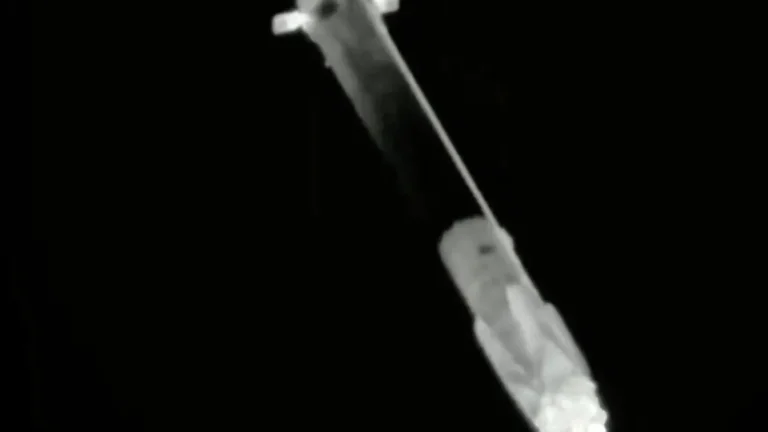
Intuitive Machines was preparing IM-3, its third Nova-C lunar landing, with the lander named Trinity and its first lunar data relay satellite, Altus-1, traveling alongside. Trinity was to carry five NASA payloads, six commercial payloads, and one civil payload to the surface, while IM-3 would deploy Altus-1 into lunar orbit with three payloads. IM-3 was slated to become the first mission to explore the surface of a lunar swirl at Reiner Gamma, supporting Moon Base science goals. Intuitive Machines completed long-range thermal vacuum testing with the X-Ray Cryogenic Facility team at Marshall Space Center to verify sensor accuracy across temperature extremes during descent.
Voyager Technologies was testing its Griffin-1 infrastructure-class lander at JPL’s Environmental Test Laboratory in Southern California; it was scheduled to launch in late 2026 and carry the largest commercial payload ever delivered to the lunar surface. Griffin-1 would carry five NASA payloads on the Astrolab FLIP rover to improve surface mobility and prepare for extended operations, and recently finished mass properties testing. After environmental testing, Griffin-1 would return to Voyager’s Lunar System Pittsburgh facility for final assembly and launch readiness before transport to Cape Canaveral.
NASA was working with Northrop Grumman on three technology demonstration payloads using power and avionics hardware originally developed for Gateway’s HALO module, now adapted for surface-focused operations. The Northrop Grumman demonstrations would test systems to survive the lunar night and multi-day shadow periods, test shared surface power infrastructure, and test key avionics and power capabilities.




Join the discussion