Key facts
- Blue Origin will deliver PROMISE to the lunar South Pole on its Mark 1 lander under a $94 million base contract with a $140 million option, targeting a late 2028 launch and 18-month mission.
- The original CLPS contract stays active through November 2028, followed by a five-year completion window for awarded lunar deliveries through November 2033.
- PROMISE will carry spectrometers, temperature and radiation sensors, visible-light cameras, and demonstrate NASA's High Performance Spaceflight Computing plus advanced autonomy sensors and algorithms.
- NASA Administrator Jared Isaacman said the agency is building the Moon Base mission by mission so the first base elements await Artemis astronauts on the surface.
NASA announced a suite of Moon Base awards on Saturday, Nov. 7, 2026, at the MAX POWER aerospace expo and air show at Kennedy Space Center in Florida, pairing new commercial lunar lander contracts with a repurposed Mars rover initiative. MAX POWER runs through November 8, 2026.
Eight firms will compete for Moon delivery missions under CLPS 2, a 10-year indefinite-delivery indefinite-quantity contract under which NASA orders missions as needed, with a $10 billion ceiling. The vendors are Blue Origin, Firefly Aerospace, Intuitive Machines, ispace-U.S., Lockheed Martin, Northrop Grumman, SpaceX and Voyager Technologies, and they will manage, build and operate landers carrying NASA science, technology and infrastructure payloads to the Moon.
The $10 billion CLPS 2 value is a ceiling for future task orders, not money already awarded to participating companies, and vendors will be eligible to compete for future lunar missions through 2036. CLPS 2 is built for Phase 2 landers carrying two to six metric tons, according to Moon Base Program Manager Carlos García-Galán. Northrop Grumman and ispace-U.S. are new to the CLPS vendor pool alongside Voyager Technologies, which acquired CLPS 1.0 vendor Astrobotic in July 2026.
NASA awarded six transportation task orders worth approximately $1.3 billion combined under the Venture-Class Acquisition of Dedicated and Rideshare contract to Arrow Science and Technology, Blue Origin, and Impulse Space. The VADR indefinite-delivery indefinite-quantity contract has a maximum total value of $5 billion across all contracts, and VADR uses a buy-now, payload-later approach that lets NASA reshuffle cargo as hardware matures. NASA’s Launch Services Program Office at Kennedy Space Center manages the VADR contracts as part of the Commercial Access to Space Program.
SpaceX Falcon 9 will fly two VADR missions, with Arrow Science and Technology carrying CAPSTONE 02 on a Quantum Space Ranger tug to test proximity maneuvers, navigation and communications around the Moon, and Impulse carrying multiple Intuitive Machines communications satellites. Blue Origin will fly three New Glenn missions under VADR, including one using Firefly’s Elytra tug to deliver three MoonFall drones to survey areas beyond traditional rovers’ reach and two using Blue Ring for cargo NASA has not yet selected. Impulse and Relativity will pair Relativity’s Terran R rocket with Impulse’s Helios kick stage and a lander that will drop NASA payloads in cislunar orbit then attempt a lunar descent to test navigation technologies in multiple cislunar orbits.
Carlos García-Galán described an eight-month period since Ignition during which NASA consolidated Moon Base efforts into a streamlined program, saying, “In the eight months since Ignition, we’ve made incredible strides in accomplishing the near impossible:” PROMISE originated in June 2026 as a hybrid engineering development version of the Mars Perseverance and Curiosity rovers before NASA greenlit it in November as the Polar Rover for Observation, Mapping, and In-Situ Exploration, a nuclear-powered rover built from spare parts and test models for the Curiosity and Perseverance rovers. The Jet Propulsion Laboratory will manage the PROMISE mission, which NASA expects to cost under $400 million including instruments and the ride to the Moon.
Blue Origin will deliver PROMISE to the lunar South Pole on its Mark 1 lander under a $94 million base contract with a $140 million option, targeting a late 2028 launch and 18-month mission. The award expands a May 2026 task order to deliver two lunar terrain vehicles to the Moon.
PROMISE will land at the Moon’s South Pole to characterize the surface and subsurface, assess resource potential, and provide data for landing site selection and future infrastructure. It will drill about one meter down to look for water ice and help NASA pick landing sites, carrying spectrometers, temperature and radiation sensors, visible-light cameras, and demonstrating NASA’s High Performance Spaceflight Computing plus advanced autonomy sensors and algorithms.
NASA awarded power and communications components for miniCAST, the lunar power and communications tower, to Honeybee Robotics for energy storage, Redwire for power generation, and Yank Technologies for wireless power transfer. Engineers at NASA’s Marshall Space Flight Center in Huntsville, Alabama, will assemble and test the systems before lunar delivery, with work expected to begin within months on components rather than an integrated system.

miniCAST will combine solar power and wireless power transfer to support operations on the Moon’s surface, and Redwire’s roll-out solar arrays for miniCAST can retract during landings and launches to dodge kicked-up lunar dust. Dayna Ise, acting director of the Moon Base program’s Utility and Infrastructure Office, said crewed missions at the South Pole will need to generate, store, and distribute substantial energy, with miniCAST as NASA’s first test. NASA anticipates a separate solicitation for fully integrated power systems in early 2027.
SpaceX was selected for a Cislunar Communications Deployment Demonstration under an existing lunar logistics contract, launching communications satellites aboard Starship to cislunar space in 2028. The demonstration will help inform development of future lunar communications networks keeping astronauts, mission controllers, and Moon Base elements connected.
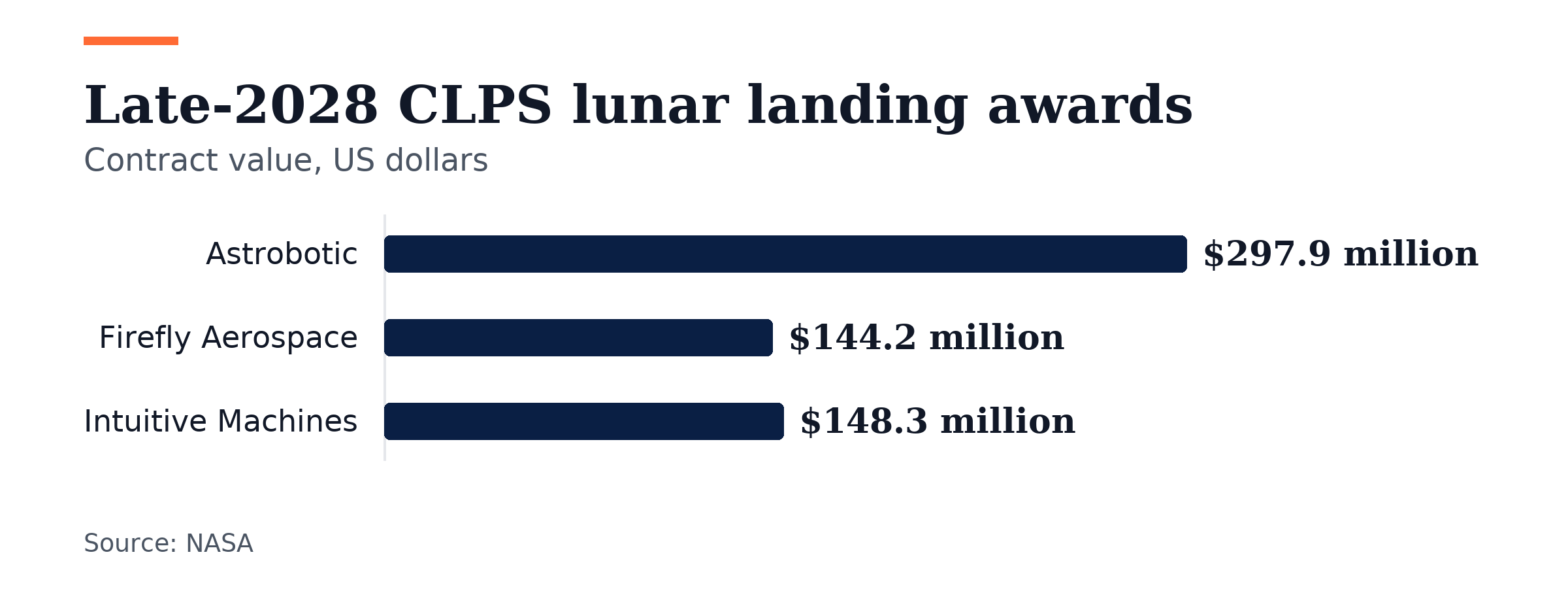
On June 30, 2026, NASA selected Astrobotic ($297.9 million for two deliveries), Firefly Aerospace ($144.2 million), and Intuitive Machines ($148.3 million) for four late-2028 CLPS deliveries totaling nearly $600 million. “These new awards to our commercial partners, totaling nearly $600 million,” Lori Glaze said. Each delivery under the June awards will carry three NASA payloads: SCALPSS, which studies landing plume effects; LRA, which provides location markers; and LETS, which measures radiation.
NASA increased the maximum value of its existing CLPS 1.0 contract from $2.6 billion to $4.2 billion to support initial Moon Base objectives. The original CLPS contract stays active through November 2028, followed by a five-year completion window for awarded lunar deliveries through November 2033.
The agency will seek lander proposals for a power and avionics demonstration, another science manifest and a South Pole optical imager. The agency also plans a constellation to handle lunar communication and navigation and will issue an open solicitation for Moon Base technology demonstrations. NASA plans a NextSTEP-3 B directed call to close architecture-driven data gaps for Moon Base development, potentially using small spacecraft, payloads or purchased commercial data.
The agency is building the Moon Base mission by mission, so the first base elements await Artemis astronauts on the surface, NASA Administrator Jared Isaacman said. “We are building the Moon Base mission by mission,” Isaacman said. NASA says the first elements of the Moon Base will already be on the lunar surface when astronauts return on Artemis IV, and NASA says the Moon Base projects will help establish a sustained American presence on the Moon’s South Pole, with commercial partners delivering equipment before astronauts arrive. NASA ultimately hopes to use lunar operations as a foundation for crewed missions to Mars one day.





Join the discussion