
Key facts
- The forward model and likelihood calculations are handled entirely by a graphics processing unit.
- A single forward model needs roughly 1 ms on an NVIDIA GH200, letting a GPU cluster process millions of models each minute.
- Joint retrieval results for WASP-77Ab show sub-solar metallicity paired with a near-solar C/O ratio.
- Injection-recovery tests indicate the posteriors underestimate abundance-ratio uncertainties by roughly a factor of two.
BeAR, the Bern Atmospheric Retrieval code and a GPU-accelerated successor to Helios-r, retrieves exoplanet atmospheres from low-resolution, high-resolution, and joint datasets by running its forward model and likelihood calculations entirely on a graphics processing unit, according to a paper posted to arXiv on Nov. 5, 2026. A forward model predicts what a spectrum should look like for a given atmosphere, and likelihood measures how well that prediction matches the observed spectrum.#|#
Atmospheric retrieval infers a planet’s atmospheric composition and temperature from its spectrum, while cross-correlation matches observed spectra against model templates. BeAR applies this cross-correlation framework to both low-resolution and high-resolution exoplanet data. Cross-correlation works by shifting a model template against the data to find the best alignment.#|#
The code uses a Bayesian approach in which a nested-sampling or other sampler explores parameter space, generates posterior distributions, and computes Bayesian evidence, while BeAR supplies the forward models and likelihoods. Bayesian methods update probabilities as evidence accumulates. Supported external samplers include MultiNest via PyMultiNest, nautilus, dynesty, and UltraNest, and MultiNest may optionally be compiled with MPI support to distribute likelihood evaluations across several GPUs. MPI is a message-passing interface for parallel computing.#|#
Joint retrievals work by adding the log-likelihoods of high-resolution and low-resolution data computed from the same model atmosphere, so one model atmosphere speaks to both kinds of data at once. A log-likelihood measures how well a model fits a data set. The framework also fits line-depth scaling analytically or samples it freely, generalizes per pixel, applies fast model filtering, and re-injects results adapted to that filtering.#|#
Supported forward models cover emission, transmission, secondary eclipse, flat-line, and high-resolution phase-curve spectra, with cross-correlation spectroscopy likelihoods from Brogi & Line (2019) and Gibson et al. (2022). The repository also lists supported observations as spectroscopic, band-spectroscopic, photometric, or high-resolution time series, and temperature profiles as piecewise polynomials, splines, PCHIP, Guillot, Madhusudhan & Seager, Milne, or adiabat plus spline.#|#
The core is written in C++ and CUDA, and users access it only through the Python module bear. CUDA is a parallel computing platform and programming model. Building the code requires a C++17 compiler, the CUDA toolkit and drivers, CMake 3.15 or newer, OpenMP, Python 3 with development headers, and a Fortran compiler with BLAS/LAPACK for MultiNest. CMake is a build automation tool, and OpenMP is an application programming interface for shared-memory parallel computing.#|#
The forward model and likelihood calculations run entirely on a graphics processing unit, with the computationally demanding parts written in CUDA. BeAR can operate on a CPU alone, though runtimes then become 10 to 100 times larger than on a GPU, and CPU-only operation is not recommended. A CPU is the main processor of a computer, while a graphics processing unit handles many calculations at once.#|#
An NVIDIA GH200 processes one forward model in about 1 ms, and a GPU cluster can handle millions of models each minute. A GPU cluster links many graphics cards to work together. A typical desktop CPU needs more than half a second for one model likelihood, but a modern graphics card finishes it almost instantly.#|#
On one NVIDIA GeForce RTX 5080, a full IGRINS retrieval with 17 free parameters takes 27 to 42 minutes. Using eight RTX 4090 GPUs brings that down to roughly 14 minutes. These timings show what a single GPU and a small GPU cluster can achieve for a demanding retrieval case drawn from the WASP-77Ab analyses. A retrieval is the process of inferring atmospheric properties from a spectrum.#|#
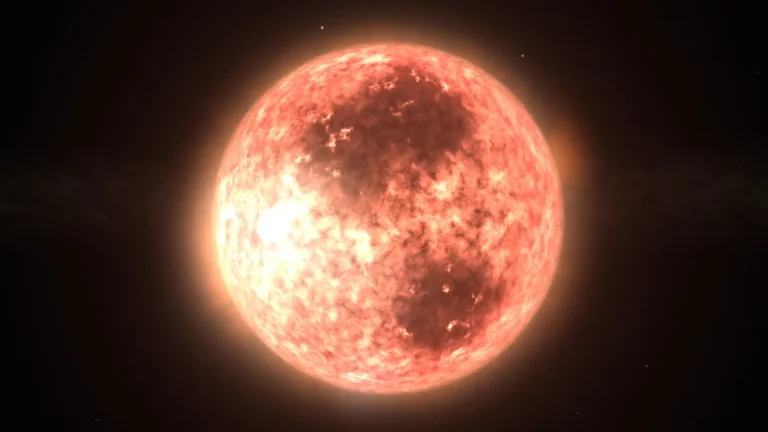
WASP-77A b is a scorching gas giant heated to about 1740 Kelvin, roughly 340 light-years from Earth, and it circles its star every 1.36 days with one side permanently facing the star. Its dayside atmosphere is rich in molecular signatures. Tidally locked means one side always faces the star.#|#

High-resolution ground spectroscopy splits starlight into thousands of spectral lines, but processing strips out Earth’s atmospheric light and removes the planetary continuum shape. Low-resolution space data then anchor the measurement with an absolute flux scale. The continuum is the baseline shape of a spectrum before spectral features are added.#|#
Separate analyses of dayside spectra from Gemini South/IGRINS and JWST/NIRSpec show BeAR matching published abundances, carbon-to-oxygen ratios, and metallicities within 1.5 sigma. That analysis also favors 13CO, a carbon monoxide isotope, while thermal structure and line contrast come back within 1 sigma. Sigma is a statistical measure of uncertainty, and line contrast describes the depth of spectral features relative to the continuum.#|#
The joint retrieval for WASP-77Ab shows sub-solar metallicity paired with a near-solar carbon-to-oxygen ratio, agreeing with earlier independent findings at a fraction of the computational cost. The joint mode also pinned down vertical temperature structure and measured amounts of water vapor and carbon monoxide, while setting strict upper limits on trace gases. Metallicity tracks the amount of elements heavier than hydrogen and helium, and the carbon-to-oxygen ratio compares carbon and oxygen. Trace gases are present in small amounts.#|#
Injection-recovery tests show that known atmospheric properties come back accurately, but abundance-ratio uncertainties in the posteriors run low by about a factor of two. Researchers trace the underestimate to correlated residual noise in the observations, a factor that also skews high-resolution cross-correlation statistics. Posteriors represent the updated probability of model parameters after seeing the data.#|#
The authors argue that open-source tools accelerated by graphics processors will become necessary as new telescopes generate ever-larger archives of spectroscopic observations. They also suggest comparing temperature profiles at fixed pressures so the community can judge differences between independent modeling codes as telescope archives grow. Open source means the software’s code is freely available to view, modify, and distribute.#|#
Astronomy & Astrophysics received the submission, and arXiv posted it as 2611.08489 on Nov. 5, 2026. Version 1 went up at 18:59:48 UTC with a file size of 2,040 KB. Esther Wang, Daniel Kitzmann, H. Jens Hoeijmakers, Joost P. Wardenier, and Helena Lecoq-Molinos authored the work. arXiv is a preprint server for scientific papers.#|#
The sources disagree on the predecessor’s name: the arXiv paper calls it Helios-r, while the GitHub repository calls it HELIOS-r2, introduced in Kitzmann et al. (2020). BeAR is presented as the successor to that earlier code in both accounts. A repository is an online storage location for code and project history.#|#
BeAR is hosted on GitHub under the GNU General Public License. Users should cite Kitzmann et al. (2020), ApJ 890, 174 and Wang et al. (2026) when using BeAR.
Join the discussion