
Key facts
- Scientists observed WISE J224607.56−052634.9, also called W2246-0526, with the Atacama Large Millimeter/submillimeter Array to measure its central supermassive black hole.
- By tracking gas motion near the galaxy's center, the team calculated that the black hole contains roughly 6.5 billion solar masses.
- The group says this is the first dynamical black hole mass measurement at redshift above 2 in an unlensed galaxy where the sphere of influence has been spatially resolved.
- Light from the galaxy has been stretched by cosmic expansion to roughly 5.6 times its starting wavelength, producing a redshift.
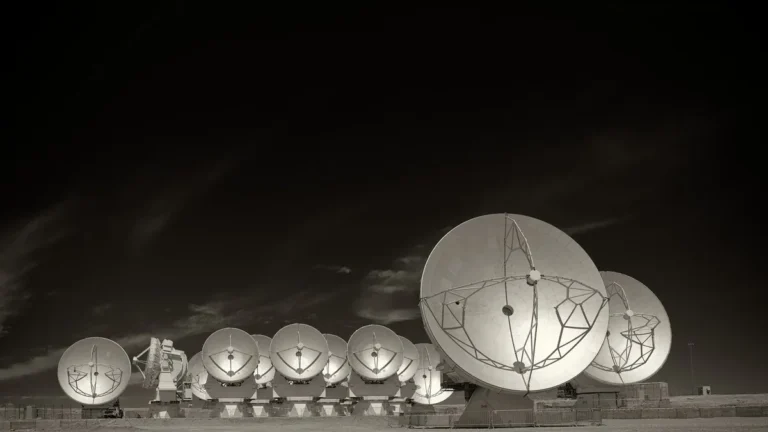
Scientists observed WISE J224607.56−052634.9, also called W2246-0526, with the Atacama Large Millimeter/submillimeter Array to measure its central supermassive black hole, and Phys.org reported the work.
The target is a dust-obscured galaxy driven by a bright active black hole at its center, and scientists call such a bright active nucleus a quasar.
Light from the galaxy has been stretched by cosmic expansion to roughly 5.6 times its starting wavelength, producing a redshift. This redshift means astronomers see the galaxy as it appeared when the universe was about 1.3 billion years old.
Science Advances published the paper “Resolving the black hole sphere of influence in a hyperluminous obscured quasar at redshift 4.6” in 2026. The text describes the redshift as about 5.6, while the title uses redshift 4.6.
By tracking gas motion near the galaxy’s center, the team calculated that the black hole contains roughly 6.5 billion solar masses. Solar mass is the mass of the Sun. A supermassive black hole is a black hole with a mass of millions or billions of times that of the Sun.
The figure is a dynamical mass from when the universe was about 1.3 billion years old. Dynamical mass is a mass determined by tracking the motion of material under gravity. It allows comparison with estimates based on the quasar’s light.
The group says this is the first dynamical black hole mass measurement at redshift above 2. It was made in an unlensed galaxy where the sphere of influence has been spatially resolved.
The team says an unlensed galaxy is one whose light is not appreciably boosted by the gravitational pull of an object in the foreground.
The sphere of influence means the area where the black hole’s gravity overcomes the gravity of the rest of the galaxy. The team defines this term in its report on resolving the black hole’s gravitational reach.
Mai Liao is the lead author tied to the National Astronomical Observatories of the Chinese Academy of Sciences and Universidad Diego Portales in Chile. She said examining gas movement near the center reveals the black hole’s gravity stamped on its environment.
Roberto J. Assef, a coauthor from Universidad Diego Portales, said ALMA enables close study of gas motions near the black hole. He said it lets researchers separate the galaxy’s moving parts, including those driven by the black hole’s gravity.
The researchers relied on ALMA observations of carbon monoxide and singly ionized carbon emitted by the galaxy. Carbon monoxide is a molecule made of carbon and oxygen. Singly ionized carbon is carbon that has lost one electron.
At this distance, ALMA’s sharpest views can separate structures spanning roughly 700 light-years. A light-year is the distance light travels in one year.
Once outward-moving gas from the quasar was removed from consideration, the team saw gas velocity spread climb steeply toward the middle, matching the black hole’s gravitational tug. Velocity spread describes the range of speeds at which gas moves.
Previous ALMA attempts to weigh black holes in luminous, unobscured quasars beyond redshift 6 used singly ionized carbon near their cores. Those attempts turned up no clear sign of gravity.
The team proposes that an active nucleus emits intense X-ray radiation. This further ionizes carbon and weakens its emission near the black hole. That effect explains why earlier ALMA studies beyond redshift 6 did not detect a clear gravitational signature.
The scientists propose that heavy dust around W2246-0526 protects nearby gas from part of the radiation so carbon and other gas tracers can last closer to the black hole.
Masses of distant quasars are usually found indirectly through emission line width and quasar brightness, relying on relationships calibrated in the nearby universe. Emission line width is the spread of wavelengths in a bright line of light from gas. These relationships connect observable features of light to estimates of mass.
Dynamical black hole mass measurements test whether relationships between emission-line width and brightness, calibrated in the nearby universe, hold for galaxies in the early universe.
Heavily obscured quasars could serve as useful targets for creating a bigger sample of black hole masses determined through dynamics in the early universe. Thick dust can shield gas from radiation. This lets carbon tracers survive closer to the black hole and makes obscured systems useful for expanding dynamical mass measurements.

Join the discussion