
Key facts
- Across all four systems, drops in the inner disk radius Rin and X-ray variability rms appeared one to ten days before radio activity from jet ejections.
- The team found no reliably detected increases in mass accreted before jet launches, with no huge jumps in the accretion rate M around ejection events.
- Jets formed below the Eddington limit in two of the four systems, contradicting models that say super-Eddington accretion is necessary to launch jets.
- Kawaguchi said monitoring Rin is suitable for predicting jet ejection timing and that a jet forecast would let observing facilities concentrate on expected ejection times.
On November 12, 2026, Toshihiro Kawaguchi of the University of Toyama and Kazutaka Yamaoka of Nagoya University published Jet Forecast: Timing of Discrete Jet Ejections of Stellar-mass Black Holes Anticipated via X-Ray Properties in The Astrophysical Journal, proposing that X-ray properties can anticipate discrete jet ejections from stellar-mass black holes.
The paper builds on work the team began in 2025 with observations of XTE J1859+226 from a 1999–2000 outburst. Their earlier paper established the first case. The new study adds three systems to that original source, giving the researchers four black hole X-ray binaries in total. They want to test whether the disk–jet link holds across more sources.
Across all four systems, declines in the inner disk radius, called Rin, and in X-ray variability, called rms, appeared one to 10 days before radio activity from jet ejections. The team found no reliably detected increases in the mass accreted before launch, with no huge jumps in the accretion rate M around ejection events. The authors present these synchronized declines as precursors that could give observers advance warning of an impending jet launch. The missing accretion surge undercuts models requiring a sudden surge of infalling material to trigger a jet and supports disk structural change as the signal.
For XTE J1859, the accretion rate M decayed exponentially during the outburst with an e-folding timescale of about 30 days. The data also showed a hint of roughly 20 percent enhancement in M just before jet production. The researchers say that tentative enhancement needs better data from future jet forecast observations to confirm.
Jets formed below the Eddington limit in two of the four systems. That result contradicts models saying super-Eddington accretion is necessary to launch jets. The Eddington limit balances inward gravity against outward radiation pressure, so the finding suggests jets can start without exceeding that threshold.
Kawaguchi said monitoring Rin is suitable for predicting the timing of jet ejections. A jet forecast would let observing facilities concentrate on expected ejection times, which he said would advance understanding of jet physics. The model would send alerts when Rin and rms continuously decrease and Rin approaches the innermost stable circular orbit, triggering Target of Opportunity observations to direct other telescopes to the event so more complete observations can reveal the extreme physics around black holes.
"Monitoring of Rin seems to be suitable for predicting the timing of jet ejections," said Prof. Kawaguchi.
Prof. Kawaguchi, Universe Today
Kawaguchi concluded that jet ejections produce high-energy photons and particles such as neutrinos. He said such cosmic rays have long influenced the evolution of living creatures on Earth including humans. Evidence tying cosmic rays to life on Earth is thin, though some researchers still consider them a factor.
On September 17, 2026, Adelle Goodwin of Curtin University‘s ICRAR and Andrew Mummery of the Institute for Advanced Study in Princeton published A universal critical accretion rate for black hole jet formation in Nature Astronomy. Goodwin, a Forrest Research Foundation Fellow, led the work based on years of global telescope observations of tidal disruption events.
The study found black holes fire jets at the same critical feeding point whether they are about 10 times the mass of the Sun or millions of times heavier. Goodwin and Mummery recognized the pattern at a conference in Madrid while comparing small black holes with supermassive ones. The researchers analyzed 20 tidal disruption events using optical, ultraviolet, X-ray and radio observations, narrowing the sample to 10 events where they could model feeding rate and radio outflow timing. Tidal disruption events compress supermassive black hole feeding into years rather than millennia, making the process observable.
Two jet-launching phases emerged: an early phase at extreme feeding rates and a later phase hundreds to thousands of days after disruption, when feeding drops to about two percent of the Eddington limit. That same two percent threshold already triggers jet formation in smaller black holes in the Milky Way. The result explains why some tidal disruption events produce radio jets quickly while others appear quiet before lighting up much later. Goodwin said the physics does not seem to care how big the black hole is.
Goodwin said anticipating jet launches enables better targeted radio telescope campaigns, fewer wasted observations, and improved chances of catching rare events when they matter. She noted that radio telescopes are powerful, but knowing when to look is as important as knowing where to look.
"Radio telescopes are incredibly powerful, but knowing when to look is just as important as knowing where to look," said Dr Goodwin.
Dr Goodwin, EurekAlert!
Western Australia will host the Square Kilometre Array low-frequency component, with the Australian Government investing 387 million dollars and total SKA cost exceeding 2 billion dollars. Forrest Research Foundation Director James Arvanitakis said the foundation backed an exceptional researcher with a difficult question rather than funding a predetermined answer. He said the discovery shows why blue sky research matters, expanding knowledge and building capability beyond astronomy.
On November 11, 2026, Centaurus A’s supermassive black hole sits around 12 million light-years away and weighs about 60 million times the mass of the Sun. The black hole hurls two plasma jets at nearly the speed of light. Centaurus A is the closest active galaxy to Earth, serving as a unique laboratory for studying extreme conditions.
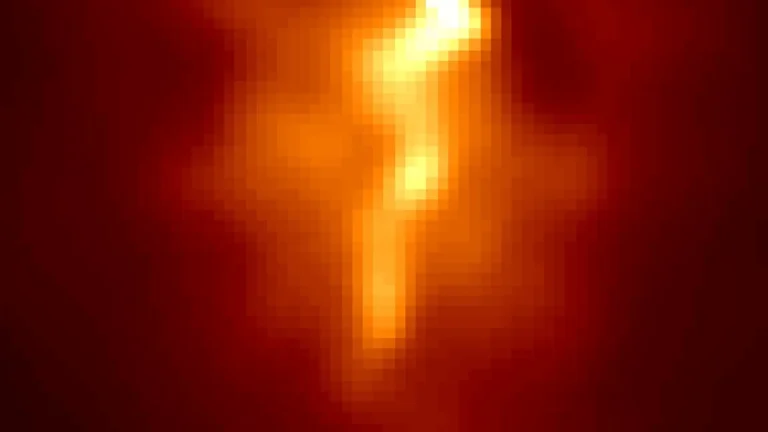
Event Horizon Telescope observations show Centaurus A’s jets are brighter at their edges than at their center, contrary to the expectation that a jet should be brightest at its core. A University of Würzburg team explained the bright edges through plasma in strong magnetic fields, where fast electrons moving along field lines emit light based on magnetic field orientation. The complex magnetic field structure creates bright edges and a dark core, matching EHT images at 1.3 millimeter wavelength. This edge-brightening phenomenon had occupied researchers for decades before the new explanation.
Felix Glaser, a master’s student at the University of Würzburg and lead author, said the plasma-informed model reproducing edge brightening captures an important piece of jet physics. The study Probing anisotropic particle acceleration and limb brightening in Centaurus A’s jet appeared in Astronomy & Astrophysics in 2026 with DOI 10.1051/0004-6361/202660093. The work is part of the DFG Research Unit Relativistic Jets in Active Galaxies FOR 5195, combining observations, simulations and plasma physics.
Matthias Kadler, spokesperson of the DFG Research Unit Relativistic Jets in Active Galaxies FOR 5195, said the result shows progress toward understanding how black holes launch jets and produce radiation. New millimeter telescopes including the planned Wetterstein Millimeter Telescope on the Zugspitze, plus the next-generation Very Large Array and Square Kilometre Array, will provide sharper observations. Those facilities will support a new generation of models improving understanding of the universe’s most powerful particle accelerators.
Karl Mannheim, holder of the Chair of Astronomy at the University of Würzburg, said black holes and fusion reactors are both governed by plasma physics and Centaurus A insights may aid fusion energy. At Centaurus A, researchers can study plasma under conditions they cannot create on Earth.


Join the discussion