Key facts
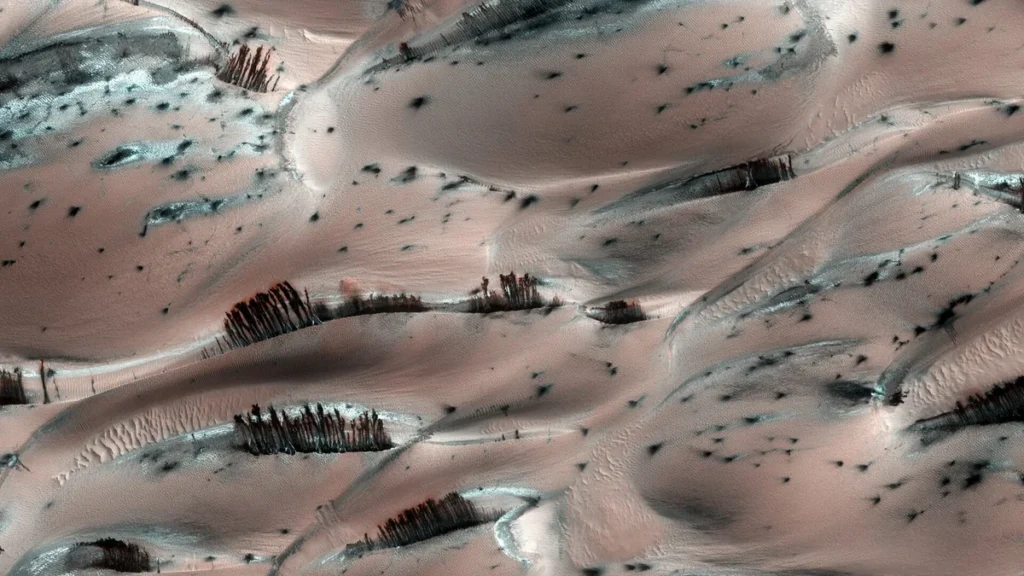
- NASA's Mars Reconnaissance Orbiter photographed frozen dunes near the Martian north pole in 2008 that resemble upright trees or an eerie forest when viewed right side up.
- The streaks are dark sand from within the dune sliding down slopes as seasonal carbon dioxide ice sublimes, not vegetation.
- No rover or orbiter has ever detected algae, cactus, or tumbleweed on Mars, the article states as current understanding.
- Mars is tilted relative to the Sun and has seasons; in winter atmospheric carbon dioxide freezes into snow and frost that blankets the polar landscape.
NASA’s Mars Reconnaissance Orbiter photographed frozen dunes near the Martian north pole in 2008 that look like upright trees or an eerie forest when viewed right side up. ScienceAlert calls the picture startling because nothing is known to grow on Mars, and says turning the image upside down makes the streaks look like sand instead of trees. The streaks are dark sand from within the dune sliding down slopes as seasonal carbon dioxide ice sublimes, not vegetation. The pattern appears only while the ice is present, disappearing by summer.
Mars is tilted relative to the Sun and has seasons like Earth’s because its axial tilt produces yearly seasons, but the winter frost is dry ice rather than water ice. In winter, atmospheric carbon dioxide freezes into snow and frost that blankets the polar landscape. In spring, the carbon dioxide ice sublimes directly into the atmosphere instead of melting into liquid. Unlike Earth snow, the Martian dry ice does not become liquid before returning to the air.
Feeble sunlight weakens and cracks ice along dune crests and passes through translucent ice to warm it from below, building gas pressure that bursts outward carrying sand. Sand cascading down steep slopes leaves long dark streaks that resemble tree branches and trunks when viewed from above. HiRISE captured a small dust cloud in the 2008 image kicked up by material cascading down a dune, direct visual evidence of an active avalanche rather than a static landform.
A 2011 study by Candice Hansen-Koharcheck of the Planetary Science Institute and colleagues compared northern polar dune images over successive Martian years. Researchers tracked changes across several Martian years to see how the polar dune landscape evolves. The study found some dunes formed new gullies and alcoves while others gained fresh sand at their bases. The changes included both erosion forming gullies and alcoves and deposition of sand at dune bases.
In five dunes measured, lower slope edges advanced between 2.2 and 4.7 meters over one Martian year as the ice cycled. The measured advance shows the dunes are actively reshaping within a single Martian year.
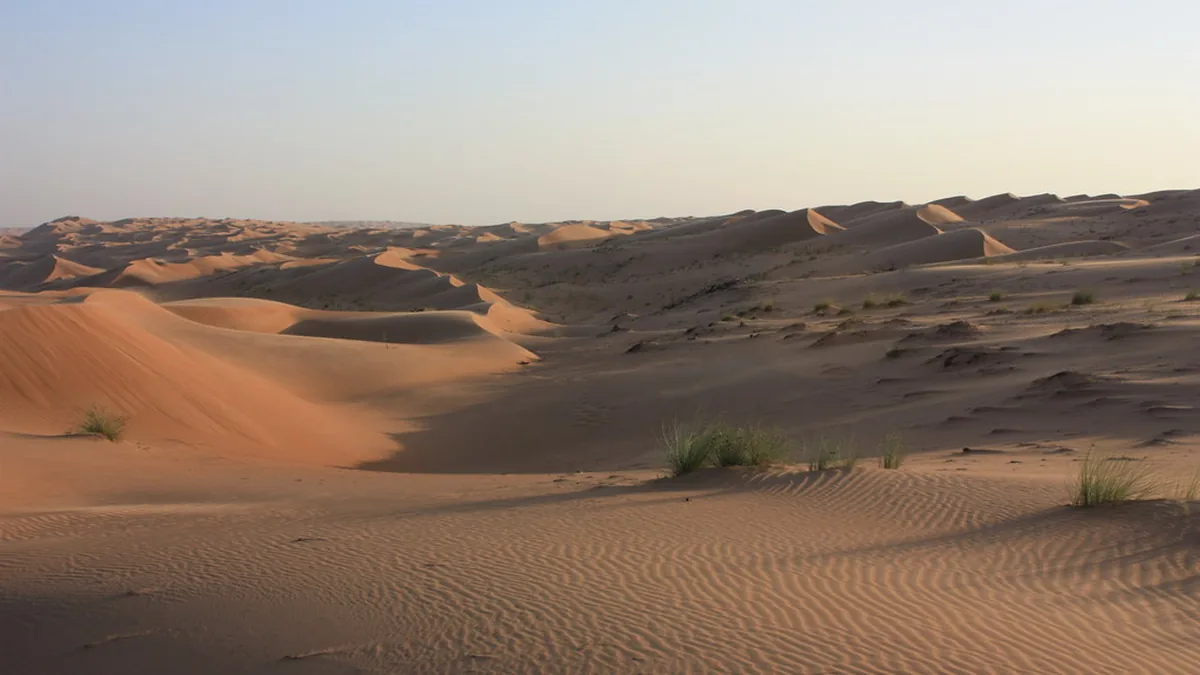
By summer the ice and dark streaks vanish and Martian winds smooth the slopes. The winds redistribute the sand and smooth slopes before the next winter freeze restarts the process. Then the cycle repeats when winter returns, and atmospheric carbon dioxide freezes into frost once more. Seasonal carbon dioxide frost drives the cycle each year.
No rover or orbiter has ever detected algae, cactus, or tumbleweed on Mars. ScienceAlert presents that conclusion as current understanding rather than as a new measurement tied to the 2008 photograph. The dark streaks arise from seasonal frost and sand movement instead of living organisms. They return when winter ice forms again.
NASA released a false-color image of blue dunes around Mars’s northern polar cap in 2021 for the Odyssey orbiter’s 20th anniversary. WPTV reported the release in April 2021 as part of NASA’s 20th anniversary observance for the Odyssey orbiter. In that image, blue marks cooler areas and yellow and orange mark warmer areas, with color indicating temperature. The false-color palette shows temperature differences across the dune field.
The blue-dune image combined infrared camera pictures taken by Mars Odyssey between 2002 and 2004. The dunes were created by winds on Mars and surround the northern polar cap, with the dune field encircling the north polar cap across a region comparable in area to Texas. Mars Odyssey lifted off April 7, 2001 from Cape Canaveral and arrived at Mars’ gravity on October 24, 2001. By 2021 the orbiter had been operating at Mars long enough to mark two decades, and it was still orbiting and collecting scientific data.

Join the discussion