Key facts
- NASA said on Nov. 19, 2026 that Perseverance science activities are temporarily paused while engineers investigate problems with the rover's two UHF radios used to send large data volumes to orbiters for Earth relay.
- On Oct. 30, 2026, Perseverance's primary downlink radio missed its heartbeat pings after power-up, triggering fault protection that powered off the radio, switched to a backup, and placed the rover in safe mode.
- Engineers found after safe-mode recovery that the backup UHF radio was transmitting at about half its expected power output, so the team halted use of both radios pending evaluation.
- Steven Lee, Perseverance project manager at NASA JPL, said the computer listens for the ping, resets a counter each time, and swaps to the backup after consecutive missed heartbeats.
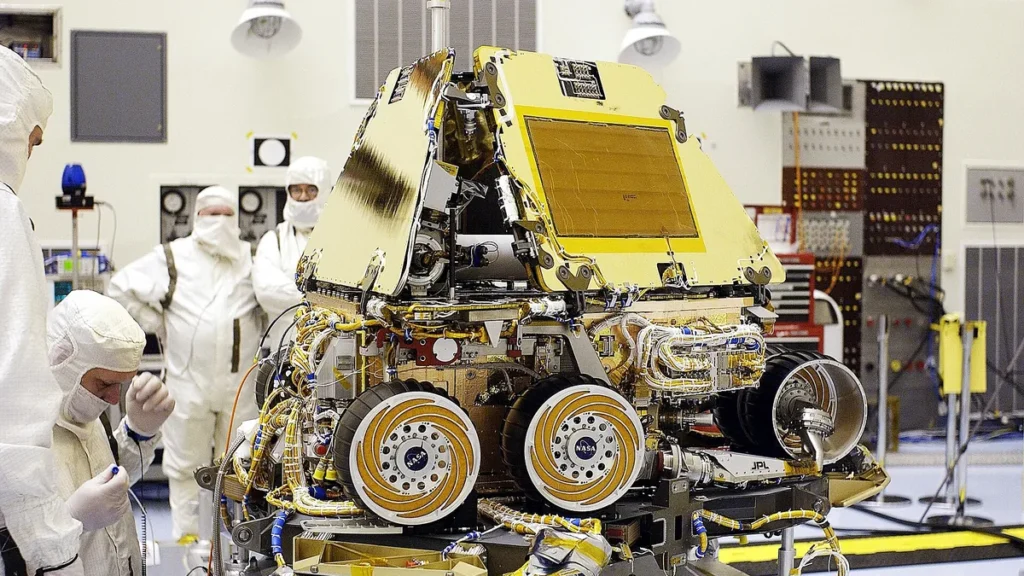
On Nov. 19, 2026, NASA said it paused Perseverance science activities while engineers investigate problems with the rover’s two UHF (ultra-high frequency) radios. Those radios normally carry large data volumes from the rover to orbiters for relay to Earth.
After the rover powered on for daily work on Oct. 30, 2026, its primary downlink radio missed heartbeat pings. Fault protection responded by powering off the radio, switching to a backup, and placing the rover in safe mode to protect non-essential systems. The computer resets a counter whenever it hears a heartbeat; after 25 consecutive misses, equal to about 100 seconds of silence, it automatically switched to the duplicate radio as designed.
Once the rover left safe mode, engineers measured the backup UHF radio output at roughly half of expected levels, so the team halted use of both radios pending evaluation. Engineers will not return either radio to service until they evaluate the causes and grant clearance to operate. NASA said on Nov. 19, 2026 that the rover remains stable and in contact with the team, even though science activities are still paused. Team members hope science can resume by the end of November, and the agency plans to give more updates as engineers address the issue.
Ground teams are treating the pause as a precaution while they investigate separate problems on Perseverance and 2001 Mars Odyssey, including the rover’s two UHF radios that carry data to orbiters for relay to Earth.
To maintain contact with Earth, Perseverance has been using X-band (a deep-space radio frequency band) communications over its high-gain antenna to speak directly with NASA’s Deep Space Network since Oct. 30. The pause also means no new pictures from the camera suite, which affects how quickly unprocessed raw images appear on the mission website. The team paused science and instrument work to save bandwidth for diagnostics because the direct-to-Earth X-band link offers a much lower data rate than the UHF relay path to orbiters.
The mission is managed by Caltech, and NASA JPL has assembled a team to study the backup radio’s performance and plan its return to service. Next, the team will address the primary radio. Engineers identified the secondary issue after the rover exited safe mode and reviewed diagnostic data; neither radio will be used until engineers evaluate the causes and clear one or both for operation. Perseverance project manager Steven Lee explained the heartbeat monitoring logic that governs automatic radio swapping, including how the counter works and the condition that triggers redundancy.
“The rover’s main computer continually listens for that ping,” Lee said.
NASA said on Nov. 19, 2026 that the team operating the 2001 Mars Odyssey orbiter is examining a malfunctioning reaction wheel, and the vehicle’s science instruments remain offline. The orbiter entered safe mode from Nov. 4 to 6 after detecting an issue, and engineers determined that a reaction wheel had stopped spinning. Odyssey has left safe mode, but its science instruments remain offline. Four reaction wheels are aboard the spacecraft, but one failed in 2013.
The craft needs at least three wheels for orientation; with fewer than three, it must rely solely on hydrazine thrusters to stay pointed.
After 25 years in Mars orbit, the craft carries enough hydrazine to point itself without reaction wheels for one to two months, the Odyssey mission team says, and work to refine those fuel estimates continues. Because it lacks three working wheels, Odyssey must rely solely on hydrazine thrusters, and the limited fuel supply adds urgency to the investigation while science instruments stay offline. NASA JPL leads the mission, and Lockheed Martin built and operates the spacecraft; both teams are still investigating with science operations offline. During one test, the faulty wheel moved when commanded.
Science and relay work should resume after testing and analysis wrap up in the last week of November, NASA said on Nov. 19, 2026, and the agency will share more status and timeline updates as the team learns more. Odyssey launched in April 2001 and reached Mars orbit in October 2001 for a mission planned to last just over 2.5 years. No other mission has operated around Mars longer than Odyssey. The teams continue running tests on the wheel to see whether they can recover it while they analyze Odyssey’s data, and the orbiter has left safe mode.
Mars geologists consider the orbiter’s first global maps of Martian surface composition foundational. The maps have helped pinpoint landing-site hazards, scientific targets for landers and rovers, and water in the upper 3 feet (1 meter) of the ground, including buried ice that might help future astronauts on Mars. It also relays data from surface missions, including the first post-landing images from Phoenix and the Spirit, Opportunity, and Curiosity rovers.


Join the discussion