Key facts
- On November 21, 2026, the spacecraft was approximately 124 million miles, or 200 million kilometers, from Earth.
- A round-trip radio signal between Earth and BepiColombo takes more than 22 minutes at that distance, so the capture window closes before any ground command can arrive.
- The mission costs €1.6 billion, or £1.4 billion, according to The Guardian.
- BepiColombo launched on October 19, 2018.
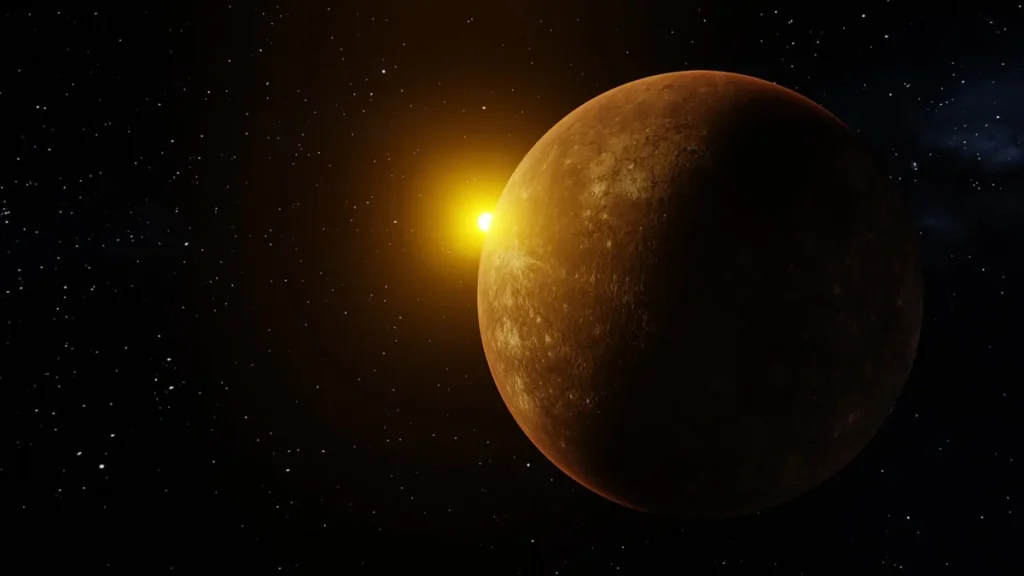
The European-Japanese BepiColombo mission arrived at Mercury on Nov. 20, 2026, completing a voyage of more than eight years and more than six billion miles. Flight controllers plan to fire the spacecraft’s thrusters on Saturday, Nov. 21, 2026, to send BepiColombo into orbit around the planet.
A successful burn would make BepiColombo only the second mission in history to orbit Mercury, after NASA’s MESSENGER operated there from 2011 to 2015. The maneuver is a single-point failure: the flight plan has no contingency orbit insertion, and if chemical propulsion fails the spacecraft will pass Mercury with too little propellant for a second attempt.
On Nov. 21, BepiColombo will be about 124 million miles, or 200 million kilometers, from Earth. A round-trip radio signal takes more than 22 minutes at that distance, so the capture window closes before any ground command can arrive. ESOC in Darmstadt cannot intervene, abort, or correct errors in real time because the entire burn sequence is pre-programmed and stored aboard. The first telemetry confirming success is expected at Darmstadt roughly 11 minutes after the capture event.
The initial capture orbit will have a period of approximately 60 hours, so the stacked pair will orbit Mercury once every 2.5 days. From that beachhead orbit, MPO will execute 16 maneuvers over the following weeks.
BepiColombo launched on Oct. 19, 2018, and reached Mercury using nine gravity assists—one Earth flyby, two Venus flybys, and six Mercury flybys—supplemented by ion propulsion and chemical braking. The ion propulsion phase ended permanently on June 15, 2026, at 9:24 a.m. ET. The Mercury Transfer Module, which housed four QinetiQ T6 xenon ion thrusters and massive solar panels, separated from the two science orbiters on Sept. 3, 2026, and is now inert debris on a diverging solar trajectory.
The two orbiters are coasting together toward Mercury in a ballistic free-fall arc powered only by the Mercury Planetary Orbiter, with all trajectory corrections from separation forward coming from MPO’s conventional chemical propulsion system. The original arrival date was December 2025, but a power conditioning fault in the transfer module’s electrical system discovered in April 2024 forced a trajectory redesign and delayed orbit insertion by 11 months.
The mission costs €1.6 billion, or £1.4 billion, according to The Guardian. Tech Times described it as a €1.65 billion joint mission built over 26 years, while Ars Technica put the price tag at nearly $2 billion. Ars Technica also reported that the European Space Agency leads the mission with contributions from Japan and the United States.
Once in orbit, the European Mercury Planetary Orbiter will map Mercury’s surface and composition at high resolution and study its interior, including its unusually large core. The Japanese orbiter, Mio, will measure Mercury’s magnetic field and its sodium exosphere, the thin layer of gas and atoms surrounding the planet. The two-orbiter design will provide simultaneous measurements from two different positions at the same time, offering the first uniformly high-resolution coverage of both hemispheres.
The spacecraft carry 16 scientific instruments across the two orbiters, far more than MESSENGER, with higher data rates. MPO carries the Mercury Orbiter Radio-science Experiment, a Ka-band transponder that will measure position and velocity with extraordinary precision to test general relativity.
Among them, the Mercury Imaging X-ray Spectrometer will produce a global map of Mercury’s surface atomic composition. MIXS is the first imaging X-ray telescope operating on a planetary science mission, and Eighty percent of its technology is new. The detector suffered no radiation damage after eight years in space, and its angular resolution was found to be slightly better than when last measured in the laboratory in 2015.
University of Leicester researchers made the first calibration measurements with MIXS by observing the Crab Nebula, which is 6,500 light-years away, using 55 spacecraft slews and 39 hours of observations during Sept. 11-12. Prof Emma Bunce, the instrument’s principal investigator, has worked on the project for 20 years and said she was excited after a long wait. She said the team thinks of George Fraser, the original principal investigator and creator of MIXS’s novel optic design, who died in March 2014. Dr. Adrian Martindale, MIXS instrument scientist and first involved in the mission in 2003 as an undergraduate, said, “These first data are mind-blowing to me.”
Prof Geraint Jones, the lead project scientist on BepiColombo at the European Space Agency, said anticipation of scientific results kept everyone enthused during the eight-year journey. Bruno Sousa, ESA’s operations chief, said during a live broadcast that the transfer module’s separation would basically be a new mission starting that day. Elsa Montagnon, BepiColombo’s operations manager, said arriving at Mercury is not easy and will involve six months of continuous activities. Ignacio Tanco, ESA’s head of Inner Solar System Mission Operations, compared the upcoming burn to launching a new spacecraft around a different planet.
A July 2026 study by researchers at the University of Michigan and UC Berkeley confirmed that Mercury hosts radiation belts, and Mio carries dedicated particle detectors needed to measure them directly. Jiutong Zhao, a UC Berkeley researcher who led the study, said BepiColombo can solve the question of how intense Mercury’s radiation is right now.
Mio will separate from the Mercury Planetary Orbiter via spin-ejection planned for Dec. 9-10, 2026, and MPO will jettison the MOSIF sunshield that protected Mio during cruise on Dec. 16. MPO will reach its final polar science orbit of 480 kilometers by 1,500 kilometers, with a 2.36-hour period, by March 10, 2027. Mio will operate independently in a highly elliptical science orbit of 590 kilometers by 11,640 kilometers with a 9.3-hour period. Full science operations for both spacecraft will begin on April 6, 2027.
The spacecraft will orbit Mercury for about three years before running out of fuel, losing altitude, and slamming into the surface. Mercury is only 50% larger than the moon but has four times its mass. Its iron core comprises roughly three-quarters of the planet’s total radius, while surface gravity is only 38% of Earth’s. Mercury’s intrinsic magnetic field is about 1% as strong as Earth’s and is measurably offset northward from the planet’s center.
Surface temperatures on Mercury range from -292°F to 842°F (-180°C to 450°C), and the solar radiation intensity at the planet’s orbital distance is roughly 10 times what spacecraft at Earth encounter. Mercury takes 58 Earth days to rotate on its axis, so any given spot can experience daylight for three months and then night for three months. Mio is a 255-kilogram octagonal spacecraft spin-stabilized at 15 revolutions per minute with 90 watts of solar power. The mission takes its name from Giuseppe “Bepi” Colombo, an Italian mathematician and engineer at the University of Padua who lived from 1920 to 1984 and proposed the gravity-assist technique used by Mariner 10 in 1974.

Join the discussion