Key facts
- Astronomers used the NSF VLBA, operated by NSF NRAO, to determine with extraordinary precision DG CVn's orbit, masses and distance; the two red dwarfs lie about 59 light-years from Earth.
- DG CVn A has about 39 percent of the sun's mass and DG CVn B has about 36 percent, making them low-mass red dwarfs.
- Both stars in DG CVn emit detectable radio waves, a surprise that let astronomers track each star's individual motion across the sky.
- The stars' close, repeated encounters within about 0.59 astronomical units gravitationally limited the size of planet-forming gas and dust disks as the system formed.
Phys.org reported that astronomers led by Paul Boven have used the National Science Foundation’s Very Long Baseline Array to determine with extraordinary precision the orbit, masses and distance of DG CVn, a flaring red-dwarf binary about 59 light-years from Earth, in research published in Astronomy & Astrophysics in 2026.
DG CVn lies 59.3 light-years from Earth. The distance came from parallax, which measures the slight apparent shift in a nearby star’s position as Earth orbits the sun. With the distance in hand, researchers combined it with the stars’ mutual orbital motion to calculate the masses with exceptional accuracy.
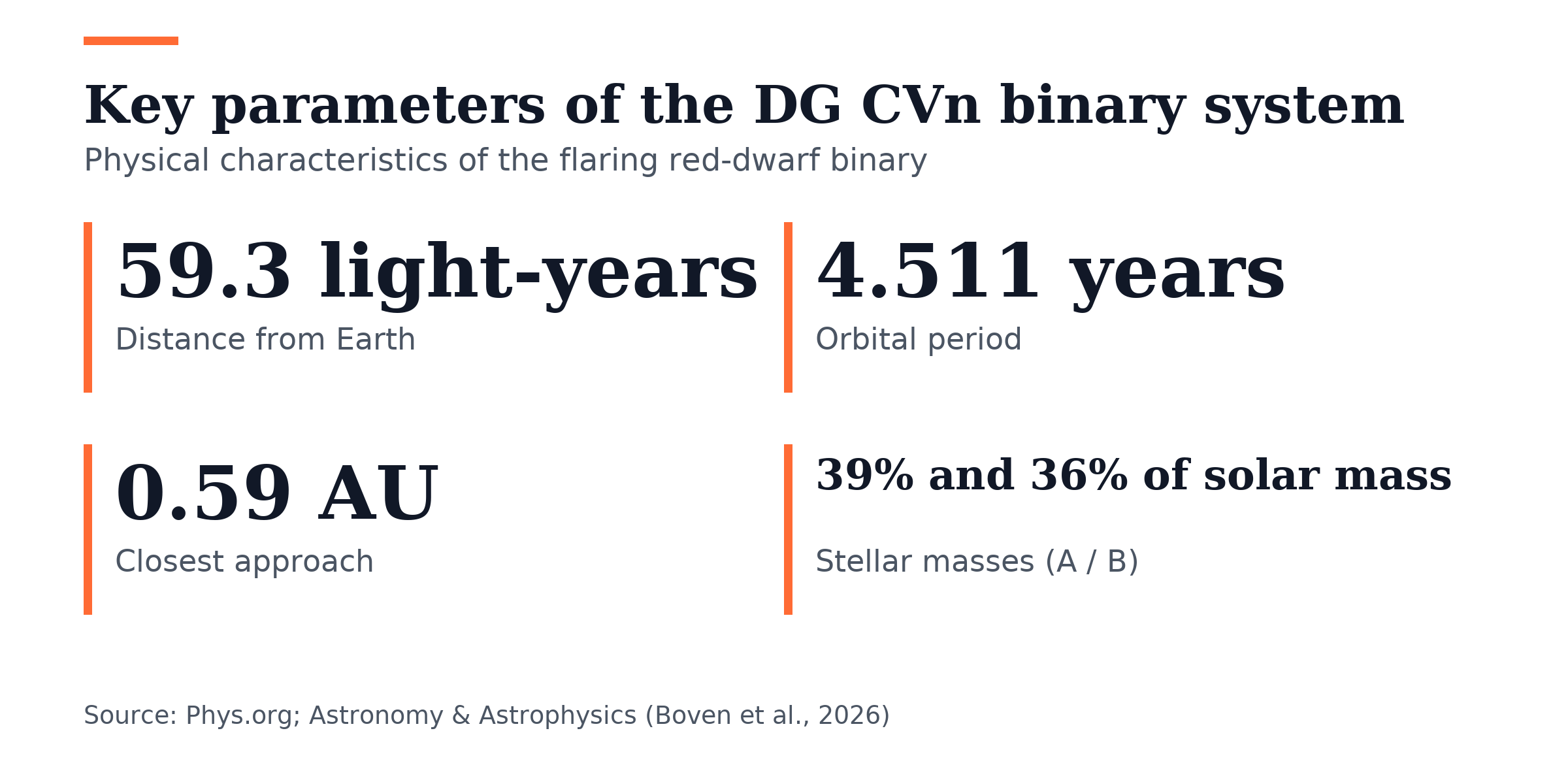
The two stars in DG CVn circle each other every 4.511 years on a stretched, elliptical path. At closest approach they come within about 0.59 astronomical units. The more massive star, DG CVn A, has about 39 percent of the sun’s mass, while DG CVn B has about 36 percent, making them low-mass red dwarfs.
The NSF VLBA, operated by NSF NRAO, consists of 10 radio telescopes spread across North America, working together as one instrument thousands of miles across. Researchers combined archival NSF VLBA and NSF GBT observations from 2007 to 2010 with seven new NSF VLBA observing sessions between 2023 and 2025. That span covered 18 years and produced 27 precise position measurements.
Radio waves from both stars in DG CVn surprised astronomers. Those emissions let them track each star’s individual motion across the sky. Because the stars sit close together in the sky and are difficult to distinguish with conventional optical observations, the VLBA’s radio pinpointing let researchers follow each star’s motion separately. Following the two stars over many years lets astronomers see their orbital motion directly and determine properties otherwise difficult to measure, according to co-author Jay Blanchard.
Paul Boven, a network system engineer at JIVE, the Joint Institute for Very Long Baseline Interferometry ERIC, and a Ph.D. student at Leiden Observatory, led the research team and is the lead author of the study. “But the real surprise came when we also detected the second radio-loud dwarf in the observations we did to confirm our model,” Boven said.
DG CVn first came to attention while astronomers searched for planets around nearby stars. They had sought a small wobble from an orbiting planet’s gravity, yet the movement proved far larger and more complex, later traced to the two stars circling each other. Boven said they were lucky to have developed tools able to explain these motions when they heard about the object.
The system is young, with an age between 30 and 150 million years. At least one of its stars is a rare, particularly active, fast-rotating flare star. Previous observations showed the system’s radio emission can increase dramatically following powerful X-ray outbursts.
Stars like the sun put out faint natural radio emission. Small red dwarfs below the sun’s mass are different because rapid rotation stirs their interiors, building powerful magnetic fields and driving strong activity such as flares that produce strong radio and X-ray output.
Close, repeated encounters within about 0.59 astronomical units gravitationally capped the size of planet-forming gas and dust disks as the system took shape. The tight orbit makes long-period planets around either individual star unlikely. For a planet around one star, stability requires an orbit of less than about 23 days. A planet around both stars needs an orbit lasting at least about 36 years.
These results rank among the most precise dynamical measurements yet made for a binary system of this type. VLBI links widely separated radio telescopes to make precise position measurements and can hunt for a star’s small reflex motion caused by an orbiting planet, potentially revealing planets.
DG CVn also hosts a complex periodic variable, or CPV, star with ongoing periodic changes in its optical light curve. It remains unknown which of the two stars displays either that behavior or the sharp radio rise that follows powerful X-ray outbursts.
Researchers say future radio facilities including the Next Generation Very Large Array and the Square Kilometre Array could make these measurements possible for many more stars and help tell binary companions apart from orbiting planets. Huib van Langevelde, JIVE chief scientist and Leiden Observatory professor, said he hopes future measurements become precise enough to spot planets around radio-loud dwarfs after ngVLA and SKA enter the VLBI network.

Join the discussion