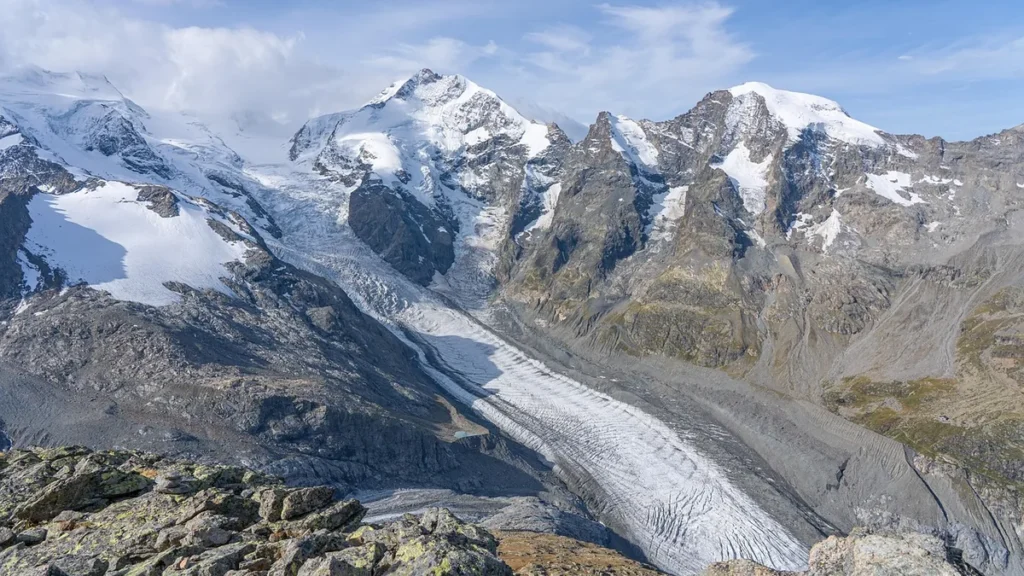
NASA Earth Observatory released satellite imagery in November 2026 showing Puncak Jaya’s remaining ice in Indonesian Papua has shrunk to scattered remnants that no longer flow under their own weight, halting active glacier movement near the equator.
To keep flowing, ice must be thick enough to move downhill under its own weight and must sit where snow accumulates faster than it melts. Puncak Jaya’s remnants no longer meet that test, and snow that falls nearby does not stay on bare rock long enough to build new ice. “While small ice remnants persist in high-altitude crevices around Puncak Jaya, their functional life as active glaciers is effectively over,” Permana said.
Permana said the September 2025 remnant covered only about 0.09 square kilometers, roughly 2 percent of the ice mapped in 1988. In 2010 the ice at the East Northwall Firn site measured 32 meters thick; by 2023 thickness reached 4 meters, and it had vanished by November 2024.
Reconstructions show the ice covered 19.3 square kilometers in 1850 and 0.43 square kilometers by 2010. The 2025 Ibel study put the 2024 remnant at 0.165 square kilometers, less than one percent of the mid-nineteenth-century extent.
El Niño raises the freezing level above the summit, so precipitation falls as rain instead of snow. In 2015-2016, El Niño drove thinning about five times faster than usual, with roughly 5.3 meters of thickness lost in one year.
Thinning glaciers fracture into pieces, and each new edge exposes more ice to melting. Bedrock newly exposed between remnants in the 2026 image sits beside dark rock that absorbs more sunlight than snow, speeding melting at the edges.
In July 2026, BMKG projected that all remaining ice could disappear by the end of 2026, or in early 2027. NASA Earth Observatory cites recent satellite studies suggesting the main glacial ice areas could disappear around 2030, though researchers cannot determine the exact final date precisely.
Five Indigenous groups hold deep spiritual ties to the mountain. The Moni call it Mbainggela, and the Amungme call it Nemangkawi or the White Arrow. Amungme activist Adolfina Kum said losing Nemangkawi compares to Muslims losing Mecca or Catholics losing Rome or the Vatican.
Marie Šabacká, a Czech glacier ecologist, said Papua’s tropical glaciers are unique because they sit thousands of kilometers from other glacier systems and are the last tropical ice between the Andes and Himalayas. Klaus Thymann, a Danish researcher, said the glaciated area around Puncak Jaya receded by 95 percent from the early 2000s to 2025, adding “There’s almost no ice left. Those are the facts.”
Researchers call the Puncak Jaya glaciers high-altitude canaries in the coal mine. They point to similar ice remnants at Humboldt Glacier in Venezuela, Quelccaya Ice Cap in Peru and Kilimanjaro in Tanzania.


Join the discussion