Key facts
- Centaurus A's supermassive black hole has a mass of about 60 million times that of the sun.
- In the jet's powerful magnetic fields, fast electrons travel along field lines, making emitted brightness depend on field orientation; the complex field structure brightens the edges and darkens the core.
- The simulations connect particle-scale plasma processes with structures across several light-days and match Event Horizon Telescope images taken at a wavelength of 1.3 millimeters exceptionally well.
- Felix Glaser, a master's student and lead author at the Chair of Astronomy, called Centaurus A the closest window into relativistic jet physics and said the model captures an important part of the underlying physics.
Researchers at the University of Würzburg published plasma simulations on Oct. 12, 2026, in Astronomy & Astrophysics that explain why Centaurus A’s relativistic jets glow brighter at their edges than at their centers, resolving a decades-old puzzle from Event Horizon Telescope observations. The paper, titled “Probing anisotropic particle acceleration and limb brightening in Centaurus A’s jet,” appears in the journal’s 2026 volume under DOI 10.1051/0004-6361/202660093. Centaurus A is the closest active galaxy to Earth at about 12 million light-years away, where researchers can study the extreme physics around a black hole about 60 million times as massive as our sun in unusual detail.
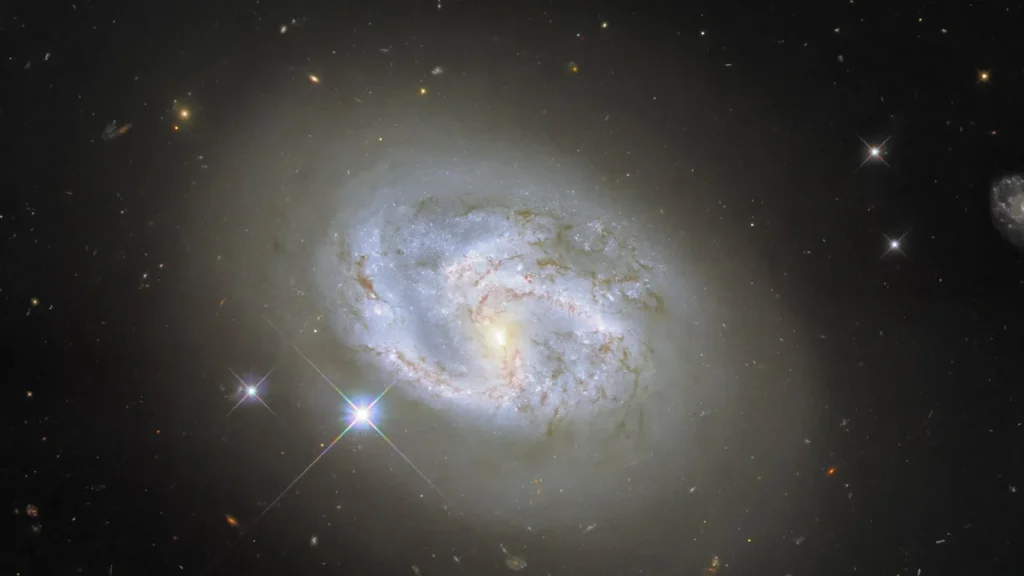
Centaurus A, also cataloged as NGC 5128, is an elliptical galaxy in the constellation Centaurus that is currently merging with a companion spiral galaxy, producing strong star formation and a luminous central region powered by its supermassive black hole. The Würzburg team places it at about 12 million light-years away, while a 2009 ESO release gave a distance of roughly 13 million light-years, highlighting the galaxy’s proximity as a key asset for study. The galaxy’s proximity makes it the closest active galaxy to Earth, giving astrophysicists an exceptionally detailed view of the jets and turning the system into a unique laboratory for the universe’s most extreme conditions, where astrophysicists can observe plasma behavior directly.
Although theoretical models predict that a relativistic jet should be brightest at its center, Event Horizon Telescope observations of Centaurus A show the opposite: the edges glow far more brightly than the core, a puzzle that has occupied researchers for decades. The observations reverse the expected brightness pattern, with the limb-brightened structure pointing to the role of magnetic fields in shaping the observed radiation. The Würzburg team used plasma simulations to test whether magnetic field geometry could explain the unexpected edge brightening.
The Würzburg simulations trace the edge brightening to the behavior of plasma in the jet’s powerful magnetic fields, where fast electrons travel along field lines and emit light whose brightness depends on the field’s orientation relative to the observer. The complex field structure – revealed by the simulations – naturally brightens the edges while darkening the central region, explaining the long-standing observational puzzle. This produces the limb-brightened pattern observed by the Event Horizon Telescope.
The simulations connect particle-scale plasma processes with structures spanning light-days, bridging the gap between microscopic physics and the jet’s shape, and showing how small-scale effects can determine large-scale appearance. By modeling how fast electrons spiral around magnetic-field lines and emit radiation whose brightness depends on orientation, the simulations produce predicted images that can be directly compared with telescope observations. The model reproduces Event Horizon Telescope images taken at a wavelength of 1.3 millimeters exceptionally well, matching the observed limb-brightened pattern and confirming that the simulation approach captures the underlying physics.
Felix Glaser, a master’s student at the Chair of Astronomy and the study’s lead author, called Centaurus A the closest window into the physics of relativistic jets, noting that the model captures an important part of the underlying physics and that the process could be common across the universe. “Cen A is our closest window into the physics of relativistic jets,” Glaser said, emphasizing the galaxy’s role as a natural laboratory for jet physics. Dr. Christian Fromm, leader of the Computational Astrophysics Group, emphasized that microscopic plasma effects can shape structures on vastly larger scales, and urged that realistic plasma physics be included in models today, with future observations expected to reveal more plasma signatures. “What is truly amazing is that microscopic plasma effects can shape structures on vastly larger scales,” Fromm said, highlighting the nonlinear effects of relativistic plasma and the importance of studying them.
The work is part of the DFG Research Unit “Relativistic Jets in Active Galaxies” (FOR 5195), which merges observations, simulations, and plasma physics to learn how black holes launch powerful jets and create the radiation observed from Earth. Prof. Matthias Kadler, spokesperson of FOR 5195, said the unit unites high-resolution observations, numerical simulations, and plasma physics to make progress on understanding black-hole jets, and that the new result illustrates the unit’s aim of combining these expertise areas. Prof. Karl Mannheim, holder of the Chair of Astronomy, noted that black holes and fusion reactors are both governed by plasma physics, and that Centaurus A offers plasma conditions impossible to create on Earth. He said the insights from Centaurus A may contribute to the development of future fusion energy.
The research arrives as the field prepares for sharper views: new millimeter telescopes, including the planned Wetterstein Millimeter Telescope on the Zugspitze, the next-generation Very Large Array, and the Square Kilometre Array, are expected to deliver more detailed jet insights and reveal more plasma signatures, sharpening the view of black-hole jets across the universe. The paper, titled “Probing anisotropic particle acceleration and limb brightening in Centaurus A’s jet,” appears in Astronomy & Astrophysics (2026) with DOI 10.1051/0004-6361/202660093, and was originally published on Oct. 12, 2026, with the university release dated Nov. 11, 2026, marking the public announcement of the findings.
The study clarifies how black holes accelerate particles to enormous energies and what radiation the process produces, addressing a fundamental question in astrophysics that has driven observations and simulations for decades. By connecting microscopic plasma physics to observable jet structure, the work demonstrates how small-scale processes can shape the appearance of some of the universe’s most powerful objects.
Centaurus A has been a target of intense study for decades; on Jan. 28, 2009, ESO announced the first submillimeter imaging of its jets and radio lobes using the APEX telescope, with the observations presented in a 2008 paper by Axel Weiss et al. in Astronomy & Astrophysics (volume 490, pages 77–86). The APEX image revealed a dust ring encircling the galaxy, the inner radio lobes north and south of the dust disc, and material in the jet moving at about half the speed of light, based on emission from fast electrons spiralling around magnetic-field lines. In X-ray emission, the expanding lobe collides with surrounding gas to the lower right of the galaxy, creating a shockwave glow, showing how the jet deposits its energy into its environment. LABOCA, the submillimeter instrument that made the observations, operates on the 12-meter APEX telescope at 5,000 meters on Chile’s Chajnantor plateau; APEX is a partnership of the Max-Planck-Institute for Radio Astronomy, the Onsala Space Observatory, and ESO, and builds on a prototype antenna constructed for the Atacama Large Millimeter/submillimeter Array; ESO operates it.

Join the discussion