Key facts
- A University of Cambridge study in Scientific Reports dated October 28, 2026, argues that comets probably did not deliver the prebiotic molecules needed for life to Earth.
- Computer modeling indicates that comets strike Earth at excessive speed and steep angles, making survival of fragile organic material very unlikely; most would vaporize on impact instead of reaching the surface whole.
- The study focused on hydrogen cyanide (HCN), a carbon- and nitrogen-bearing molecule regularly detected in Solar System comets, finding that impacts preserving it at useful concentrations would be exceptionally uncommon.
- Even a scenario in which comets bounce between closely spaced planets and slow down enough to survive impact would have been rare in our solar system, according to the researchers.
University of Cambridge researchers published a study on Oct. 28, 2026, in Scientific Reports arguing that comets probably did not deliver the prebiotic molecules needed for life to Earth.
The computer modeling indicates that comets strike Earth at excessive speed and steep angles, making survival of fragile organic material very unlikely because most of it would vaporize on impact instead of reaching the surface intact. This fragility underlies the finding that molecules would likely vaporize on impact even if they survived atmospheric entry. Researchers said it is very likely that organic-material comets have struck Earth at some point in the distant past.
Richard Anslow of Cambridge’s Institute of Astronomy, the study’s lead author, said successful cometary delivery would have to be a one-in-a-million occurrence and, at best, a one-off fluke. “We can’t rule out for certain that it happened that way,” he said.
The team focused on hydrogen cyanide, a carbon- and nitrogen-bearing molecule regularly detected in Solar System comets, and found that impacts preserving it at useful concentrations would be exceptionally uncommon. Cometary ices include carbon- and nitrogen-bearing compounds such as hydrogen cyanide, which can take part in reactions yielding some essential building blocks of life.
For about the past century, scientists believed comets brought prebiotic molecules to Earth. NASA describes comets as icy bodies of frozen gas, rock and dust containing a substantial amount of organic material, which is why researchers long suggested they could have delivered life’s building blocks.
The solar system began roughly 4.6 billion years ago from a cloud of gas and dust, and the rate of comet impacts on Earth fell sharply during the planet’s initial 500 million years, leaving few opportunities for meaningful hydrogen cyanide delivery. This sharp decline narrows the time window in which comets could have contributed to life’s chemistry. Impacts from asteroids occurred far more often than comet impacts, and asteroids transport many of the same molecular building blocks.
The team found that a comet must move slower than about 9 miles (15 kilometers) per second, or its molecules would break apart from impact speed and temperature. The paper says surviving organic compounds would provide only an insignificant source of the concentrated feedstock molecules needed for prebiotic chemistry. Even if molecules survived impact, researchers said there would not have been enough quantities to help start life, including hydrogen cyanide, and surviving molecules would probably disperse before prebiotic chemical reactions could progress far. On a global scale, intact delivery of hydrogen cyanide via comets is orders of magnitude below what Earth’s atmosphere can produce, even in the most unfavorable conditions.
Mars may have been somewhat more favorable than Earth for receiving cometary organic molecules because it is smaller and has a much thinner atmosphere, though the simulations do not establish that delivery actually happened there. Organic molecules from comets might survive a Mars impact thanks to its weaker gravity, though the researchers judged even that unlikely.

Richard Anslow offered another, perhaps more likely, alternative: that seeding did not happen on either Earth or Mars. Any molecules comets delivered to Earth were likely deposited in a one-off event rather than arriving on an ongoing basis.
If comets were not a major source of Earth’s prebiotic molecules, the researchers say asteroids – which struck early Earth much more frequently – or endogenous chemical synthesis occurring in Earth’s atmosphere remain possible explanations. The study outlines two chief origins for prebiotic chemistry: exogenous delivery via comets, asteroids, and interplanetary dust particles, plus endogenous synthesis inside Earth’s atmosphere. The team noted that conflicting evidence still exists, making scientists hesitant to fully endorse the atmospheric-origin view. Early Earth experienced many more asteroid strikes than comet strikes, and those impacts may have set off chemical reactions creating organic compounds.
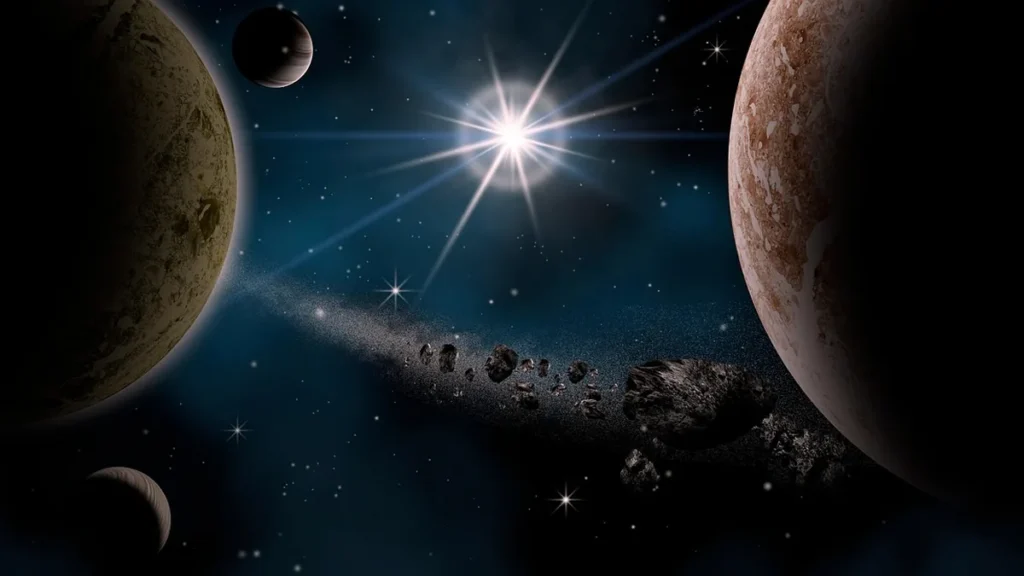
The study draws on recent advances in comet-impact simulations, atmosphere interactions and dynamic modeling of comet origins and evolution. The work extends 2023 research by Anslow and colleagues, who proposed that closely spaced planets could help comets deliver organic molecules through gravitational encounters that gradually slow the comets. EarthSky reported in 2023 that comets might slow by bouncing from one planet to the next. Even a scenario in which comets bounce between closely spaced planets and slow down enough to survive impact would have been rare in our solar system, according to the researchers.
When worlds orbit close together in a planetary system, gravitational interactions could slow incoming comets sufficiently to enhance organic-molecule delivery chances. Finding places where these “bouncing” comets could survive long enough to drop off their chemical cargo might help narrow the hunt for potentially habitable worlds.
The research team says its results could help astronomers study the chemical makeup of worlds orbiting other stars and focus the search for potentially habitable planets. In 2023, Anslow and colleagues explored whether comets could deposit organic materials on other planets in the galaxy, viewing such systems as promising candidates in the search for extraterrestrial life. Future observatories including the proposed Habitable Worlds Observatory could investigate exoplanet systems where closely orbiting worlds slow incoming comets enough to improve organic-molecule delivery prospects.
The paper credits Richard J. Anslow, Catriona H. McDonald, Amy Bonsor, Paul B. Rimmer and Auriol S. P. Rae as authors, gives the publication date as Oct. 28, 2026, in Scientific Reports, and lists DOI 10.1038/s41598-026-74214-y. Funding came in part from the Royal Society, the Leverhulme Centre for Life in the Universe, and the Science and Technology Facilities Council (STFC), which is part of UK Research and Innovation (UKRI).

Join the discussion