Key facts
- UCLA astrophysicist and co-author Smadar Naoz compared studies of Little Red Dots to blind people describing an elephant and said the research connects several perspectives together.
- Early dense clusters could be the environment that spawned early intermediate-mass black holes, which merged more often in the past and generated today's supermassive black holes.
- Quote candidate from S4: Claire Williams said, "One place in the nearby universe where collisions between stars are common is the galactic center.".
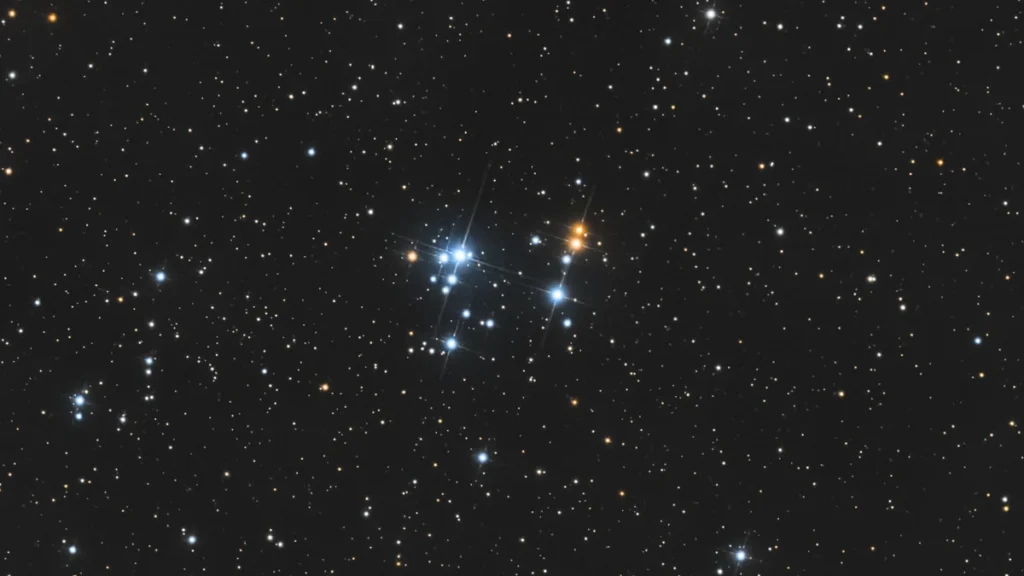
A UCLA-led research team published modeling in The Astrophysical Journal on Oct. 27, 2026, showing that collisions between stars in dense early-Universe clusters may have forged the massive stars that collapsed into the first black hole seeds.
JWST has found supermassive black holes that existed just 400 million and 500 million years after the Big Bang – far earlier than theory allows – and researchers lack a solid, widely held explanation for how they formed so early. The early appearance leaves less time for slow growth than researchers once expected.
The Astrophysical Journal paper, titled A Cosmological Framework for Stellar Collisions at High Redshift in Proto-globular Clusters, Nuclear Star Clusters, and Little Red Dots, was led by UCLA doctoral student Claire Williams of the Department of Physics and Astronomy. Their models examined extremely dense early-Universe star groups and what could happen inside them.
Researchers at the University of California, Los Angeles said stars around the solar system are spaced so far apart that direct collisions rarely happen, while in packed clusters encounters occur more often and results depend partly on stellar speeds. The team set early cluster parameters using initial conditions from AREPO cosmological simulations, supplemented by JWST observations of star clusters and galaxies from the high-redshift Universe.
The researchers compared these clusters to the Nuclear Star Cluster near Sgr A*, the black hole at the Milky Way’s center, where collisions can refresh an old population. Researchers estimate that nearly every galaxy contains a supermassive black hole and that roughly 80% of early galaxies also contain a Nuclear Star Cluster, pointing to collision-rich settings across the Universe.
Each test case started with 1,000 stars within 1 parsec of the center – fewer than the central Milky Way region around its black hole, which holds more than 6,000 stars within the same distance. The test cases varied velocity dispersions and mass density profiles across different cluster environments.
The results show stellar collisions are common across star clusters and nuclear star clusters. Runaway sequential collisions can produce massive stars early in the Universe. Researchers often use a mass above 100 solar masses to define very massive stars. Claire Williams said repeated mergers inside a cluster can build a single giant star weighing as much as an entire cluster.
In the team’s model, slower collisions merge stars while faster ones destroy them, and a merged star that meets others can repeat the process to create a single giant star. Some collisions did not yield stars that would collapse into black holes; instead, collisions destroyed both stars and turned them into gas.
High rates of destructive collisions can build dense gas around massive black holes, which may serve as an analog to the Little Red Dots that observers have detected. Little Red Dots are compact early-Universe objects that look like black holes surrounded by plentiful gas, and those black holes may be accreting at a super-Eddington rate, meaning they pull in gas faster than the theoretical limit where radiation pressure balances gravity; observers have counted hundreds of them.
If these objects are gas-shrouded black holes, the gas hides the x-rays that would expose them, and they could be growing rapidly through super-Eddington accretion, with the research suggesting that stellar collisions supply the gas. The paper’s diagrams show two paths: in clusters without a black hole, collisions build very massive stars, while in clusters with a black hole, collisions destroy stars and create thick gas near the black hole.
Smadar Naoz, a UCLA astrophysicist and co-author, said studies of Little Red Dots remind her of blind people describing an elephant, and that her team’s research ties viewpoints together. “Our research connects several of those perspectives together and may help us see more of the elephant,” Naoz said.
Claire Williams said star clusters act as a natural birthplace for massive black-hole seeds in the team’s model, with the same setting forming the black hole and supplying stars and gas that shape later growth. The paper lays out a bottom-up framework for stellar dynamics across systems with or without intermediate-mass and supermassive black holes, including cases where stellar collisions do or do not drive evolution.
Intermediate-mass black holes are elusive objects that sit between stellar-mass and supermassive black holes in size, and although some firm candidates exist, none has won universal agreement. The team proposes that early dense clusters spawned early intermediate-mass black holes, which merged more frequently in the past and produced present-day supermassive black holes.
The team likened the early-Universe clusters to the Milky Way’s center, where a massive black hole sits inside a dense star cluster, and said similar ingredients came together in the early Universe. After a black hole forms, its gravity can speed up nearby stars, and the resulting high-speed collisions may rip stars apart and release gas into the surrounding area. Claire Williams said, “One place in the nearby universe where collisions between stars are common is the galactic center.”
Stellar collisions remain rare across most of the present-day Universe. Those clusters came from early-Universe conditions unlike the present day, when there were no large spiral galaxies such as the Milky Way but only dense star-forming regions; inside them, stars crashed together and built black holes around which galaxies later grew.
The work exists as an arXiv preprint and rests on models rather than direct observation of individual ancient collisions, so testing the idea requires more observations and research. Other observations have turned up active black holes in one distant galaxy; Hannah Übler said, “This is the first evidence of three active black holes in a single galaxy in the distant Universe.”

Join the discussion