Key facts
- JWST and ALMA identified dust-reddened quasar J1440+0019 at redshift 6.5488 from the early universe, before it reached one billion years of age.
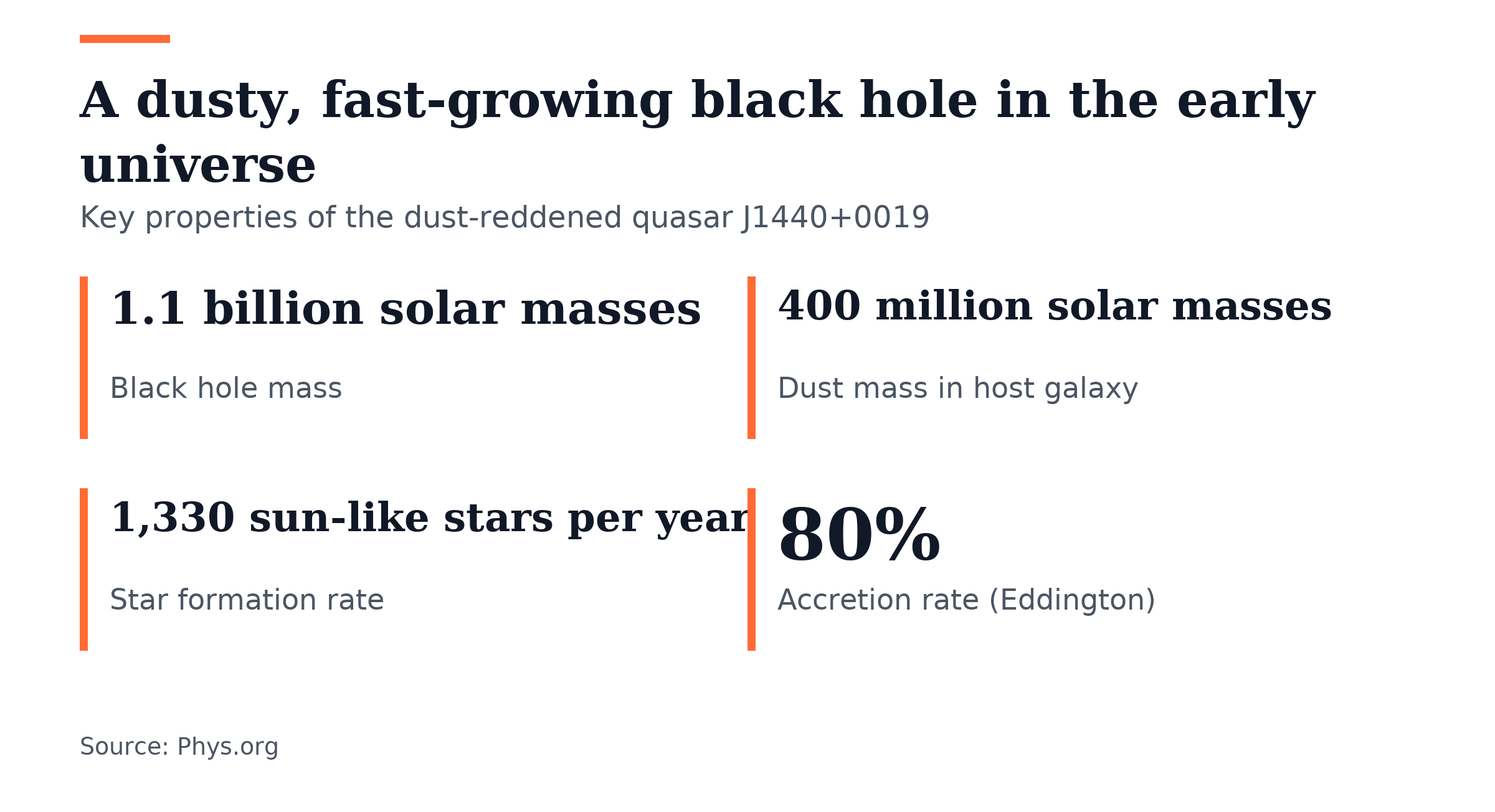
- The supermassive black hole in J1440+0019 has a mass of about 1.1 billion solar masses.
- The spectrum shows three high-ionization absorption systems that are blueshifted compared with the component moving away, at estimated speeds up to 3,600 kilometers per second, a sign of fast nuclear outflows.
- Once corrected for dust, the quasar shines at roughly 80% of its Eddington luminosity, indicating a fast rate of material accretion.
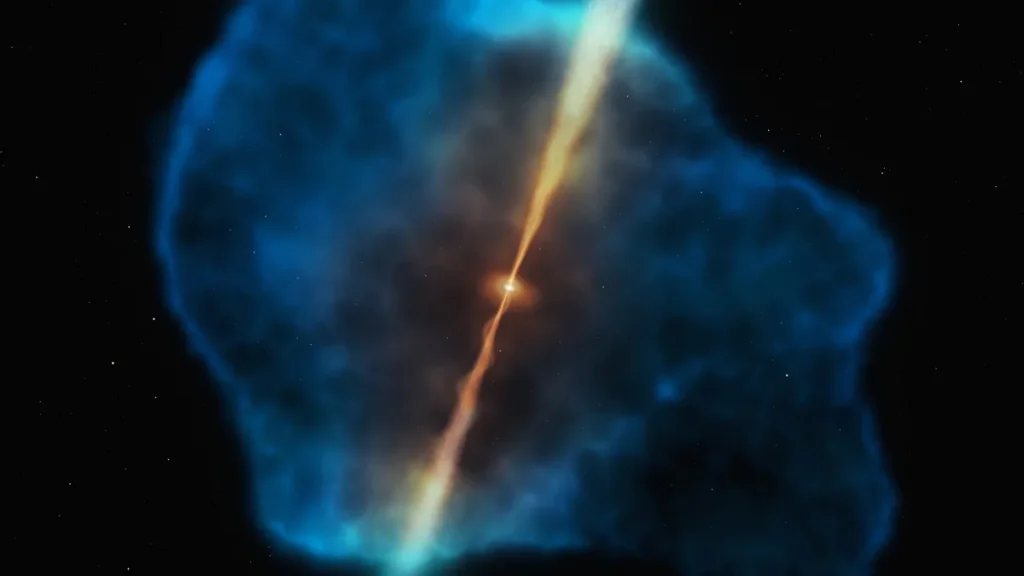
Researchers using JWST and ALMA have identified a dust-reddened quasar called J1440+0019 at redshift 6.5488, from a time when the universe was less than one billion years old, according to work posted to arXiv on Oct. 9.
The black hole holds about 1.1 billion solar masses and shines at roughly 80% of its Eddington luminosity after dust correction, indicating rapid accretion, researchers say.
The team, led by Daming Yang of the Leiden Observatory, posted the paper under the title A dust-reddened quasar in a [C II]-luminous host at z=6.55, with DOI 10.48550/arxiv.2610.13758, to the arXiv preprint server. The object had already turned up in the Subaru High-z Exploration of Low-Luminosity Quasars survey, known as SHELLQs. For this work, the researchers paired JWST NIRSpec spectroscopy of the quasar’s nucleus with ALMA observations of cold gas and dust in the host galaxy, an approach that let them study both the nucleus and its surroundings.
The central black hole weighs about 1.1 billion solar masses and is rapidly accreting material, according to the paper. A quasar is the bright center of an active galactic nucleus, powered by a supermassive black hole. The measurement comes from the arXiv paper posted on October 9 by Daming Yang and colleagues. After dust corrections, the quasar shines at about 80 percent of its Eddington luminosity, the ceiling on brightness for a black hole pulling in gas.
Measurements of the spectrum match dust reddening and reveal prominent emission lines together with obscuration, which the team reads as a nucleus viewed directly through moderate dust along the line of sight. They categorize the object as a red type-1 quasar, meaning a direct view of the nucleus through moderate dust extinction. Most quasars from this era are found through ultraviolet light, which dust can block, making this dust-reddened object significant because it would be missed by standard searches.
The spectrum also shows three high-ionization absorption systems. These are shifted toward the blue relative to the component moving away, and gas in them moves at estimated velocities reaching as high as 3,600 kilometers per second. Those blueshifted features indicate material moving toward us, and the high speeds point to powerful outflows from the black hole region.
Observations from ALMA show the host galaxy glowing brightly in ionized carbon emission, placing it in the top group of bright sources of this kind past redshift 6. Ionized carbon is a tracer of cold gas in the galaxy. The galaxy’s dust reservoir comes to an estimated 400 million solar masses. Star birth there tops out at roughly 1,330 sun-like stars per year.
The dust reddening around the core looks like that of moderately reddened quasars in the local universe, but the large dust reservoir is more like heavily reddened systems. Researchers compare the object to both local and early-universe reddened quasars, noting it mixes characteristics from different populations. Comparing this source with other early-universe reddened quasars turned up both similarities and dissimilarities. The researchers conclude that red and obscured sources cover a range of accretion states and host properties.
Just 5.5 minutes of ALMA observing time were enough to detect the main gas and dust tracers. The team says this short observing time shows that dust-rich systems can be found efficiently with modest ALMA resources. The scientists suggest brief ALMA observations could flag targets for more detailed follow-up.
The scientists argue that brief observations can flag strong reddened-quasar candidates for later spectroscopy, making large surveys practical. They expect Euclid and Roman to gather a larger sample of reddened quasars and close the observational gap.
Estimates place cosmic reionization roughly from 600 million to one billion years after the Big Bang, across redshifts 6 to 8. This was the epoch when early stars and galaxies ionized the universe’s neutral hydrogen. During that epoch, ultraviolet light from early stars and galaxies ionized neutral hydrogen gas into the state seen today, a process that defines cosmic reionization.
Astronomers typically find quasars from this era using bright rest-frame ultraviolet light, but even modest dust reddening can heavily block that UV emission. Past studies suggest many early active galactic nuclei are hidden, while just a few reddened quasars have been found at redshifts near 6 or higher. That means dust-obscured quasars may be missing from standard ultraviolet-selected samples, which is one reason searches like this one matter.
The discovery speaks to a longstanding puzzle: how objects millions or billions of times as massive as the Sun came to exist under 600 million years after the Big Bang. New supercomputer modeling indicates that the small red objects JWST observed could be rapidly growing black holes from the early cosmos. A team led by Sunmyon Chon used the ATERUI III supercomputer to model how gas clouds in the early universe could form supermassive stars instead of many smaller stars. JWST was expected to help solve this mystery by observing faint, distant galaxies.
Strong far-ultraviolet radiation from nearby galaxies can prevent ordinary star formation in some gas clouds, letting the gas collapse into a single giant star that becomes a black hole seed. A black hole seed is the initial mass from which a black hole grows. After the seed forms, the black hole can sit inside a thick disk of dense gas. That disk traps radiation and lets the black hole consume material far more efficiently than today.
In such environments, black holes can grow at speeds dozens of times greater than modern limits. The simulations show these gas-rich conditions came about naturally in the young cosmos, without exotic assumptions or rare coincidences. The simulations show gas-rich environments around black hole seeds enable unusually efficient growth in the young universe.
The simulated black holes look much like the Little Red Dots that JWST observed, suggesting these red objects may be an early stage of rapid black hole growth. Little Red Dots are small, red objects seen in JWST images of the early universe. JWST first saw these strange ruby specks when it began its early universe observations in 2022, and astronomers have puzzled over them since.
A team looking at an extraordinarily bright little red dot called MoM-BH*-1 says it may be an unknown kind of celestial object: a black hole star. Researchers describe it as a black hole driving a cloud of hot gas that shines in a star-like way. Analyses suggest the object is a black hole 100,000 times as massive as the sun. It sits inside a thick star-like cocoon of hydrogen gas about as large as the solar system, based on computer simulations.
Commentators Dominik Schleicher of Sapienza University of Rome and Rodrigo Herrera-Camus of the University of Concepción say gas effects explain the object’s red color with only a negligible dust contribution. They wrote a commentary accompanying the Nature paper.
Rohan Naidu, a co-author at the University of Hawaii, says each red speck matches a black hole star inside an ordinary early galaxy. MoM-BH*-1 stands out because its black hole star vastly outshines the host galaxy. Naidu said, “MoM-BH*-1 is one in a billion!”


Join the discussion