Key facts
- Iizawa's team used magnetic helicity, which measures twisting, looping, and linking of magnetic field lines, to study the solar wind interface.
- Iizawa's team found that Parker Solar Probe high-resolution magnetic readings showed normalized magnetic helicity density spectra with a pair of counter-rotating helical peaks near the ion kinetic interface.
- The reversal in magnetic field rotation coincides with the transition where plasma shifts from fluid-like collective behavior at larger scales to individual particle-driven behavior at smaller scales.
- The Sun's corona reaches millions of degrees while its visible surface, the photosphere, is about 10,000 degrees Fahrenheit, a discrepancy known as the coronal heating problem.
Researchers led by Masatomi Iizawa at the Technical University of Braunschweig published a paper in The Astrophysical Journal Letters on the solar wind’s plasma-ion interface, Universe Today reported. The team found counter-rotating helical peaks near the ion kinetic interface using high-resolution magnetic readings from NASA’s Parker Solar Probe. Universe Today reported the study Oct. 26, 2026, and Knowridge Science Report published its account Oct. 16, 2026.
Magnetic helicity measures the twisting, looping, and linking of magnetic field lines, and its handedness describes whether a twist runs clockwise or counter-clockwise. In the Sun’s chaotic magnetic field, handedness normally washes out without strongly affecting the solar wind. Iizawa’s team found the property emerging at the boundary between fluid and particle physics.
The helical signal showed frequencies biased lower than expected, a feature the researchers call nonlocal evolution. Scientists expect twists to form nearby with frequencies matching their local plasma environments. Parker’s data indicated instead that the twists couple with structures spanning many size scales, from particle ripples to large fluid plasma motions.
The study links the twists to the helicity barrier, where handed turbulent plasma blocks energy at the ion boundary between fluid and particle plasma. That blockage forces twists into larger structures seen as giant switchbacks in the corona. Once the solar wind crosses the heliospheric current sheet, a membrane separating opposite magnetic polarities, that crossing compromises the stream’s structure and the helical signature vanishes.
When viewed outward from the Sun, magnetic fields rotate counterclockwise at larger scales and clockwise at smaller scales, according to Knowridge Science Report. The reversal grows stronger and shifts to longer wavelengths as the wind moves away.
The reversal coincides with the transition where plasma shifts from fluid-like collective behavior at larger scales to individual particle-driven behavior at smaller scales. Solar eruptions create shock waves and magnetic structures that turbulence can affect, so the reversal provides a measurable feature space plasma theories must account for instead of treating fluctuations as wholly random.
Researchers say the observations still lack a full explanation of turbulent energy sharing and a completed forecasting tool for magnetic storms. Further work must establish how the pattern operates under different conditions.
The Sun’s corona reaches millions of degrees while its visible surface, the photosphere, is about 10,000 degrees Fahrenheit, a discrepancy known as the coronal heating problem. For decades, solar physicists have used two competing methodologies to model the solar wind.
Magnetohydrodynamics treats the wind as a conductive fluid for large-scale interactions, while the other framework models individual charged ions spinning around magnetic field lines on a granular scale. The fluid and particle frameworks do not combine well, like quantum mechanics and relativity.
That leaves a large gray area around the interface between large-scale hydrodynamic plasma properties and microscopic ion properties. Scientists believe understanding large-scale solar features, including why the corona is hotter than the surface, may rely on knowledge of that interface.
Magnetic helicity’s handedness feature plays a crucial role in understanding the fluid-particle interface, though in the Sun’s magnetic chaos those properties typically wash out with no big impact on solar wind structure.
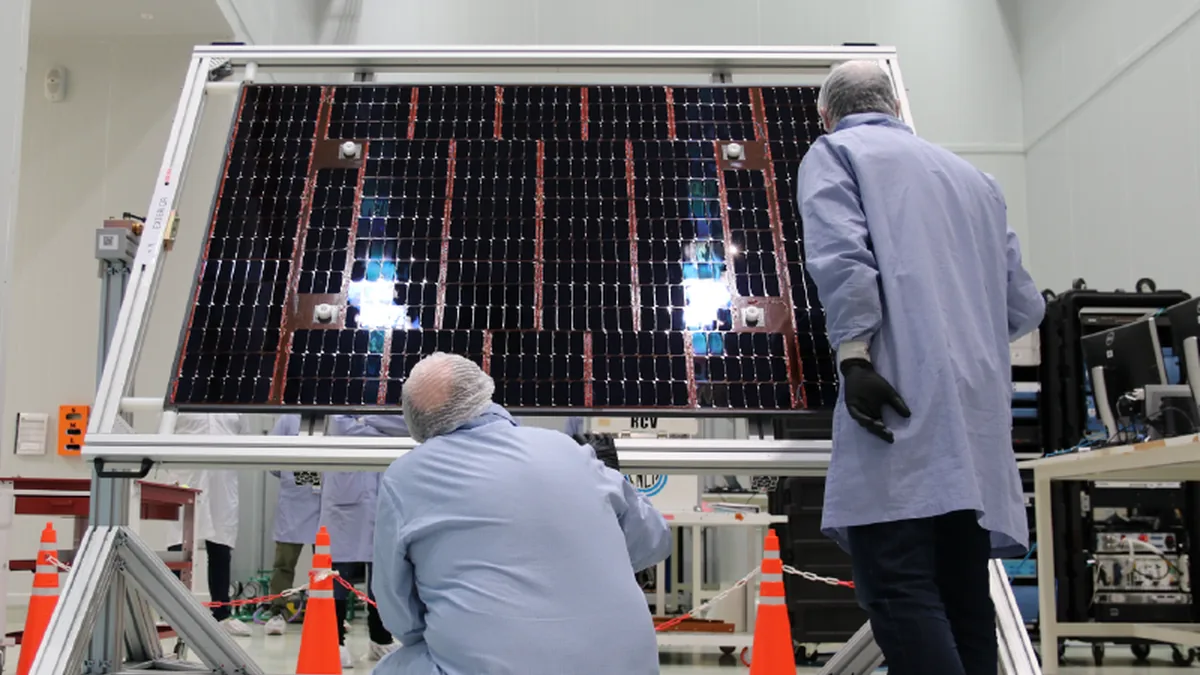
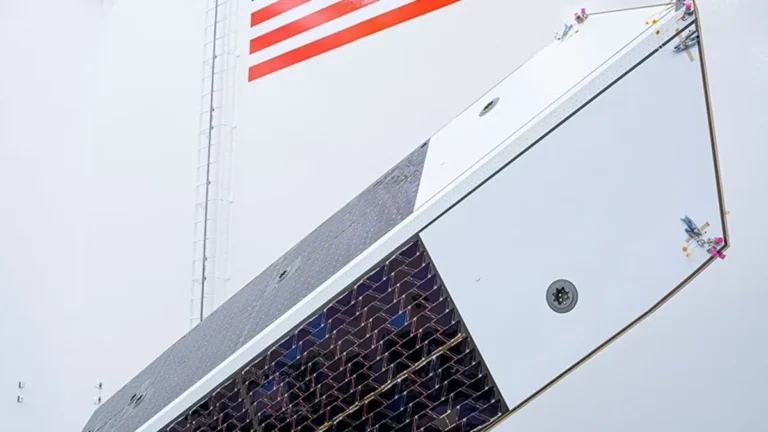
Parker Solar Probe will settle into an orbit with perihelion at 3.9 million miles from the Sun’s visible surface, more than seven times closer than earlier spacecraft, and will plunge into the corona 24 times. The probe launches on a Delta IV Heavy, uses Venus gravity assists, and reaches a top speed of 430,000 mph behind a 4.5-inch-thick carbon-composite sunshield while experiencing 475 times Earth’s solar radiation.
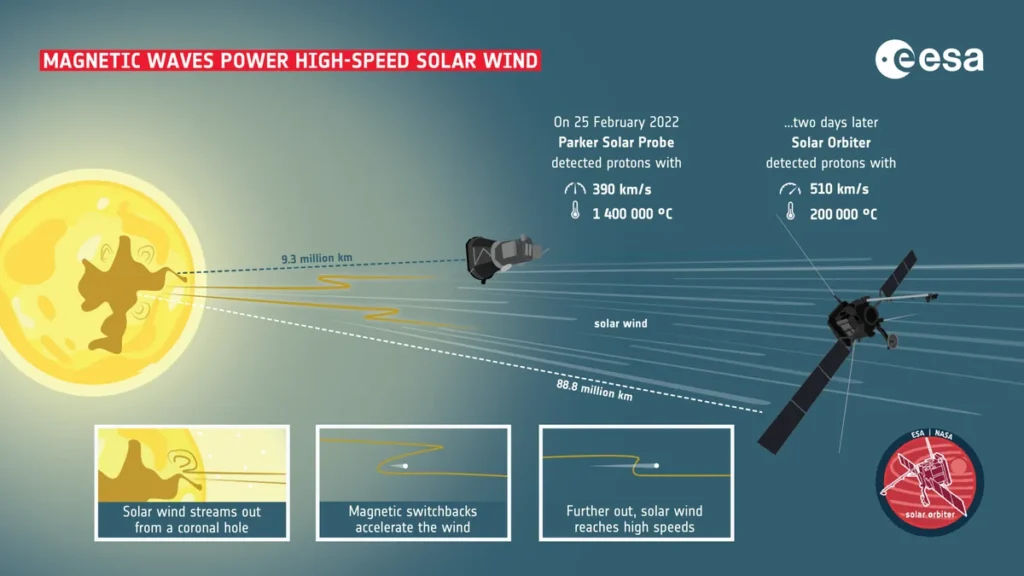
Parker Solar Probe will fly directly into the corona, the only region of the solar system unexplored by spacecraft, and its dynamics affect Earth. The spacecraft will measure the direction and strength of plasma waves, the speed and density of particles from lowest-energy to most energetic protons, and watch the solar wind rev up to supersonic.
Data from the Parker Solar Probe and Solar Orbiter have helped scientists map the Sun’s chaotic magnetic environment somewhat better. Solar Orbiter, a joint NASA-ESA mission, will launch the following year to fly close to the Sun, study its interior, and provide close-up views of its polar regions. As Parker continues its mission, scientists expect other insights into solar turbulence, though full understanding may not come even in Parker’s lifetime.
The solar wind shapes conditions around Earth and can influence space weather. Solar wind from the corona crosses 93 million miles of space to create auroras in Earth’s magnetosphere. Understanding space weather is crucial for safeguarding Earth’s economy and future missions to other planets.
Coronal mass ejections can interfere with satellites, ground communications, and power networks, cause blackouts, and shower airplanes and spacecraft with dangerous radiation. Severe CME events can be catastrophic for spacecraft and humans in orbit. CME material takes hours or days to travel from the Sun to Earth, and no one knows why the Sun spews them or can reliably predict them.
Eugene Parker coined the term solar wind in a 1958 paper describing the outflow as plasma, magnetic fields, and energetic particles. His theory was vindicated in 1962 when Mariner 2 observed the supersonic solar wind, and his computations showed the corona’s gas must flow away from the Sun extremely quickly and would still be supersonic at Earth. Parker also predicted the twisted shape of the rotating Sun’s magnetic field, now called the Parker spiral.
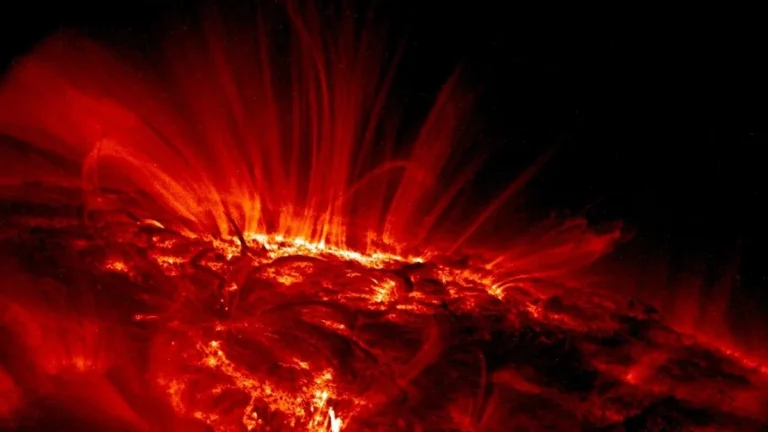
Separate research using pictures from Earth-orbiting IRIS and AIA found low-lying magnetic loops heated to millions of degrees Kelvin. A paper funded by NASA appeared in Nature Astronomy describing brightenings in loops where magnetic fields reconnected, with spectra showing oxygen and heavier silicon ions. Stephen Bradshaw of Rice University, Shah Mohammad Bahauddin of the Laboratory for Atmospheric and Space Physics at Colorado, and Amy Winebarger of NASA examined IRIS images of transition loops.
The team analyzed ionic movements and temperatures using spectral lines that act as chemical fingerprints. Reconnecting jets at hot spots contained silicon ions moving toward or away from IRIS at velocities up to 100 kilometers per second, and this Doppler shift was not detected for lighter oxygen ions. Silicon ion spectral lines were much broader than oxygen ion lines.
The transition region is only about 10,000 degrees Fahrenheit, but convection twists and braids thin magnetic strands, adding energy that heats the plasma. The IRIS observations showed magnetic reconnection taking place, and the jets are a key signature of that process. Magnetic fields of plasma strands rupture and reconnect at braiding spots into lower energy states, releasing stored magnetic energy where plasma becomes superheated.
In the solar wind, heavier ions are hotter than lighter ions. The study shows for the first time that heavier-ion heating is also a property of the transition region and might persist throughout the atmosphere, including heating the corona. Bradshaw, Bahauddin, and Winebarger hope more IRIS data will allow them to craft a concise global theory. “It’s in the emission lines where all the physics is imprinted,” said Bradshaw.
Nobody knows why the Sun’s magnetic dynamo flip-flops roughly every 11 years, and no one knows precisely how or why the solar wind forms. No one knows how the solar wind produces 6,000-mile-long jets called spicules. Competing ideas for coronal heating include plasma waves, magnetic braids snapping like rubber bands, and heat bombs or nanoflares.
Parker data should provide better data for space weather forecasting models and may pinpoint causes of CMEs. Studies like this one and Parker data are letting scientists see the structure of the Sun’s chaos more than ever before.




Join the discussion