Key facts
- The calculated prokaryote abundance is 6 × 10^8 microbes per milliliter of inclusion brine, so a 1-centimeter halite cube with 1 percent fluid inclusion volume contains six million trapped microbes.
- Cultivation of prokaryotes from fluid inclusions occurred in only 0.4 percent of the crystals tested.
- Modern prokaryotes are straight or curved rods 1 to 10 micrometers long and about 0.5 to 1 micrometer wide, or coccoid about 1 micrometer in diameter.
- Modern halite crystals spiked with 1.5, 3.0, and 4.5 nanograms of human DNA showed constant DNA yields after surface sterilization regardless of spike amount, with about an 80 percent decrease from unspiked crystals.
Researchers are examining reports that viable microorganisms have been recovered from halite (rock salt) deposits tens to hundreds of millions of years old, including the Salado Formation in New Mexico and sites in Death Valley and Saline Valley, California, Astrobiology Web reported Oct. 23, 2026.
The most prominent case involves a Permian bacterium from the Waste Isolation Pilot Plant site in the Salado Formation of New Mexico, recovered from a brine inclusion inside a large halite crystal and claimed to be 250 million years old, though its age is disputed. The biological science community maintains that DNA should degrade over time scales far shorter than 250 million years without a repair mechanism, citing research published in 2004 and 2005. Several putatively ancient isolates or sequences closely resemble modern organisms despite host-rock ages of tens to hundreds of millions of years.
Reports of extreme microbe longevity in salt remain controversial, according to Astrobiology Web and the Geological Society of America. Over the past 50 years, papers have claimed long-term survival of prokaryotes in buried salt deposits, in some cases for more than 250 million years. No single explanation currently accounts for all reported observations and their uneven evidentiary quality. Astrobiology Web said, “Reports of viable microorganisms from ancient halite create an unusual test of the biological limits of cellular survival.”
Researchers frame the question as relevant to astrobiology and biomedical science, asking how long a cell can preserve molecular integrity when metabolism, repair, and replacement approach lower limits, and as complementary to the search for microbial life elsewhere in the solar system. Possible explanations for the reports include contamination after sampling, later recrystallization, groundwater entering the crystal, cells surviving in a low-activity state, and conserved markers such as 16S rRNA (a gene used to compare microbial relatedness) understating how much genomes have diverged.
The geological age of a halite crystal or fluid inclusion (a tiny pocket of trapped liquid) does not by itself establish the age of a recovered organism, leaving both modern contamination and uninterrupted geological survival difficult to confirm. Studies with careful controls have applied chemical surface sterilization, chosen primary crystals using petrography, and sampled primary fluid inclusions directly to cut modern contamination.
A robust surface sterilization protocol using a 10-normal hydrochloric acid soak, sodium carbonate neutralization, a 6 percent sodium hypochlorite soak, and four rinses in halite saturated brine consistently removed contaminating surface DNA. Non-overlapping algal genera across four Saline Valley samples are consistent with effective surface sterilization rather than persistent modern contaminating DNA.
Fluid inclusions in modern and ancient buried halite from Death Valley and Saline Valley, California, contain an ecosystem of salt-loving prokaryotes and eukaryotes, some of which are alive, with host rocks dating to tens of thousands of years. A March 2004 bloom of planktonic halophiles in Saline Valley contained Dunaliella and many heterotrophs in bright red brines at salinities of 26 to 30 percent, seven to eight and a half times more concentrated than seawater.
When Saline Valley surface brines evaporated to salinities greater than about 30 percent during March 2004, halite saturation was reached and crystals nucleated at the air-brine interface, forming floating rafts, while vertically oriented crystals grew off the brine bottom. Microscopic study of more than 1,000 brine inclusions from 10 halite-crust crystals showed more than 20 percent contained prokaryotes.
The calculated prokaryote abundance is 6 × 10^8 microbes per milliliter of inclusion brine, so a 1-centimeter halite cube with 1 percent fluid inclusion volume contains six million trapped microbes. Prokaryotes trapped in Saline Valley halite for up to 15 years can be readily cultured when placed in nutrient-rich media.
Cultivation of prokaryotes from fluid inclusions occurred in only 0.4 percent of the crystals tested, derived from five successful Death Valley cultures out of about 900 crystals and none from more than 500 Saline Valley crystals. DNA from the five cultured organisms from the Death Valley core shows they are halophilic Archaea from the genera Haloterrigena, Natronomonas, and Halorubrum. All halophilic Archaea cultured from the Death Valley core came from one stratigraphic interval where prokaryotes and Dunaliella were observed in situ within fluid inclusions.
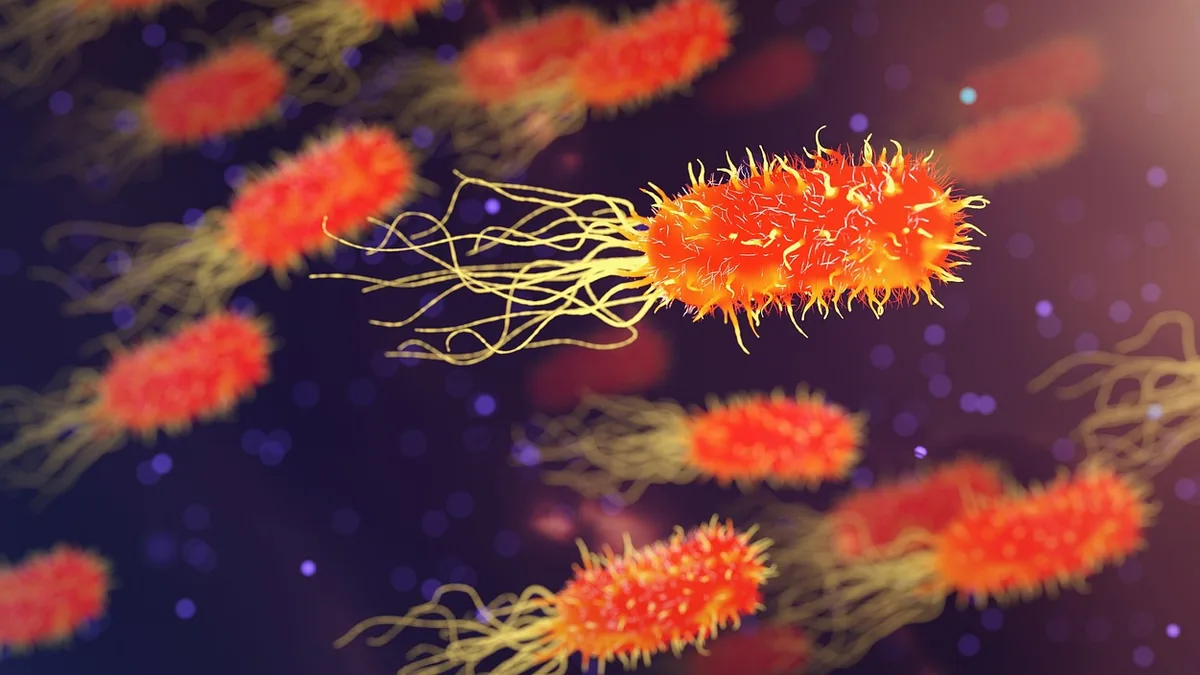
Modern prokaryotes are straight or curved rods 1 to 10 micrometers long and about 0.5 to 1 micrometer wide, or coccoid about 1 micrometer in diameter. Some prokaryotes under nutrient-poor conditions adjust by rounding from rod-shaped to coccoid-shaped and reducing their size, a known starvation-survival response. Trapping halophilic Archaea in nutrient-free fluid inclusions in experimentally grown halite led to rounding and cell-size reduction over weeks to years.
Lowenstein et al. (2001) state that certain ancient bedded halite and the brines and microorganisms trapped within it have remained undisturbed for millions of years. The brine inclusion holding the well-known Permian bacterium could have been trapped after the Permian during burial cementation and recrystallization, though later study shows the WIPP fluid inclusions most likely contain evaporated Permian seawater, supporting their 250-million-year age. DNA from the Permian bacterium is nearly identical to modern Virgibacillus marismortui from the Dead Sea, which suggests to some that the Permian bacterium is a laboratory contaminant.
Subsurface habitats including sub-seafloor sediments and continental and oceanic crust contain microbes at depths reaching roughly 3 kilometers. Prokaryotes in ancient salt deposits survived in brine-filled fluid inclusions isolated from surrounding pore- and fracture-filling waters.
Modern surface sterilization protocols render surface microbes non-viable but have not been fully evaluated for complete removal of contaminating surface DNA, which is crucial for PCR-based (a method that amplifies DNA for analysis) genetic diversity studies. Existing protocols including Vreeland et al. (2000) and Fish et al. (2002) fail to completely remove spiked human DNA, and a bleach wash was required to completely destroy surface DNA.
Modern halite crystals spiked with 1.5, 3.0, and 4.5 nanograms of human DNA showed constant DNA yields after surface sterilization regardless of spike amount, with about an 80 percent decrease from unspiked crystals. A second round of booster PCR detected no amplification from surface-sterilized crystals, confirming the absence of even trace amounts of spiked human DNA.
The desalting protocol using Amicon centrifugal filters followed by Qiagen spin column purification gave the best DNA yields, averaging 0.29 nanograms with about 17 percent variance. Amicon centrifugal filters retain only molecules larger than 50 kilodaltons and DNA fragments longer than 50 base pairs, providing more than 10-fold DNA concentration increase while reducing salt from about 1 molar to less than 20 micromolar.
Older halites up to hundreds of millions of years old, including the Salado salt of New Mexico at 250 Ma, the Wellington Formation of Kansas at 277–283 Ma, and the Silurian Salina Salt of Michigan at 416–418 Ma, allow study of DNA preservation in deep geological time. Modern halite crystals were sampled from Saline Valley surface deposits collected in 2004 and 2007, while older samples came from core SV-4A at depths of 21.3 meters (~36 ka), 43.9 meters (~64 ka), and 91.5 meters (150 ka).
Join the discussion