Key facts
- Flare ribbons, formed by plasma and high-energy particles slamming back into the Sun’s chromosphere during reconnection, can serve as a diagnostic tool for studying hidden magnetic explosions in the corona.
- A study in The Astrophysical Journal found that flare ribbons break into fragments of varying sizes, depositing energy in bursts rather than uniformly during an M6.5-class solar flare on June 22, 2015.
- Researchers demonstrated that the complexity of flare ribbons increases with the reconnection rate, confirming simulations that predicted this behavior for the first time through observational data.
- Flare ribbons deposit energy in the chromosphere in irregular patterns, with smaller details revealing the structure of the energy conversion region in the corona.
A study led by Marcel Corchado Albelo, with Maria Kazachenko as co-author, published in The Astrophysical Journal in 2026, shows that flare ribbons can serve as a diagnostic tool for hidden magnetic explosions in the Sun’s corona.
Flare ribbons form when plasma and high-energy particles slam back into the chromosphere during magnetic reconnection, creating bright patches that reveal clues about the structure of the energy conversion region in the corona. The ribbons follow magnetic field lines and light up brightly upon collision with the chromosphere. Because the corona is difficult to observe directly due to the Sun’s glare, these visible ribbons provide a critical trace of reconnection events that would otherwise remain hidden.
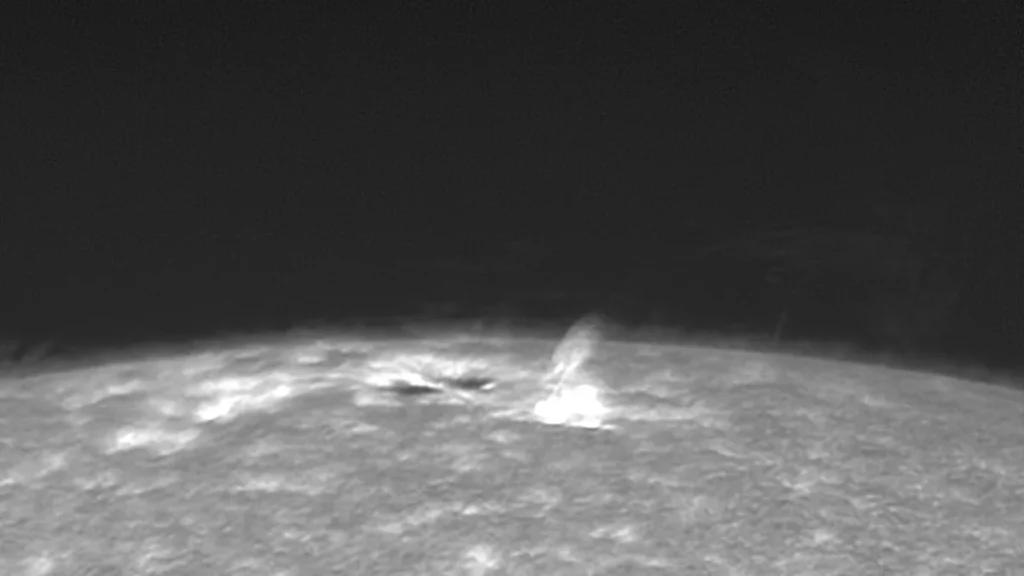
The team studied an M6.5-class solar flare observed on June 22, 2015, by NASA’s Interface Region Imaging Spectrograph, a spacecraft launched in 2013. Astrophysicists classify solar flares by X-ray brightness into categories A, B, C, M, and X, with each letter representing a tenfold increase in energy output. The classification system helps quantify the energy released during solar flares, which can range from relatively minor to extremely powerful events. These explosions release energy equivalent to the simultaneous detonation of millions or even billions of hydrogen bombs, making them the most powerful explosions in the solar system.
This immense energy release dwarfs other terrestrial and cosmic events, such as supervolcano eruptions and asteroid impacts.
In the 2015 event, the flare ribbons broke into fragments of varying sizes and deposited energy in bursts rather than uniformly. Smaller details within the ribbons revealed the structure of the energy conversion region in the corona, showing that energy lands in irregular patterns across the chromosphere. The researchers tested their model against synthetic observations and validated their approach by comparing it to a real flare event recorded by IRIS. This provided direct evidence linking ribbon substructure to coronal reconnection processes.
Magnetic reconnection triggers solar flares, a process in which twisted and rotated magnetic fields snap and reconnect into a simpler, more stable configuration, releasing stored energy. This occurs in the corona, the outermost layer of the Sun’s atmosphere, where magnetic fields are highly dynamic and prone to sudden releases of energy. The Sun’s magnetic fields are constantly twisted and rotated, leading to reconnection events that release energy as solar flares.
The researchers adapted a novel tool from a different scientific field to quantify flare ribbon complexity, enabling the first observational confirmation of simulations predicting ribbon behavior. Simulations had predicted ribbon behavior but lacked observational confirmation. Corchado Albelo, a lead author of the study and an ambassador for the Daniel K. Inouye Solar Telescope, quantified the evolution of flare ribbon substructure to link it to magnetic reconnection dynamics in the corona. Corchado Albelo works with the U.S. National Science Foundation.
This interdisciplinary approach demonstrates how repurposing tools from unrelated fields can advance solar physics, providing a new method to study solar phenomena. Kazachenko, a co-author and scientist at the National Solar Observatory, described the study as the first quantitative observational test of simulations predicting flare ribbon behavior, emphasizing its collaborative and interdisciplinary nature. She also advises Corchado Albelo’s graduate work. Kazachenko highlighted the study’s significance in bridging theory and observation, noting that the adapted tool used by Corchado Albelo confirmed long-standing simulations about ribbon complexity and reconnection rates.
"It's a beautiful example of theory, observation, and collaboration coming together…"
Maria Kazachenko, Universe Today
The study, titled Evolution of Spatial Complexity in Flare Ribbon Substructure and Its Relationship to Magnetic Reconnection Dynamics, marks a milestone in solar physics by experimentally confirming a relationship only theorized in simulations. Corchado Albelo developed a novel method to measure flare ribbon complexity, adapting tools from another field to analyze how ribbon fragmentation correlates with reconnection processes. The publication in The Astrophysical Journal in 2026 builds on simulations that lacked observational confirmation.
Flare ribbon substructure can serve as an observational proxy for current-sheet fragmentation in the corona, offering insights into otherwise hidden magnetic processes. The study authors state that this substructure can serve as a unique diagnostic tool for physical processes in the flare current sheet, the region where reconnection occurs. This finding is critical for solar physics because it provides a tangible method to study coronal reconnection indirectly through observable flare ribbons, which are easier to study than the corona itself. The diagnostic potential is significant because it allows scientists to infer complex coronal processes indirectly through observable patterns in flare ribbons.
Solar flares can disrupt Earth’s technology by causing radio blackouts, GPS inaccuracies, satellite malfunctions, and power grid failures, particularly when accompanied by coronal mass ejections. These disruptions occur when flares and coronal mass ejections interact with Earth’s ionosphere and magnetic field, affecting critical infrastructure and communications systems. The study does not enable direct forecasting of solar flares but contributes to understanding how flares release energy, potentially improving future models. While the research provides insights into the physical processes of solar flares, it does not currently offer a method to predict when or where the next flare will occur.
A separate study published in Philosophical Transactions A suggests the Sun has the potential to produce a superflare, an event 100 to 10,000 times more powerful than a normal solar flare, though such events are extremely rare. The study analyzed historical solar events, including the Great Sunspot of 1947, which had the prerequisites for a superflare but did not trigger one, indicating the Sun’s latent capability. The Great Sunspot of 1947 covered 0.6% of the solar disk and measured roughly 40 times Earth’s diameter, placing it at the lower limit of the superflare regime.
The Carrington Event of 1859, known as history’s greatest solar storm, caused telegraph wires to catch fire and generated auroras visible near the equator. While the Carrington Event was historically significant, the Philosophical Transactions A study suggests the Great Sunspot of 1947 had even greater potential for a superflare.
Researchers found that larger active regions on the Sun produce larger flare ribbons, and flare energy scales with the size of the ribbon area. Data from NASA’s Solar Dynamics Observatory tested this correlation between 2010 and 2016, confirming the relationship between ribbon size and flare energy.
An artistic rendition by Corchado Albelo illustrates the connection between flare ribbon boundaries and the multi-layer reconnection site in the corona, highlighting how irregular shapes correspond to fragmented energy conversion regions. The illustration visually represents the study’s findings, showing how the structure of flare ribbons relates to the complex magnetic processes occurring in the corona during reconnection.



Join the discussion