Key facts
- The magnetic canopy above the quiet Sun contains many narrow thread-like features rather than a smooth, uniformly expanding structure.
- Sunrise-III measured magnetic fields within spicules near the solar limb and showed how field distribution changes with height above the visible edge of the Sun.
- The Sunrise-III project uses a one-meter telescope carried by a high-altitude balloon and operated from the stratosphere at roughly 35 kilometers above Earth during its 2024 flight.
- Quiet regions cover most of the Sun, contain generally weaker magnetic fields than active areas, and are difficult to measure from the ground because atmospheric turbulence blurs fine details.
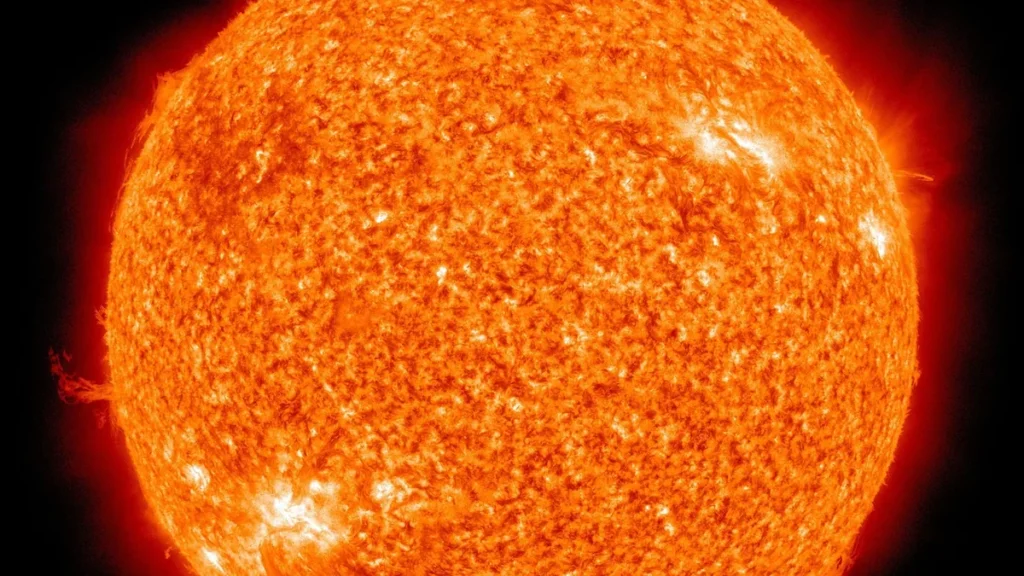
Researchers led by Japan’s National Astronomical Observatory flew the balloon-borne Sunrise-III telescope in 2024 and found thread-like magnetic features above a calm part of the Sun.
During a 2024 mission, the Sunrise-III project flew a one-meter telescope on a high-altitude balloon from the stratosphere, about 35 kilometers above Earth. The flight took the instrument above most of the atmosphere to reduce interference from atmospheric turbulence. The gondola carried three instruments from different countries, including SCIP, a near-infrared tool developed under the National Astronomical Observatory of Japan’s leadership.
The Sunrise Chromospheric Infrared spectropolarimeter, or SCIP, measures magnetic fields from the photosphere up through the chromosphere. The photosphere is the Sun’s visible surface, and the chromosphere is the layer of solar atmosphere just above it. A spectropolarimeter measures the polarization of light to infer magnetic properties. By observing these layers, the instrument captured magnetic conditions in the Sun’s lower atmosphere that ground-based telescopes struggle to resolve.
Quiet regions make up most of the Sun. They generally have weaker magnetic fields than active areas, and atmospheric turbulence blurs fine details, making them difficult to observe from the ground. Scientists describe comparatively inactive areas without sunspots as quiet, and these regions are especially important for understanding how the star behaves. Sunrise-III was designed to overcome that limitation by placing a telescope above most of the atmosphere during its stratospheric flight.
The magnetic canopy above the quiet Sun contains many narrow thread-like features rather than a smooth, uniformly expanding structure. The canopy forms as magnetic fields concentrated at the solar surface spread outward and arch upward into the chromosphere. Researchers found that the chromosphere contains many more complex magnetic features than a basic expanding canopy would show. That finding advances understanding of how magnetic activity heats the Sun’s atmosphere in calm areas.
Sunrise-III measured magnetic fields within spicules near the solar limb and showed how field distribution changes with height above the visible edge of the Sun. The solar limb is the visible edge of the Sun as seen from Earth. Spicules are narrow jets of solar material extending upward from the surface. For these measurements, the observatory examined another quiet region near the visible edge of the Sun.
Computer simulations matched the Sunrise-III patterns and showed that motions on the solar surface twist magnetic field lines to form the thread-like structures seen higher in the atmosphere. The findings point to surface motions as the force that twists field lines into the thread-like shapes seen above.
The paper appeared in The Astrophysical Journal Letters, volume 1008, issue 1, article L9, and carries the DOI 10.3847/2041-8213/ae909b. A DOI is a digital identifier that provides a persistent link to the scholarly article. The journal reference lists a large international author team. The National Institutes of Natural Sciences provided materials for the article.


Join the discussion