Key facts
- The U.S. Space Force posted a request for information on SAM.gov on Nov. 2, 2026, representing its first formal acquisition step for cislunar satellite operations.
- Maj. Gen. Stephen Purdy said the Space Force plans two near-future requests for information for cislunar technology and autonomous AI software, and wants capabilities fielded by the end of fiscal 2029.
- Maj. Gen. Stephen Purdy said China is moving out in the cislunar area while the United States has traditionally not done so.
- Defense Secretary Pete Hegseth said on Oct. 20 in Dayton, Ohio, that "[whoever] controls subsea and cislunar is going to destroy and control the next fight.".
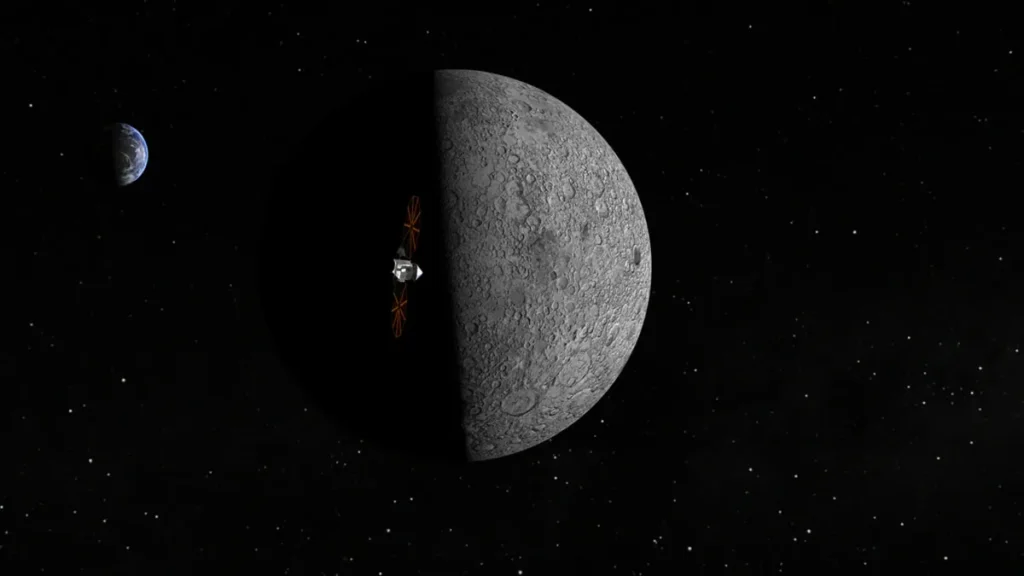
The U.S. Space Force posted a request for information on SAM.gov on Nov. 2, 2026, its first formal acquisition step for cislunar satellite operations—the region between Earth and the Moon—while China already operates the Queqiao-2 communications relay satellite in cislunar space.
The request asks industry for as many as five design contracts, potentially awarded in early 2027, before a down-select chooses the final constellation provider. The Space Force envisions satellites in orbit by late 2029 and initial operations in 2031.
Those five spacecraft would serve as an initial operational testbed, and the lessons from them would guide a later buying strategy for a bigger permanent constellation of still-undetermined size. The group is meant to be the smallest useful presence in the Earth-Moon corridor, showing that the concept works, checking orbital designs, and producing data that can only come from actual time in orbit.
The satellites would need onboard propulsion for station-keeping and orbital transfers, plus artificial intelligence and machine learning capability for autonomous mission execution. Space domain awareness, as defined in the request, means more than tracking where objects are; it includes intent attribution, or understanding why a spacecraft is maneuvering and telling a routine orbital adjustment apart from a hostile approach. Within the Earth-Moon three-body system, analysts consider just five points analytically stable, and those Lagrange points work as natural parking spots for surveillance craft and for opposing assets trying to keep their signature small.
Current American military watches extend only to about 36,000 kilometers around Earth, whereas the corridor to the Moon reaches roughly 385,000 kilometers and has no lasting American military surveillance presence. The volume of cislunar space is roughly 1,728 times larger than the volume inside geostationary orbit. All current American military sensors, from Space Fence on Kwajalein Atoll to the Ground-Based Electro-Optical Deep Space Surveillance network, were built for the tight conditions of Earth orbit and cannot watch the cislunar volume.
Radar strength drops by the square of the distance, so a target ten times farther away returns only one-hundredth of the signal energy, which weakens ground tracking past geostationary orbit. GPS signals fade below a functional threshold beyond approximately 36,000 kilometers, and there is no working cislunar positioning, navigation, and timing system yet, while the National Geospatial-Intelligence Agency develops a cislunar PNT framework.
A round-trip signal at lunar distance takes at least about 2.5 seconds, which rules out real-time human control for fast autonomous tasks. Forecasts from industry and government put roughly 30 moon-bound spacecraft moving through cislunar space from 2024 to 2030, in a region where the American military has no constant watch even as lunar traffic grows this decade. University of Texas at Austin researchers say tracking cislunar space properly needs space-based sensors plus advanced estimation algorithms built for the local gravity environment, and neither capability is operational today.
Beijing has fielded Queqiao-2, a cislunar communications relay satellite in a highly elliptical frozen orbit covering the lunar south pole, while Washington fields no declared military counterpart. China aims to land astronauts on the Moon around 2030 under the International Lunar Research Station program it runs with Russia. China also sent 30 Cubesats into a highly elliptical orbit close to an Earth-Moon Lagrange point and into a circular lunar orbit, the People’s Daily Chinese language version reported in September. That deployed asset gives China hands-on communications experience in the Earth-Moon system even as the service is still at the request-for-information stage for its first cislunar constellation.
Maj. Gen. Stephen Purdy said China is advancing in cislunar space while the United States has generally stayed away, and he called that the reason for the new buying push during remarks at the annual Space Industry Days conference in Los Angeles. The creation date of the Space Force’s Cislunar Coordination Office is disputed: he said it was established in May, while Tech Times reported it was established in April 2026. Jaime Stearns leads the office within Purdy’s portfolio, and the office manages cislunar policy, strategy, and buying across the service.
Purdy reports to Air Force Secretary Troy Meink and holds the title of Space Force Senior Advisor to the Secretary of the Air Force for Space Acquisition, a classified portfolio meant to enable joint warfighting systems. He has supervised over $24 billion in Space Force research-and-development spending since starting his current post in February 2026.
Two near-future requests for information are planned, one covering cislunar technology and the other autonomous artificial intelligence software, and the service wants capabilities in place by the end of fiscal 2029. Purdy said the service prefers not to spend research-and-development money and instead wants working equipment deployed by the fourth quarter of 2029. The first request will ask for off-the-shelf technology suited to early cislunar missions such as space domain awareness and positioning, navigation, and timing. The second request, expected at the same time or soon after, will seek artificial intelligence software enabling spacecraft to operate on their own between Earth and the Moon.
The office is building an early cislunar roadmap covering mission areas such as lunar time, space domain awareness, and communications, and it has assembled a prioritized list of unfunded requirements. Purdy said a couple hundred thousand dollars could solve many problems on that list, though he did not disclose the total funding needed, describing the amount as budget dust in space terms. He also said the military had signaled nothing to industry, so companies had pursued only their own interests, and his shop is supposed to send industry a clearer signal about what the military needs.
The Air Force Research Laboratory’s Cislunar Highway Patrol System, established in October 2020, has spent six years working on experimental spacecraft for cislunar space situational awareness under the name now used, the Oracle program. Oracle-M, which Blue Canyon Technologies is building, should arrive by the end of 2026 and fly in 2027. Oracle-P, also called Oracle Prime, aims for a 2027 launch.
An executive order from December 2025, “Ensuring American Space Superiority,” ordered the Department of Defense to build cislunar capabilities and gave top-level political backing to the programs the coordination office now runs. Purdy said the Office of the Secretary of Defense is starting interagency groups to set policy across agencies on cislunar issues. He also said the Space Force is coordinating infrastructure plans with NASA instead of building separate systems, reviewing NASA investments to find gaps where the Space Force can spend.
Defense Secretary Pete Hegseth said on Oct. 20 in Dayton, Ohio, that “[whoever] controls subsea and cislunar is going to destroy and control the next fight.” Officials at the senior defense level have increasingly described cislunar space as a coming battleground when the remark was made.
Maj. Gen. Stephen G. Purdy Jr. said at the Air Force Association’s AFCEA SPACE conference in October 2026 that the work will not take four or five years like a science project. General Dan Caine, chairman of the Joint Chiefs of Staff, said at the Air, Space and Cyber Conference that the Joint Force must learn to fight, survive, and prevail in contested settings worldwide from the ocean floor to cislunar space, where cislunar here means the Moon’s surface as well as lunar orbit. At that same event, Air Force Secretary Troy Meink said the United States already fields on-orbit weapons to control space and protect the Joint Force from hostile adversary moves.
The Fox News commentary author says China is going after American satellites in low and geosynchronous orbit, arguing that these satellites decide the fate of the U.S. military, economy, and country. The article also describes China’s space program as entirely military-run and says it wants control of near-space for both military and economic reasons.
Some experts estimate that the Moon’s surface contains millions of metric tons of helium-3 and that only 25 metric tons would power American energy needs for one year. Beijing’s lunar landers have already brought helium-3 samples back to its labs for study, showing China is not waiting to judge the Moon’s value for energy and economic security.
Starting in May 2022, the Space Force has called off or reorganized 14 major acquisition programs because they failed to perform. Until recently, the service saw cislunar space only as a possible future military theater, while research groups worked hard on the mission area without backing from the wider community because attention stayed on terrestrial support for warfighting. Maj. Gen. Stephen Purdy said the Air Force Research Laboratory, SpaceWERX, and DARPA have been experimenting with cislunar technologies albeit in a vacuum. A May 2026 Mitchell Institute analysis warned that China might gain strategic dominance over the Earth-Moon corridor if it sets up a lasting lunar presence before the United States can watch cislunar space.
Purdy said his office does not control every cislunar operation but provides money and backing, while teams that set requirements and handle acquisition still define mission needs and buy capabilities. That split makes Purdy’s office a funding and support coordinator instead of the only authority over cislunar requirements.




Join the discussion