
Key facts
- Lockheed Martin is now under contract for 124 space vehicles for the SDA’s Tracking and Transport Layer programs under the Proliferated Warfighter Space Architecture (PWSA).
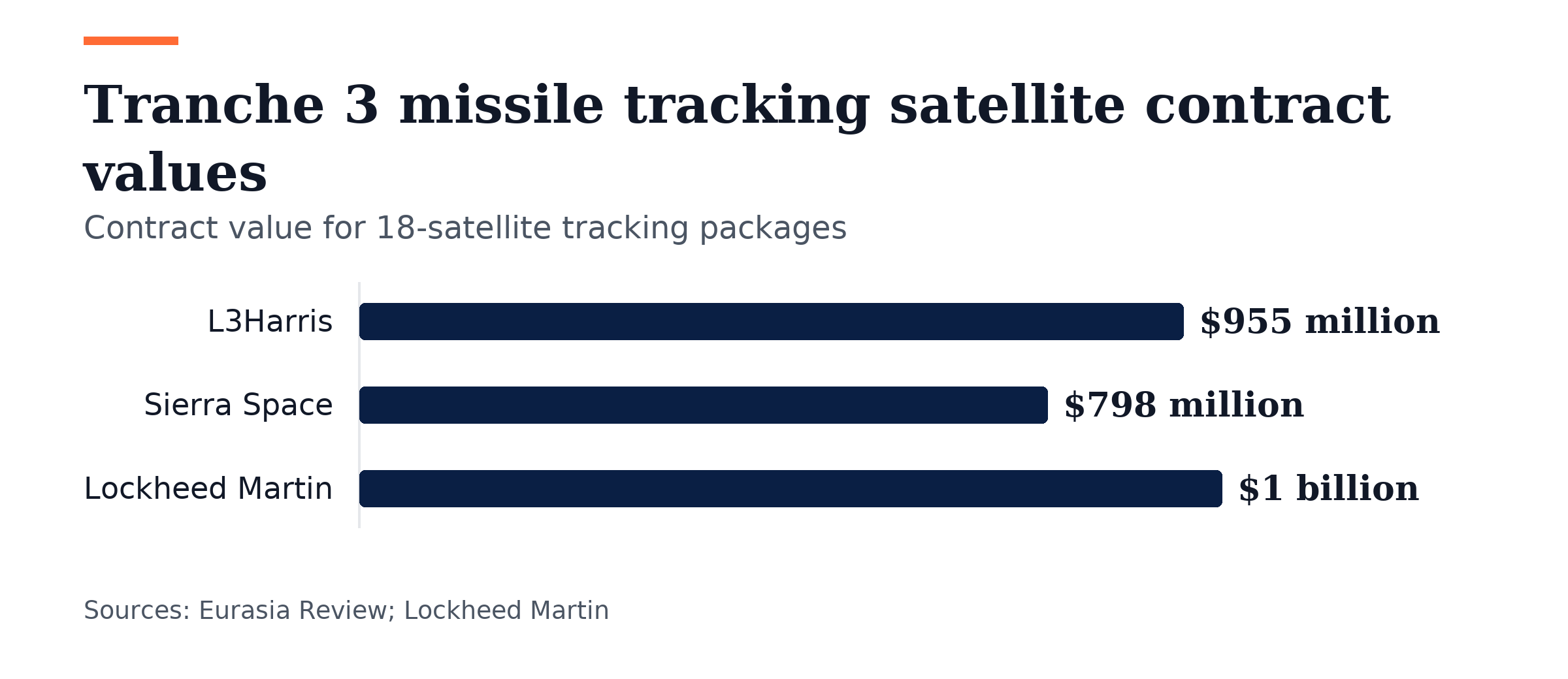
- L3Harris received a $955 million contract to build 18 hypersonic and ballistic-tracking missile defense satellites for the Golden Dome system.
- Sierra Space received a $798 million contract to produce 18 missile warning and tracking satellites for the Golden Dome system.
- Lockheed Martin expects to begin launching GPS IIIF satellites in 2027, with deployments continuing through the mid-2030s.
Lockheed Martin received a $514 million contract from the U.S. Space Force in June 2026 to build two GPS IIIF satellites, and the company also holds a December 2025 contract from the Space Development Agency worth more than $1 billion for 18 missile-tracking satellites.
The GPS IIIF satellites include Regional Military Protection capability, offering roughly 63 times greater anti-jamming capability than legacy GPS systems. The spacecraft will add encrypted M-Code signals for military users on land, at sea, and in the air, and carry a fully digital navigation payload to improve accuracy, signal strength, and reliability. Lockheed builds GPS IIIF satellites on its evolved LM2100 Combat Bus platform.
Lockheed expects to begin launching GPS IIIF satellites in 2027, with deployments continuing through the mid-2030s. A separate $105 million contract covers launch, early-orbit, and disposal support plus ground control infrastructure modernization, distinct from the satellite manufacturing award. The program runs under the original 2018 contract, which allows options for as many as 22 satellites.
The Space Development Agency awarded Lockheed Martin the December 2025 contract for 18 Tranche 3 Tracking Layer satellites, bringing the company’s PWSA work to 124 space vehicles across the Tracking and Transport Layers. The award follows Lockheed’s earlier Tranche 2 Tracking Layer work and stems from long-term investment in secure networks, test assets, and a small satellite production center. Lockheed will build the vehicles at its SmallSat Processing & Delivery Center in Colorado. “These innovative approaches position Lockheed Martin to meet the warfighter’s urgent need for a proliferated missile defense constellation,” said Joe Rickers.
In October 2025, the company put 21 Tranche 1 Transport Layer satellites into orbit, with another 21 in production for communication and data relay. Once deployed, defense units can use the Tracking Layer vehicles to turn targeting data into usable information. As of July 2026, the Space Development Agency reports 63 deployed Tranche 1 satellites out of roughly 155 planned, while Tranche 2 is in production with 270 satellites planned.
The agency awarded $1.75 billion in July 2026 for 36 Tranche 3 Accelerated Missile Defense satellites supporting Golden Dome, with L3Harris receiving $955 million for 18 satellites and Sierra Space receiving $798 million for 18. The full Tranche 3 will consist of 104 satellites, and initial December 2025 awards covered four companies including Lockheed Martin for 72 satellites total. The Space Force will operate and sustain the July batch, with deliveries supporting a planned 2028 launch. “With these awards, SDA is accelerating the deployment of the tracking layer,” said GP Sandhoo.
The Tracking Layer makes up a worldwide network of missile warning, tracking, and defense satellites with infrared sensing payloads linked by a low-latency communications system from low Earth orbit. Information from the satellites will travel directly over tactical data links instead of depending only on ground-based relay, and the agency described the architecture as seeking global stereo coverage. During June 2026, American forces ran a successful test of Golden Dome’s directed-energy system, which on its own found, aimed at, and stopped mock drones and cruise missiles.
Christina Mancinelli of Lockheed said the work will “ensure military users continue to have access to secure and resilient GPS capabilities.” The GPS IIIF program remains part of a broader modernization effort to improve navigation security for military and civilian users.

Join the discussion