
Key facts
- Blue Origin CEO Dave Limp announced Glenn Stage 3 (GS3) and the Northstar first-stage engine at an invite-only Up.Summit event at Kennedy Space Center on Nov. 5, 2026.
- GS3 can deliver up to 8 metric tons to geostationary orbit and 10 metric tons to trans-lunar injection on the 7×2 vehicle.
- GS3 is powered by the BE-7 engine, which Blue Origin also uses on its Blue Moon Mark 1 and Mark 2 lunar landers.
- Blue Origin said GS3 is not required for current astronaut Moon delivery plans but could support sustained lunar operations.
Blue Origin Chief Executive Dave Limp announced Glenn Stage 3 (GS3) and the Northstar first-stage engine on Nov. 5, 2026, at an invitation-only Up.Summit event at Kennedy Space Center.
Blue Origin designed GS3 for direct injection to geostationary orbit and Earth-escape trajectories. Blue Origin positioned GS3 as an expansion of New Glenn performance for high-energy orbits without changing how customers integrate payloads.
On the super-heavy 9×4 vehicle, GS3 can deliver up to 14 metric tons to geostationary orbit and 20 metric tons to trans-lunar injection. These figures describe the super-heavy 9×4 configuration paired with the new third stage.
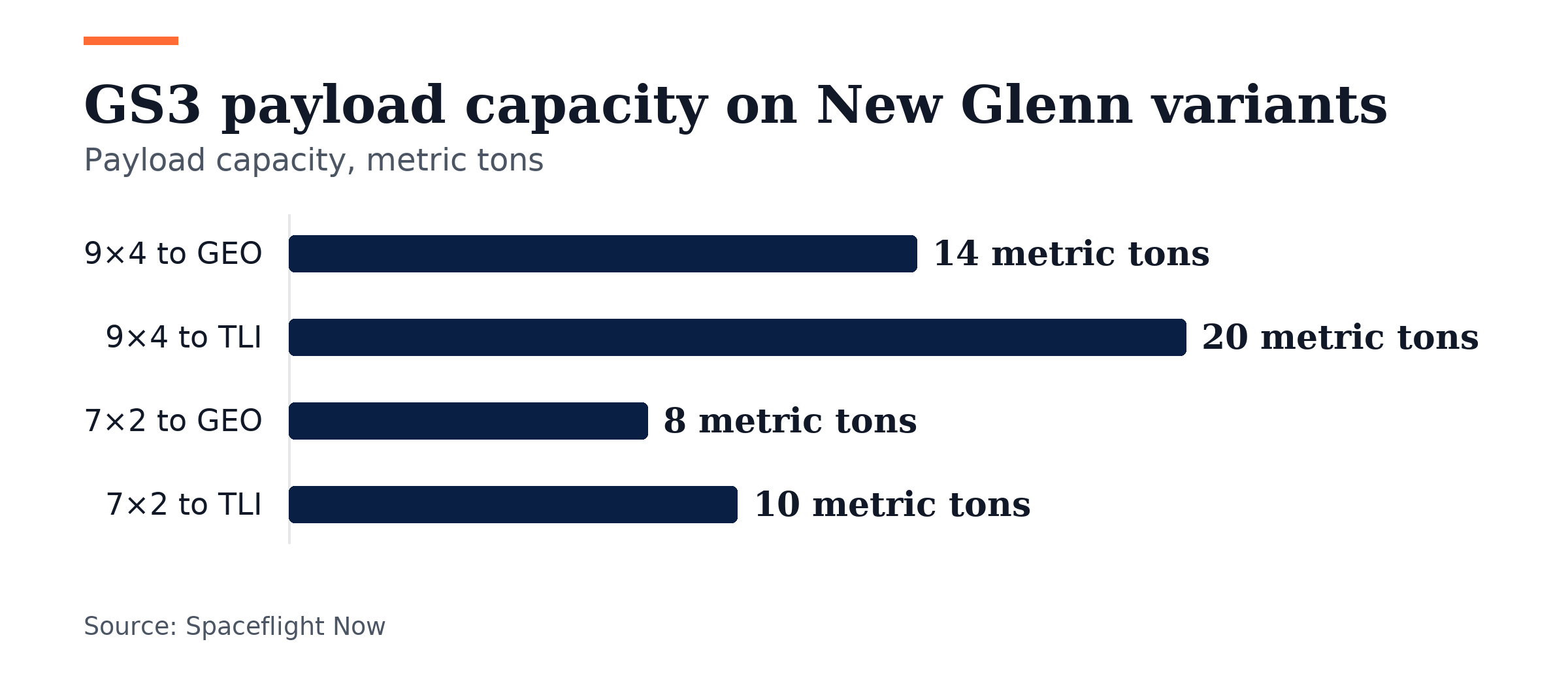
On the standard 7×2 vehicle, GS3 can deliver up to 8 metric tons to geostationary orbit and 10 metric tons to trans-lunar injection. GS3 uses the same fixed payload adapters and payload fairing as the two-stage vehicle, preserving full fairing volume for customer payloads.
The stage is integrated within an interstage and builds on proven New Glenn hardware to expand performance without changing the customer payload experience. The stage is powered by the BE-7 engine, which Blue Origin also uses on its Blue Moon Mark 1 and Mark 2 lunar landers.
Blue Origin said GS3 is not required for current astronaut Moon delivery plans but could support sustained lunar operations. Testing is under way at Launch Site One in Texas, including liquid hydrogen tank pressurization to 100 percent maximum expected operating pressure for 2.5 hours and 150 percent maximum expected operating pressure for 10 minutes.
Blue Origin expects the tank to be the first composite liquid hydrogen tank ever flown in space. The testing is part of development already under way for the new upper stage.
Blue Origin described Northstar as a new first-stage engine fueled by liquefied natural gas and liquid oxygen, similar to the BE-4. It produces 715,000 pounds of thrust, compared to 640,000 pounds on the BE-4.
The company said Northstar engines can be assembled in less than a day because manufacturing advancements shortened production timelines, and the engine went from program approval to development testing in 11 months. Northstar burns liquid oxygen and liquid methane, reducing mass by 30 percent and parts count by 50 percent compared to the BE-4.
Northstar will join the BE-4 engine lineup. A person familiar with Northstar said the engine will be compatible with the New Glenn 9×4 rockets, while adding that BE-4 will continue to play an important role, including on the return-to-flight mission. Blue Origin has not said when Northstar will fly for the first time, and the company did not elaborate on a Northstar timeline.
New Glenn is currently a two-stage vehicle with seven BE-4 first-stage engines and two BE-3U upper-stage engines. The standard 7×2 version stands 322 feet (98 meters) tall and can haul 14.3 tons (13 metric tons) to geostationary transfer orbit and 50 tons (45 metric tons) to low Earth orbit. These are the baseline specifications for the vehicle that has flown three times before the GS3 and Northstar announcements.
The 9×4 variant features nine first-stage BE-4s and four upper-stage BE-3Us, stands nearly 400 feet (122 meters), and can loft 15.4 tons (14 metric tons) to geostationary transfer orbit and 77 tons (70 metric tons) to low Earth orbit. Blue Origin announced development of the variant the year before the November 2026 reveal.
New Glenn has flown three times in the 7×2 configuration: in January 2025, November 2025, and on April 19, 2026. The rocket debuted on January 16, 2025, at 2:03 a.m. ET from Cape Canaveral, reached orbit, and lost its first stage during a drone ship landing attempt.
On April 19, 2026, it deployed AST SpaceMobile’s BlueBird 7 into the wrong orbit, losing the spacecraft. That mission was one of three New Glenn flights to date and represented a setback before the May pad explosion.
On May 28, 2026, New Glenn exploded on the pad during a routine engine test at Cape Canaveral Space Force Station. The anomaly began at the main oxygen valve on one BE-4 engine during a static fire test at Space Launch Complex 36, and no injuries were reported.
Each BE-4 engine produces 640,000 pounds of force thrust, and the first stage is reusable for a minimum of 25 flights with six hydraulic legs. Two BE-4 engines are used on the first stage of United Launch Alliance’s Vulcan rocket, per Blue Origin’s website, linking the company’s engine to a competing heavy-lift vehicle.
An internal memo obtained by WESH says Blue Origin delayed the next New Glenn launch to January 2027 because of pad rebuilding delays at Cape Canaveral Space Force Station. Chief Executive Dave Limp told employees the timing slipped from an earlier expectation of resuming launches by the end of 2026. Other reporting has indicated November 2026 or end-of-2026 targets, creating disagreement over the return-to-flight date.
A government customer has booked a GS3 mission to cislunar space with launch targeted for 2028. Blue Origin did not name the government customer, and the booking represents early demand for the new stage’s deep-space delivery capability.
Blue Moon is one of two private vehicles NASA selected as crewed lunar landers for Artemis; the other is SpaceX’s Starship. Blue Moon landing missions will not need to launch on GS3-equipped New Glenn rockets, though GS3 can support sustained operations around the Moon.
Isaacman called Blue Origin’s post-explosion response “almost beyond impressive,” and said Artemis III Plan A launches Blue Moon Mark 1 on New Glenn. Isaacman said if tracking moves toward mid-2027, that has implications for the Artemis III mission.
NASA has Blue on the clock to launch Blue Moon Mark 1 for the planned Artemis III mission in Earth orbit. SpaceX’s Starship has yet to reach orbit more than three years after its debut launch. Starship is the other NASA-selected crewed lunar lander, and NASA plans an Artemis III orbital flight test of its upper stage.
New Glenn was first revealed in 2016 and stands 320 feet tall, powered by seven BE-4 engines, with contracts with NASA, the Space Force, and Amazon’s Project Kuiper. The successful January 2025 launch kicked off a new era for Blue Origin, which until then had been stuck with a rocket not designed to go into orbit.


Join the discussion