
Key facts
- ICEYE and Nokia announced in early October 2026 that they would develop secure, sovereign, high-performance broadband satellite communications in low Earth orbit for government customers.
- ICEYE and Nokia signed a Letter of Intent with Ukraine's Ministry of Defence on October 22, 2026 to explore space cooperation and sovereign satellite communications.
- Launch of the first communications satellites is expected in 2028.
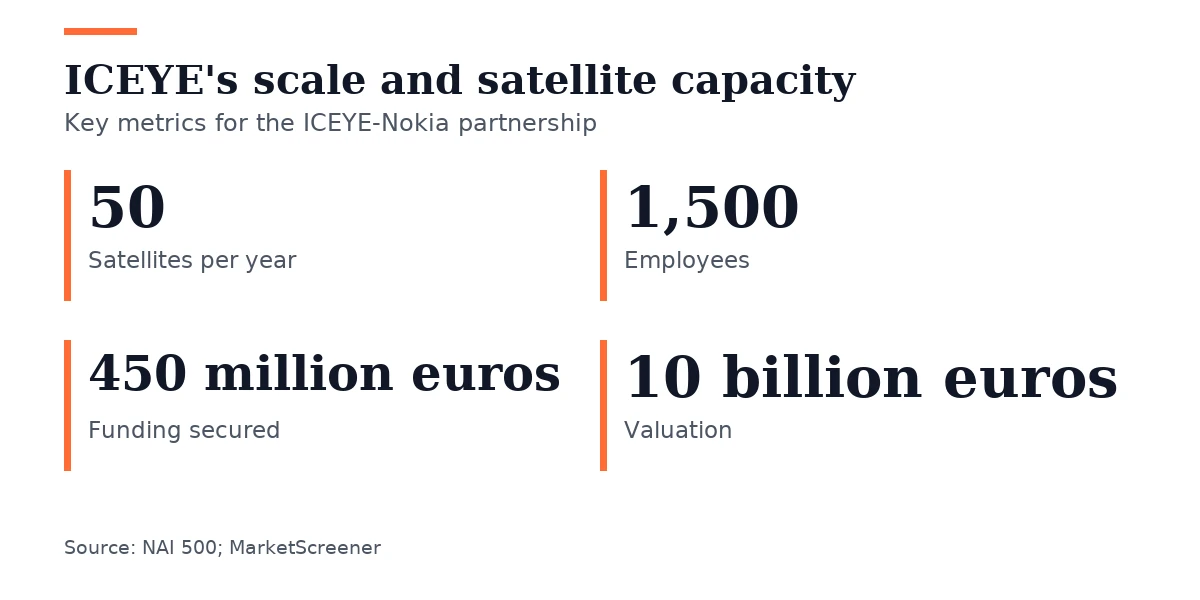
- The two companies expect to put as many as 50 low Earth orbit satellites into orbit annually beginning in 2028, based on statements by Nokia's and ICEYE's chief executives in a joint interview.
Ukraine’s Ministry of Defence signed a letter of intent with ICEYE and Nokia on Oct. 22, 2026. The agreement calls for exploring space cooperation and a sovereign satellite communications effort in Ukraine.
The signing took place during the visit of the Prime Minister of Finland to Ukraine. It follows an Oct. 1, 2026 announcement by ICEYE and Nokia of a broader government-focused satellite communications partnership. The Oct. 1 announcement came from Helsinki. The companies disclosed plans for a secure, sovereign satellite communications system in low Earth orbit, with high-performance broadband aimed at government customers.
“Ukraine needs secure, sovereign and high-performance satellite communications systems that it controls,” said Rafal Modrzewski, ICEYE’s chief executive and co-founder, at the Oct. 22, 2026 signing. Modrzewski said ICEYE has supported Ukraine since 2022 and remains committed to continuing that support. He made the remarks at the Oct. 22, 2026 letter of intent signing.
Mikko Hautala, Nokia’s chief geopolitical and government relations officer and chair of Nokia Defense, said reliable communications are essential in every situation. He said satellite networks maintain and safeguard connectivity if ground networks fail. He described satellite networks as a key part of any secure communications system because they protect connectivity when ground networks fail. Hautala made the remarks during the Oct. 22, 2026 announcement.
The planned service will combine satellites, ground networks and durable terminals for users in the field. Government customers will receive ground terminals and satellites built to operate alongside land-based networks so armed forces, first responders and ministries stay connected during outages. The capability is intended to keep those users connected when terrestrial networks are disrupted or compromised. Integrating these elements extends ICEYE’s sovereign intelligence from space business model into satellite communications.
Nations using the systems will receive targeted, high-throughput, low-latency connectivity focused on priority mission areas. The design complements existing military and commercial networks instead of replacing them, adding reach, resilience and capacity. Existing military and commercial networks gain reach, resilience and capacity without being replaced or displaced.
The first communications satellites are expected to launch in 2028. The October 1 announcement from Helsinki set that date as part of the jointly developed sovereign systems plan. The firms plan to deploy up to 50 low Earth orbit satellites annually, beginning in 2028. Chief executives Justin Hotard and Rafal Modrzewski discussed the outlook in a joint interview together.
“Sovereign operations depend on the ability to sense, decide and act in real time,” said Justin Hotard, president and CEO of Nokia.
ICEYE runs the largest synthetic aperture radar satellite constellation on Earth, and the company calls it the most advanced. The company describes itself as the world leader in sovereign intelligence from space. Its imagery offers superior quality, latency and revisit times regardless of weather or time of day. ICEYE offers the capability to customers for detecting and responding to changes in any location on Earth.
Governments that operate their own constellation can receive this proven capability as a sovereign system from ICEYE, an offering aimed at governments that choose to operate their own constellation rather than rely on a third party.
The company’s constellations serve defense and intelligence customers as well as environmental monitoring, insurance and emergency management clients. Founded in Finland and natively European, ICEYE operates globally and has more than 1,500 employees worldwide.
Nokia provides fixed, mobile, IP, optical, core and data center network infrastructure as part of its connectivity business. The company describes itself as enabling the AI supercycle through security-by-design and AI-optimized architecture.
The company is moving into satellites and data center equipment while expanding past its core mobile network business. The expansion connects to Nokia’s focus on AI infrastructure, and an investment from Nvidia helped drive its stock price up about 65 percent during the year.
Earlier in October 2026, ICEYE signed a letter of intent with Poland’s PGZ SA to develop military satellite communications capability for Poland. Modrzewski cited the Polish agreement as one of the demand signals behind developing satellite communications capabilities. ICEYE secured 450 million euros in June, achieving a 10 billion euro valuation.
In August, the European Union announced that it would expand the IRIS2 sovereign satellite program, seeking a single service free of foreign suppliers. IRIS2 seeks a unified service that avoids foreign suppliers. The EU move sits within a broader European trend toward autonomous secure communications capabilities.



Join the discussion