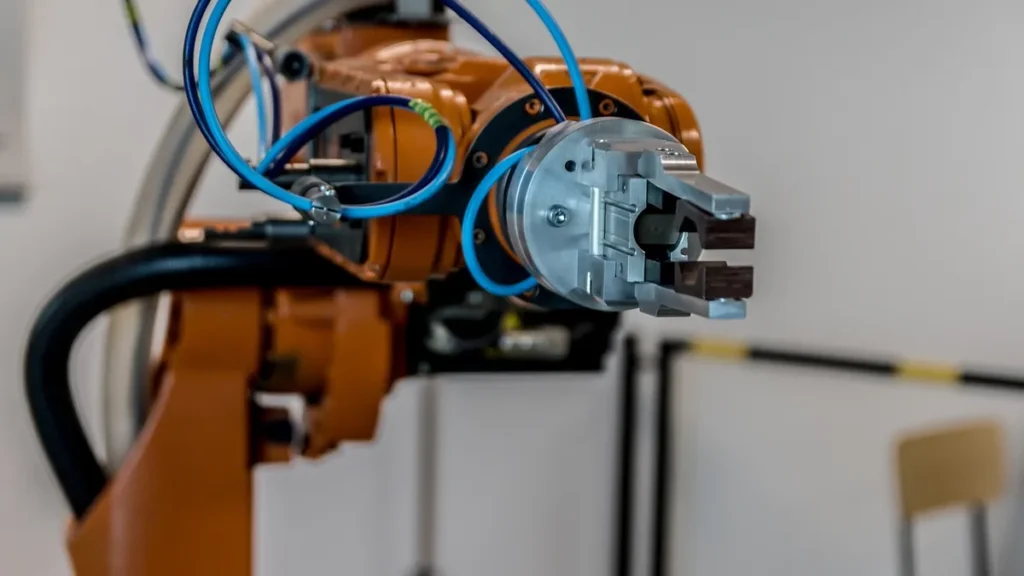
A robot developed by the California Institute of Technology independently constructed the first bay of a 1.4-meter reflector antenna in low Earth orbit, an industry first for orbital construction. The roughly 1-cubic-meter payload lifted off Mar. 30, 2026 from Vandenberg Space Force Base on Momentus Inc.’s Vigoride 7, one of 10 payloads riding the SpaceX Transporter-16 mission.
The robot spent six months in space working with composite fiber tubes and aluminum joints step by step to complete the initial section. Ground controllers issued commands through the Momentus Vigoride vehicle to release launch restraints, deploy the two prebuilt bays, and assemble the third. It carried two prebuilt truss bays with diagonal supports, struts, joints, an armlike manipulator, and motorized dispensers stocked with parts for the remaining truss.
The central manipulator moves to each bay’s mounting plate, picks up parts and places them, then secures netlike perforated film that forms two reflective cable nets kept under tension by springs. After each bay is ready, the robot pushes it into orbit and the process starts again for the next bay. ASTRA completes the truss only after finishing all 11 bays, tethering them to netlike reflectors, and pushing them out.
Researchers from Caltech and the University of Pennsylvania worked with professor Igor Bargatin on a perforated reflective film that requires less prestress than conventional metallic mesh, which permits lighter structures. Charles Sommer, a former Caltech systems engineer, Caltech research engineer Alan Truong, and graduate student Tara Venkatadri sent the commands, and the team checked results against photos downloaded from space. Ground crews get about seven or eight contact windows per day, each lasting roughly 15 minutes.
With so little contact time, engineers constructed a ground twin in Sergio Pellegrino’s lab to try out fixes on it before sending workarounds to orbit. Engineers repeated the procedures to work past unexpected problems caused by gaps between conditions in orbit and on Earth. Sommer said that whenever the team confirms an issue in orbit, they go to the lab and try to recreate the problem on the ground.
The demonstration falls under DARPA‘s Novel Orbital and Moon Manufacturing, Materials, and Mass-efficient Design program, an effort started in 2022 to expand space capabilities. The orbital work is the project’s third phase, coming after two earlier phases where the ASTRA team developed the concept and design and verified it in laboratories on Earth. Delivery of the completed, tested payload to Momentus Inc. took less than 12 months.
Only two projects have reached NOM4D phase 3 for small-scale orbital demonstrations, and ASTRA is one of them. The University of Illinois Urbana-Champaign effort will launch equipment to the space station before the end of 2026, and astronauts there will test a method for turning liquid materials into solid materials to shrink launch payloads.
“As we wrap up the mission, we are finally able to start thinking about the new avenues of research opened by this demonstration,” said Sergio Pellegrino, who leads the ASTRA team. He teaches aerospace and civil engineering at Caltech and co-directs the Space Solar Power Project there. He called the short development timeline an enormous undertaking for the small team, given the payload’s complexity. Jaden Suh, now at the University of Texas at Austin after a Caltech postdoctoral fellowship, wept at launch and called it incredibly lucky to build the project from scratch.
Andrew Detor, DARPA program manager for NOM4D, said NOM4D aims to enable efficient, scalable construction of large space structures, meaning structures hundreds of meters or kilometers across. He said today’s methods cannot produce anything approaching that scale. He said future space operations will require large items such as depots, habitats, power arrays and large radio antennas.
Caltech researchers say they can scale the ASTRA techniques up for bigger projects, eventually reaching large perimeter trusses and giant reflective surfaces. DARPA likened the work to assembling high-tech K’Nex or Tinkertoy, though automating the construction in orbit is far from child’s play.
Rocket fairing size currently caps how large a structure can be, which drives demand for construction in orbit. In the past, big structures launched folded and unfolded in orbit, or astronauts assembled them piece by piece across multiple flights; ASTRA offers a new path: building directly in orbit. Such reflectors could serve as enormous mirrors for space telescopes or as apertures for big radio antennas, and support communications and large solar arrays for space solar power. NASA also operates a mission devoted to in-space servicing, assembly, and manufacturing.
Because the mission ends in December, finishing the full truss seems unlikely, yet the team gained enough knowledge to prove that on-orbit assembly works. Team members say the design needs simplifying and refining now that they have learned enough lessons. Pellegrino said engineers must consider in-orbit construction once structures grow too large to prebuild on the ground and unfold.




Join the discussion