Key facts
- TitanMPAS combines a non-hydrostatic MPAS dynamical core with TitanWRF physics schemes, while adjusting gravity and curvature terms to move past thin-atmosphere assumptions.
- TitanMPAS improves on TitanWRF through an upgraded moist convection parameterization and the use of observed surface properties.
- The model captured vertical and latitudinal changes in methane abundance found in the reanalysis of Cassini VIMS data.
- Even with weak solar insolation, the model showed daily cycles in near-surface temperature, pressure, wind strength and methane amount.
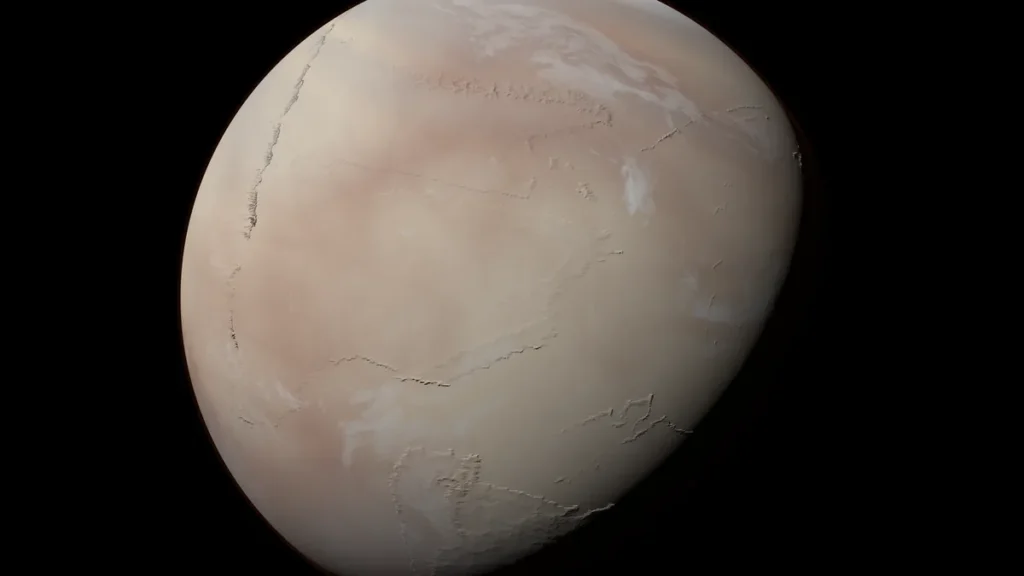
Scientists built TitanMPAS to study Titan’s atmosphere and methane cycle globally and regionally, and posted the research as an arXiv preprint on November 5, 2026, Astrobiology Web reported.
Scientists submitted a paper describing the framework to The Planetary Science Journal, naming Yuan Lian, Mark I. Richardson, Claire E. Newman and Martin A. Cordiner as the authors. The preprint appeared on arXiv on November 5, 2026. The system joins a non-hydrostatic MPAS dynamical core with TitanWRF physics schemes and changes gravity and curvature terms so the model no longer relies on thin-atmosphere assumptions. Those adjustments aim to better represent Titan’s atmosphere than older versions that used thin-atmosphere simplifications.
Compared with TitanWRF, the new system uses an upgraded moist convection parameterization and observed surface properties. That marks a departure from the earlier model. The team conducted extended runs covering more than 100 Titan years at 1-degree resolution with realistic topography included. The runs produced stratospheric superrotation at typical equatorial wind speeds above 120 meters per second and maximum zonal wind speeds greater than 170 meters per second.
Temperature profiles from the model agreed well with Cassini CIRS observations. Simulated tropospheric wind, temperature and methane abundance agreed with Huygens probe in-situ measurements. It also recreated seasonal methane precipitation patterns drawn from observed cloud activity. The system matched vertical and latitudinal methane abundance changes seen in the reanalysis of Cassini VIMS data.
Resolution sensitivity tests found that finer grid spacing speeds up stratospheric superrotation and strengthens near-surface wind, since the model resolves terrain variations better. That result indicates grid spacing shapes both stratospheric circulation and surface winds in the model. Despite weak solar insolation, the model produced daily cycles in near-surface temperature, pressure, wind strength and methane amount. The authors describe this as evidence of daily atmospheric behavior under Titan’s faint sunlight.
The authors found possible topographic effects on methane transport and eddy momentum flux through both atmospheric layers and called for more study. That issue closes the paper’s summary of results. The arXiv preprint carries identifier 2611.08700 [astro-ph.EP], version 1, submitted on Thursday, November 5, 2026 at 21:00:00 UTC with a file size of 6,121 KB. Yuan Lian appears as the submitter in the arXiv submission history.



Join the discussion