Key facts
- At full phase the Moon is about 360,765 km (224,170 miles) to 360,768 km (224,171 miles) from Earth, qualifying as a supermoon under the common definition of a full moon within 90% of perigee. (S2, S3, S4, S6).
- Western North America sees the dark-sky occultation before dawn, while eastern North America sees it closer to dawn in a brightening sky and may only see the Moon approach the Pleiades. (S1, S4).
- S1, S3 and S6 advise looking low in the west toward Taurus before dawn to find the constellation holding the Pleiades, and looking east around sunset at dusk to watch the Moon rise.
- Astronomy Magazine's Sky This Week entry places the full moon at 9:54 A.M. EST in its November 23 item and calls it the year's second supermoon. (S1).
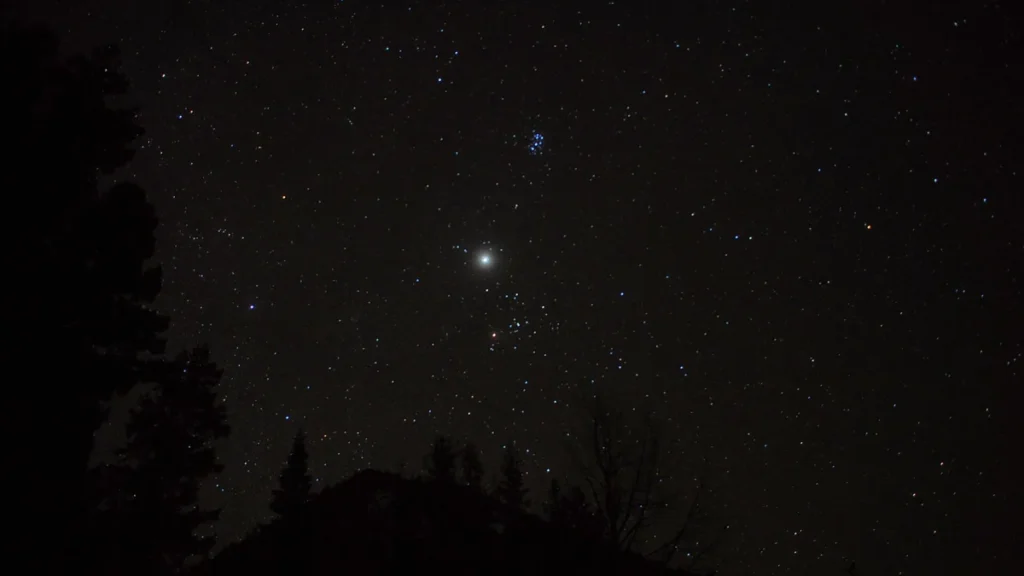
You can watch the Moon occult several bright Pleiades stars before dawn on Nov. 24 from parts of North America, according to Astronomy Magazine and Tech Times.
The full Beaver Moon reaches exact phase at 9:53 a.m. EST (14:53 UTC) on Nov. 24, 2026, according to Space.com, Earth.com, timeanddate.com, Star Walk, and the U.S. Naval Observatory. Astronomy Magazine‘s Sky This Week entry lists 9:54 a.m. EST. Tech Times says NASA’s supermoons list and EarthSky put the full-phase moment at 9:54 a.m. ET, one minute after the times from Star Walk, BBC Sky at Night Magazine and Space.com. At that exact moment, the Moon will be below the horizon for stargazers in the United States, so Space.com says viewers in America should look shortly after sunset as the Moon looms low over the eastern horizon.
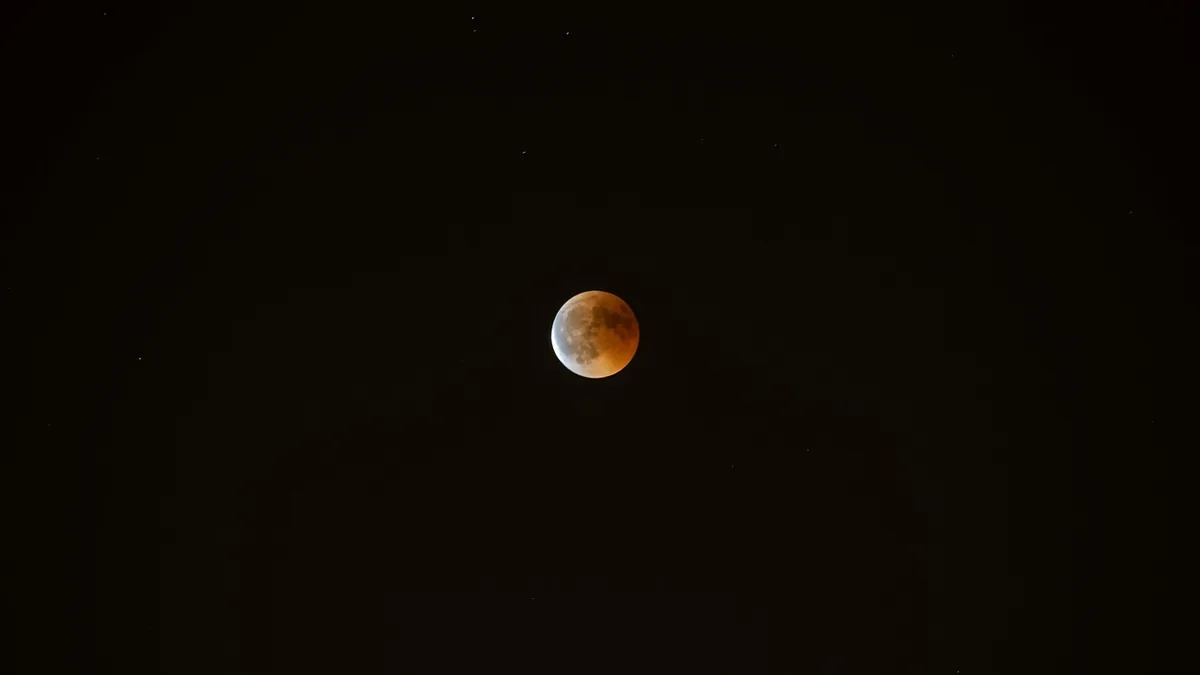
At full phase, the Moon is about 360,765 km (224,170 miles) to 360,768 km (224,171 miles) from Earth, qualifying as a supermoon under the common definition of a full moon within 90% of perigee, the Moon’s closest point to Earth in its orbit. NASA calls “supermoon” an unofficial astronomical term that usually means a full moon within at least 90% of perigee, a word astrologer Richard Nolle coined in 1979. timeanddate.com revised its supermoon definition and brands the November full moon the “Super Beaver Moon,” peaking at 14:53 UTC on Nov. 24, 2026, when the Moon is near its closest point to Earth.
Against an average full moon, the November supermoon appears about 6.5% larger in diameter and 13.5% brighter, figures Star Walk derives from geometry using a mean Earth-Moon distance of 384,400 km (238,855 miles). The Royal Observatory Greenwich measures the gain at up to 7% larger and 15% brighter and says the naked-eye difference against average is imperceptible. NASA’s widely quoted figure of up to 14% larger and 30% brighter compares the closest full moon with the year’s faintest micro-moon, not an average one, and Tech Times says both figures follow from geometry.
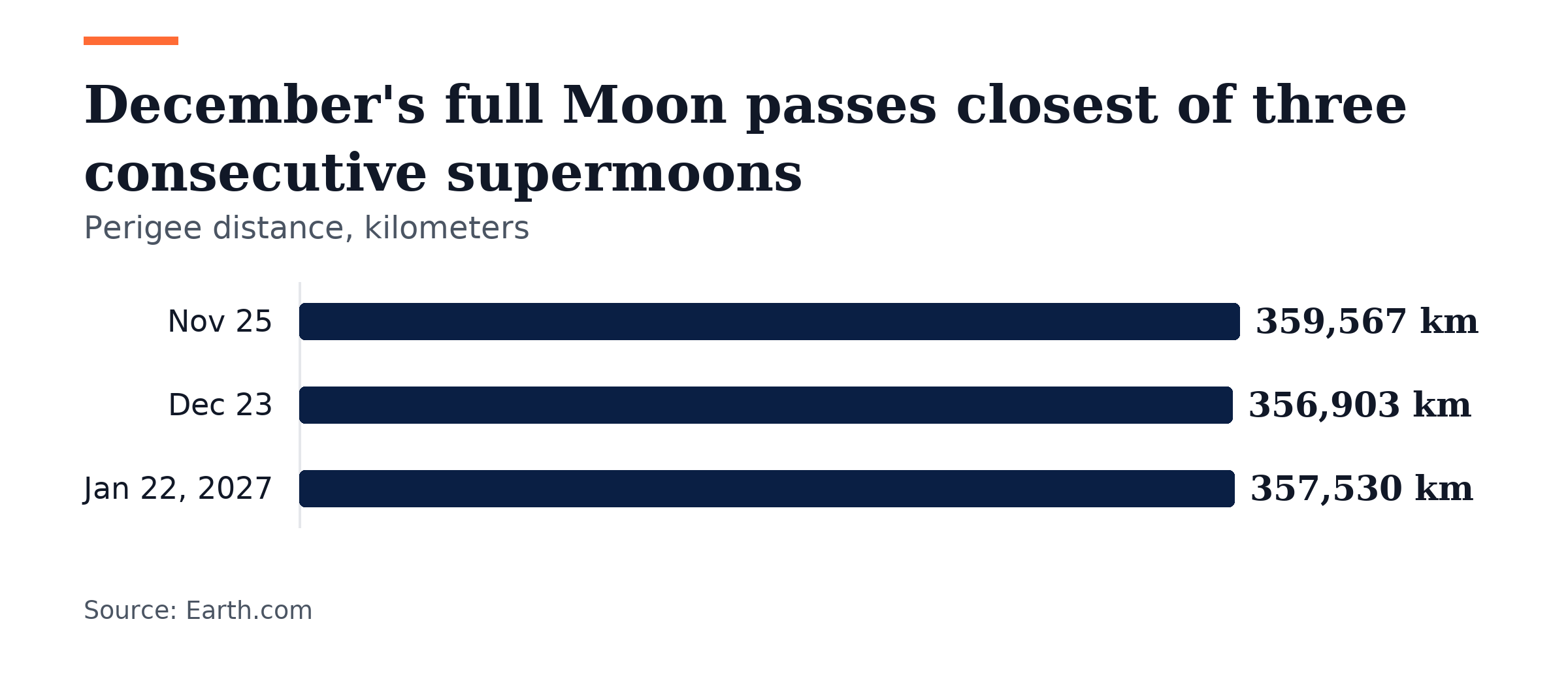
Perigee arrives about 30 hours after full phase, around 4 p.m. ET on Nov. 25, when the Moon is roughly 223,280-223,400 miles (359,336-359,567 km) away. Earth.com gives perigee on Nov. 25 at 4:01 p.m. EST at 223,400 miles per a Land Information New Zealand almanac, while Tech Times puts it at roughly 4 p.m. ET at 359,336 km. The December 23 and January 22, 2027 full moons pass closer.
At perigee, the Moon is about 226,000 miles (363,300 km) from Earth, and at apogee about 251,000 miles (405,500 km). The Moon’s slightly oval orbit causes its distance to change between these extremes. Tech Times says perigee changes with each orbit, driven chiefly by the Sun with lesser effects from Venus and Jupiter, and the tightest approaches happen near new or full Moon on a cycle of about 411 days.
Space.com credits astrologer Richard Nolle with the 90% supermoon threshold, and both Space.com and EarthSky use Fred Espenak’s tables for dates and distances. Royal Museums Greenwich defines a full Moon within 10% of its closest distance and lists four supermoon dates running from Nov. 24 through Feb. 20, 2027. BBC Sky at Night Magazine puts the 2026 total at three supermoons, in January, November and December.
Western North America sees the dark-sky occultation before dawn, while eastern North America sees it closer to dawn in a brightening sky and may only see the Moon approach the Pleiades. Star Walk predicts the worldwide occultation window runs from 3:21 a.m. to 8:44 a.m. ET on Nov. 24, with the Moon closest to Alcyone, the cluster’s brightest star, at about 7:06 a.m. ET. Star Walk’s New York row lists the closest Moon-to-Alcyone approach at 5:45 a.m. ET with a separation of one degree 36 arcminutes, providing close-approach windows rather than individual star contact times.
Look low in the west toward Taurus before dawn to find the constellation holding the Pleiades, and look east around sunset at dusk to watch the Moon rise. NASA’s November skywatching guide advises looking east around sunset to watch the Moon rise, and it may look even bigger near the horizon because of the Moon illusion. Moonrise on Nov. 24 is about 4:15-4:24 p.m. local, with New York at 4:16 p.m. EST and Los Angeles at 4:43 p.m. PST.
Moonset is around 7:05-7:10 a.m., with New York at 7:05 a.m. EST, 12 minutes after sunrise, and Los Angeles at 6:49 a.m. PST. Astronomy Magazine gives moonrise at 4:24 p.m. and moonset at 7:10 a.m. local for 40° N 90° W, and notes sunrise there is 6:55 a.m. local. According to BBC Sky at Night Magazine, on Nov. 23 the Moon rises in the east while the Pleiades and Hyades clusters sit below and to its left as it climbs.
Binoculars or a telescope help viewers follow Pleiades stars into the lunar edge, and Space.com says 10×50 binoculars can frame both the Moon and the cluster. Astronomy Magazine calls the event easy to watch with the naked eye or with binoculars or a telescope and notes a Moon filter may be wanted because the satellite is so big and bright. Star Walk says the Pleiades are normally naked-eye under a dark sky, but the nearly full Moon’s glare makes many stars harder to see.
The Moon is more than 99% lit on the evenings of Nov. 23 and 24, and its glare makes many Pleiades stars harder to see without optical aid. Viewers can block the Moon’s glare with their thumb and may spot the blue-white Pleiades less than 10 degrees away, about the width of a clenched fist held at arm’s length. At the predawn hours of Nov. 24, the Moon hangs low in the western sky less than five degrees from the Pleiades, offering the best U.S. view of the near-full Moon.
In the Midwest (40° N 90° W), magnitude-5 Celaeno (16 Tauri) disappears behind the Moon’s leading edge just before 6 a.m. CST, followed minutes later by magnitude-4 Taygeta (19 Tau). Magnitude-4 Maia (20 Tau) vanishes just before 6:20 a.m. CST and Sterope (21 Tau) follows a few minutes later, and both are hard to see from the Midwest without optical aid as sunrise approaches. Celaeno reappears around 6:40 a.m. CST, about 15 minutes before the 6:55 a.m. local sunrise.
Astronomy Magazine advises Midwest viewers using binoculars or a telescope to put them away several minutes before local sunrise because sunrise approaches fast during the occultation. During an occultation, a star vanishes or reappears in 0.1 seconds or less because the Moon has no significant atmosphere and a star is a point of light; bright moonlight may wash out fainter stars. Tech Times explains that stars will not fade during the event, so binoculars help observers track them against the lunar glare.
The Moon drifts west to east against the background stars while passing in front of a star and cutting off its light. Star Walk says viewers in parts of Japan, China, eastern Russia, Southeast Asia, northern Australia, the Pacific, and North America can watch individual Pleiades stars vanish behind the Moon or reappear at its limb, with western North America looking before dawn on Nov. 24 and East Asia watching on the evening of Nov. 24. IOTA offers free prediction software for calculating local occultation timings, so observers should check local circumstances before planning around a single star.
Astronomy Magazine directs readers to the International Occultation Timing Association at lunar-occultations.com/bobgraze/index.html for specific timings from their location. Earth.com notes the IOTA listing does not rank the event among the year’s best passages and that bright moonlight makes the cluster’s faint stars harder to pick out. A bright Moon passing in front of the bright Pleiades cluster is a rare, accessible skywatching event because the occultation is visible to the naked eye or with binoculars from much of North America.
The Pleiades lie about 444 light-years away and hold more than 1,000 confirmed stars, though the brightest six or seven are easy to spot by eye. Tech Times contrasts this with Aldebaran, the Bull’s eye at about 65 light-years, which only looks like part of the more distant Hyades cluster at about 153 light-years. Aldebaran, the orange-red star marking the Bull’s eye at magnitude 0.9, contrasts against the Moon’s bright white or yellow disk.
The nearly full Moon will make a broad triangle with Aldebaran and Betelgeuse on Nov. 25-26, visible late in the evening or before dawn. On Nov. 24, the Moon then shines all night near Aldebaran and the Pleiades, according to EarthSky. On Nov. 24, the Moon rises near 4:15 p.m. ET in New York and sits between the Pleiades and Hyades clusters.
Mars and Jupiter shine high in the south before dawn near Regulus in Leo after appearing about 1.2 degrees apart on Nov. 15-16, and such pairings recur every two to 2.5 years on average. Jupiter is the brighter of the two planets, Mars has a reddish tint, and a closer look comes from binoculars or a low-powered telescope under 40x magnification. On the night of Nov. 24, Mars and Jupiter will rise in the east around local midnight while Saturn sinks toward the southwest.
Uranus will sit in Taurus about 5° from the Full Moon on Nov. 24 but will be hard to spot in the bright moonlit sky, so viewers should use a telescope or powerful binoculars. Star Walk describes the Moon’s closest approach to Alcyone during the Pleiades encounter on Nov. 24 at about 12:05 UTC, with an angular separation of about 0°57′, less than twice the lunar disk’s apparent diameter. In the actual sky the Full Moon will be in Taurus, though the tropical astrological zodiac may reference it as being in Gemini.
The Beaver Moon nickname draws on Native American and European traditions, including beavers fortifying dams and stocking food and the historical trapping season, though the Royal Observatory notes disagreement over the origin. One explanation ties the name to beavers fortifying their dams and storing food in November, while another connects it to the season for trapping beavers for thick winter pelts. Alternative names include Frost Moon, Freezing Moon, and Trading Moon; in Celtic tradition, the last Full Moon before the December solstice is the Mourning Moon or the Darkest Depths Moon.
NASA’s then-senior photographer Bill Ingalls advised including a local landmark when photographing the Moon rather than shooting it alone. “Don’t make the mistake of photographing the moon by itself with no reference to anything,” Ingalls said. He also suggested phone-camera users hold a finger on the Moon to lock focus, then slide it to adjust exposure.
A perigee full moon can cause higher tides than usual, typically adding a couple of inches to a spring tide, NASA says; an analysis of 204 magnitude-8-plus earthquakes found no supermoon-quake link. Tech Times says the Ash Wednesday Storm of 1962, a perigean spring tide, flooded the U.S. Atlantic coast, killed 40 people and caused more than $500 million in damage. NASA states that a supermoon might be hard to detect visually but does affect Earth by causing higher tides than usual at perigee.
Atmospheric Rayleigh scattering can make a low rising or setting Moon look yellow-orange. Space.com explains that sunlight reflected from the Moon’s disk passes through more of Earth’s atmosphere near the horizon, scattering shorter bluer wavelengths and allowing more red and orange light through. Ross and Plug estimated in 2002 that the Moon illusion typically makes a horizon Moon look about 50% wider even though its measured angular size does not change.
timeanddate.com’s former Supermoon rule required the Earth-Moon distance at New or Full Moon to be less than 360,000 kilometers, and the site revised its definition after 15 years of using that simpler fixed-distance rule. The Moon’s orbit is tilted by about 5° to the ecliptic, so it occasionally wanders into other constellations, such as Auriga. Full Moon is the only phase that stays up all night, with moonrise and moonset happening around sunset and sunrise.
Star Walk says binoculars with 7–10× magnification reveal more lunar surface detail, and viewers can spot dark lunar maria and bright crater rays around Full Moon. Each patch of the lunar surface looks no brighter than usual during a supermoon, since the extra light arrives as the disk covers more sky. The full Moon stands about 1,400 km farther away than at perigee since the gap can shift by more than 1,000 km in six hours.
Star Walk reports most people cannot tell a supermoon apart from an ordinary Full Moon by eye, and it recommends watching the Moon rise near the horizon for the Moon illusion effect. The May 31, 2026 micromoon lay about 406,135 km away and showed a smaller apparent diameter. The December 24, 2026 supermoon is the largest Full Moon of 2026.


Join the discussion