Key facts
- Astronomer Patryk Sofia Lykawka of Kindai University teamed up with Pedro Bernardinelli of the University of Washington and Jonti Horner of the University of Southern Queensland to conduct the simulation study.
- Simulations modeling temporary planets comparable in size to Mars or Earth showed they typically crossed giant-planet orbits and were ejected or destroyed in collisions within tens of millions of years.
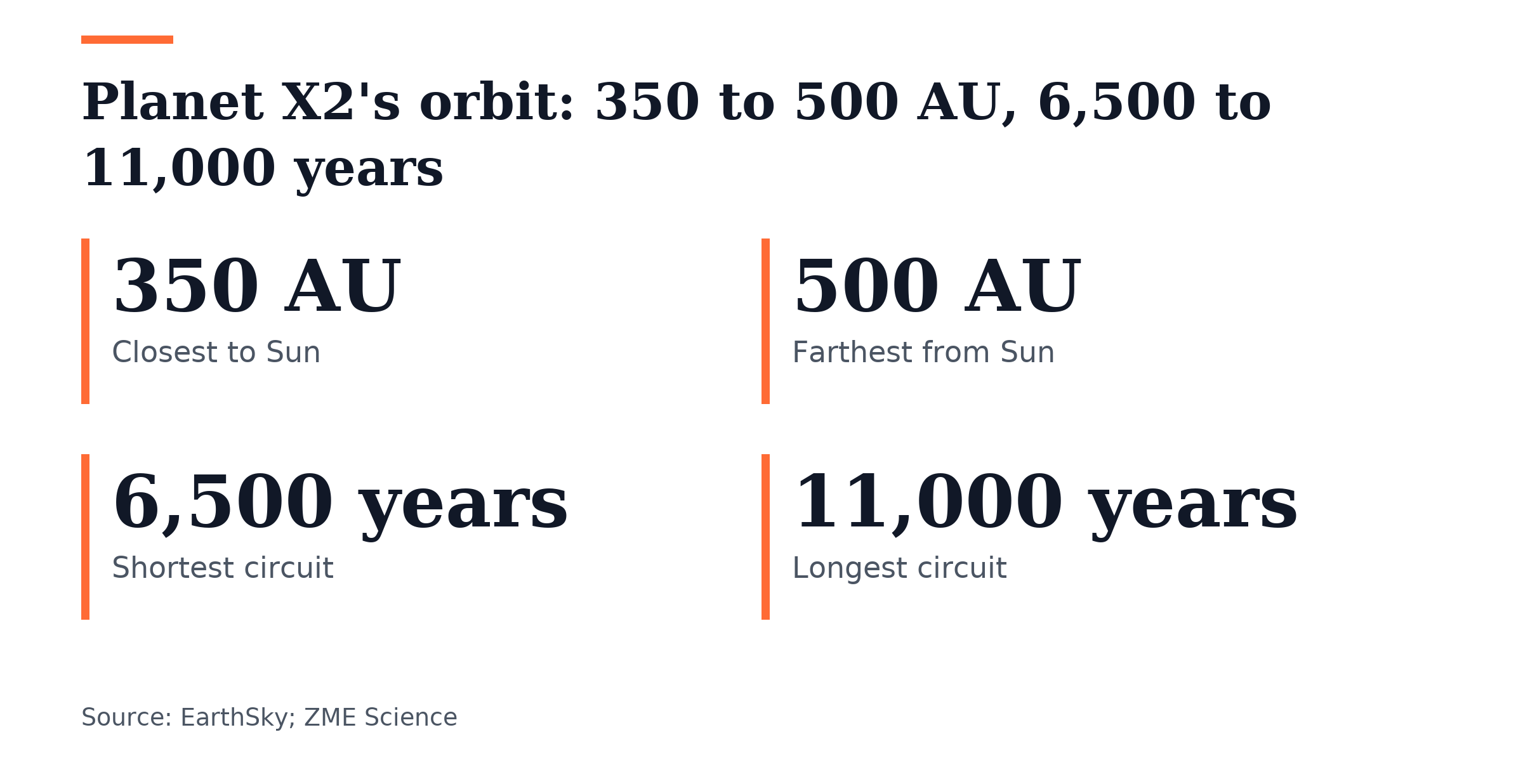
- In the preferred simulation models, Planet X2 maintains an elliptical orbit ranging from 350 to 500 astronomical units from the Sun on average, taking between 6,500 and 11,000 years to complete one circuit.
- When researchers compared simulation outputs against Dark Energy Survey observations, the models successfully reproduced closest approaches and orbital tilts but generated fewer detections of larger orbital sizes.
Patryk Sofia Lykawka of Kindai University, Pedro Bernardinelli of the University of Washington and Jonti Horner of the University of Southern Queensland proposed on November 23, 2026 that an undiscovered world nicknamed Planet X2, with about twice Earth’s mass, orbits in the distant Kuiper belt beyond Neptune to explain two puzzling populations of icy bodies, though it has not been detected, and the work was published as a simulation study.
The researchers modeled billions of years of planetary evolution to examine whether an unseen planet could shape the distant paths of small icy objects beyond Neptune, using computer models to simulate orbital change over vast spans of time. The simulation allowed them to test how a hidden mass influences orbital behavior over enormous timescales. Lykawka, Bernardinelli and Horner conducted the simulation study together from Kindai University, the University of Washington and the University of Southern Queensland. Horner said, “The exciting thing is that we now have an opportunity to put this idea to the test,” expressing the team’s view that the proposal can now be checked against real observations.
The study focuses on icy bodies beyond Neptune whose orbits are difficult to explain using only the known planets. One population travels on steeply inclined paths, meaning their orbits sit at sharp angles to the plane of the planets. Another remains detached from Neptune’s gravitational reach even at its closest point to the Sun, so these bodies stay far from the giant planets at all times. These two groups present separate challenges for models of the outer solar system, and Planet X2 itself has not been directly detected; astronomers stress that neither it nor the heavier hypothetical Planet Nine has been observed, making the proposal a hypothesis rather than a confirmed discovery.
Planet Nine, by contrast, is estimated at five to 10 times Earth’s mass and was proposed to explain clustered alignments of distant objects, and it was designed to explain why some distant objects appear to share similar orbital orientations. That earlier hypothesis focuses on a much heavier body in a different orbital arrangement. Planet X2 is put forward as a lighter body of 1.5 to 2 Earth masses. The two hypothetical worlds offer distinct explanations for separate outer solar system anomalies.
In the preferred simulation models, Planet X2 follows an elliptical orbit ranging from 350 to 500 astronomical units from the Sun on average, taking between 6,500 and 11,000 years to complete one circuit. An astronomical unit is the average distance from Earth to the Sun, and an elliptical orbit is an oval-shaped path around the Sun. The proposed planet’s elliptical path means its distance from the Sun changes dramatically over its long year. Even at its nearest point, it remains at least 200 astronomical units from the Sun, and the path keeps the proposed world far from the giant planets at every point in its circuit.
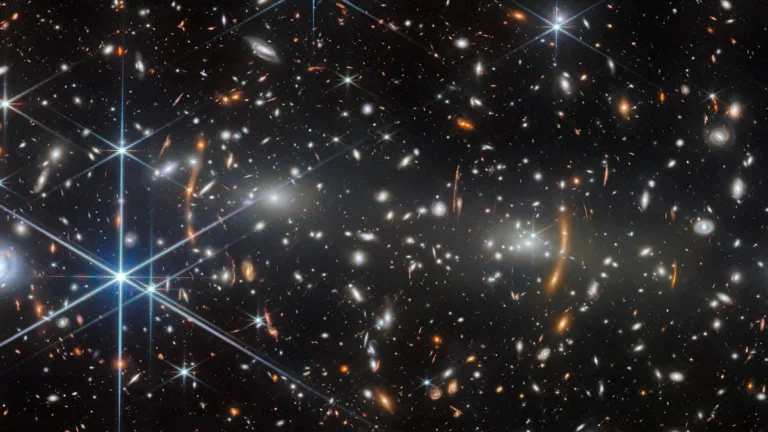
When the team compared simulation outputs against Dark Energy Survey observations, the models successfully reproduced closest approaches and orbital tilts. However, the simulations generated fewer detections of objects with larger orbital sizes than the survey recorded. Dark Energy Survey observations provided a real-world benchmark for the simulation results. Comparing models to real survey data revealed where the simulation matches observations and where it falls short, and both the agreements and discrepancies require further investigation before the model can be considered settled, meaning more observational data will be needed.
Sedna offers a clear example of a detached object, meaning a body that never ventures close to the giant planets. The distant trans-Neptunian object has a diameter roughly one-thirteenth of Earth’s and follows an eccentric path from 76 astronomical units to 937 astronomical units. It completes one orbit every 11,400 years. Sedna never comes close enough to Neptune or the other giants for their gravity to have easily placed it there, and its extreme orbit raises questions about how such a body arrived at its present path.
The researchers also tested scenarios with temporary planets comparable in size to Mars or Earth. Those models showed such worlds typically crossed giant-planet orbits and were ejected or destroyed in collisions within tens of millions of years. Temporary worlds that crossed the paths of the giant planets faced dynamical instability over comparatively short timescales, making it unlikely they could remain in place long enough to sculpt the Kuiper belt. The team ran these transient scenarios alongside permanent companion models to determine which condition best replicates observed outer solar system structures, and this comparison helped the team identify which planetary arrangement can survive long enough to shape the Kuiper belt.
Other researchers have offered different explanations for the same outer solar system patterns. A 2021 study suggested the structures reflect observational telescope biases, while other models describe a passing star disturbing early planetary orbits. These alternatives show that several hypotheses can account for structural quirks in the Kuiper belt. That multiplicity means simulations by themselves cannot prove an unseen world exists, and the 2021 study and passing-star models illustrate how the same orbital patterns can arise from different causes.
The Vera C. Rubin Observatory’s Legacy Survey of Space and Time could help search for Planet X2 and track distant objects. The survey follows recent discoveries such as the dwarf planet candidate 2026 ED138. Such surveys could eventually provide the observations needed to test the proposal.
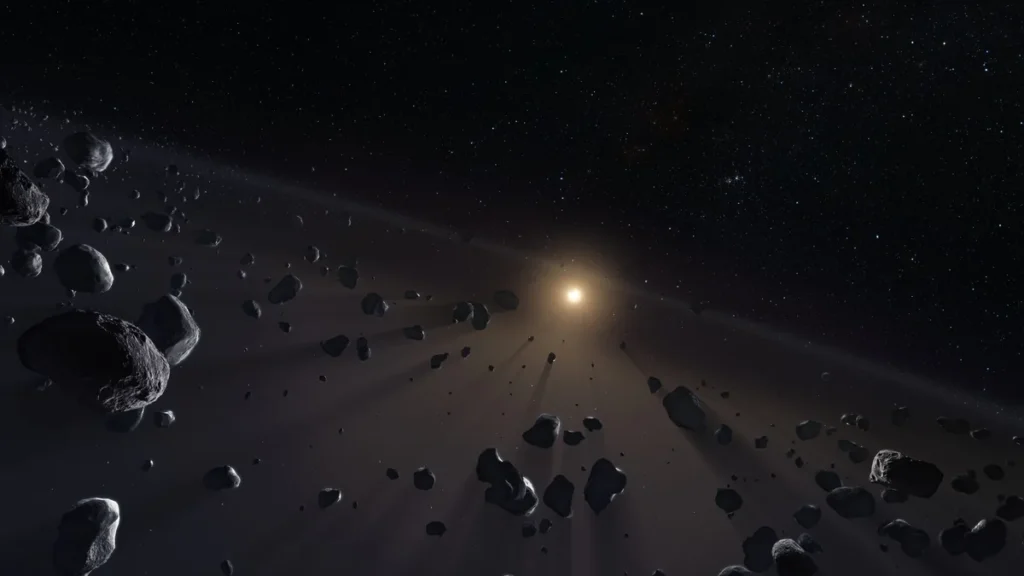
The Kuiper belt contains icy bodies left over from the formation of the solar system, spanning beyond Neptune’s orbit. During early planetary history, Neptune’s migration scattered small bodies and shaped the architecture of trans-Neptunian populations. The Kuiper belt’s icy leftovers formed alongside the planets and have remained in the cold outer region since the solar system’s birth. A trans-Neptunian object is any body orbiting the Sun beyond Neptune, and these distant remnants include bodies that never approach the giant planets.
The hunt for unseen outer planets dates back to the early twentieth century, when astronomers first began looking for a world beyond Neptune. Percival Lowell searched to resolve perceived orbital irregularities in Uranus and Neptune, work that led to Clyde Tombaugh discovering Pluto in 1930. Voyager 2 disproved those irregularities in 1989, and the historical quest established the term Planet X, which modern researchers now use generally for theoretical outer solar system bodies. The Pluto discovery showed that searches for unseen worlds could yield real results, even if the original rationale was later overturned.
Computer simulations alone cannot settle whether Planet X2 exists, so astronomers are looking to upcoming observations to test the idea rather than relying on models alone. Until a sighting is made, the proposal rests on model output rather than direct evidence. The history of outer planet searches shows that hypothetical worlds can remain undetected for decades or be disproved by new data.

Join the discussion