Key facts
- Pioneer Labs, an institute founded by Erika DeBenedictis for biological space-exploration technology, posted an arXiv preprint called Mars Seed by D. A. Stork et al.
- The Mars Seed preprint describes a self-contained habitat architecture that produces roughly 870 square meters of pressurized living space using only Martian inputs approximately every four Earth years.
- The Astera Institute funded the research under an open-science policy, and the authors have no plans to publish the work in a paid journal.
- The mission begins by landing at a mid-latitude location on Mars that has flat terrain and underground water ice.
The institute Erika DeBenedictis founded for biological space-exploration technology, Pioneer Labs, posted to arXiv a preprint called Mars Seed from D. A. Stork et al. on Nov. 23, 2026. Universe Today reported the preprint, introducing it as part of recent concepts intended to prepare for eventual human landings on Mars.
An arXiv preprint is a research paper that authors post online before it appears in a journal. Such papers have not yet undergone formal journal review. The Mars Seed authors do not plan to release the work through a paid journal. The Astera Institute paid for the research under an open-science policy, so the work stays freely available instead of moving behind a paywall.
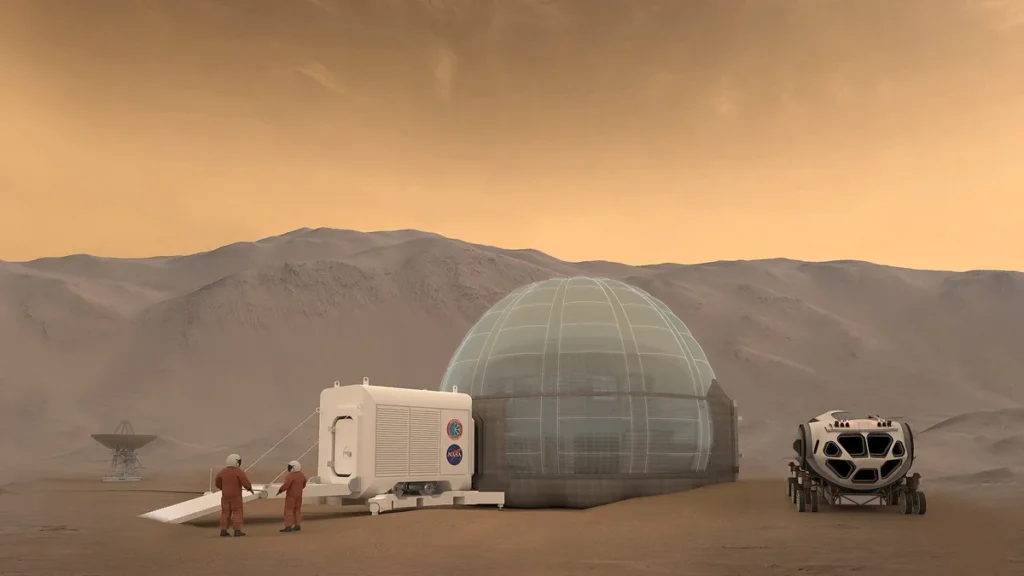
The Mars Seed preprint lays out a self-contained habitat design that yields roughly 870 square meters of pressurized room for people using only materials from Mars on a cycle of about every four Earth years. Self-contained means the habitat makes what it needs inside itself. Universe Today describes the result as a complete habitat volume put together entirely using materials from the Red Planet.
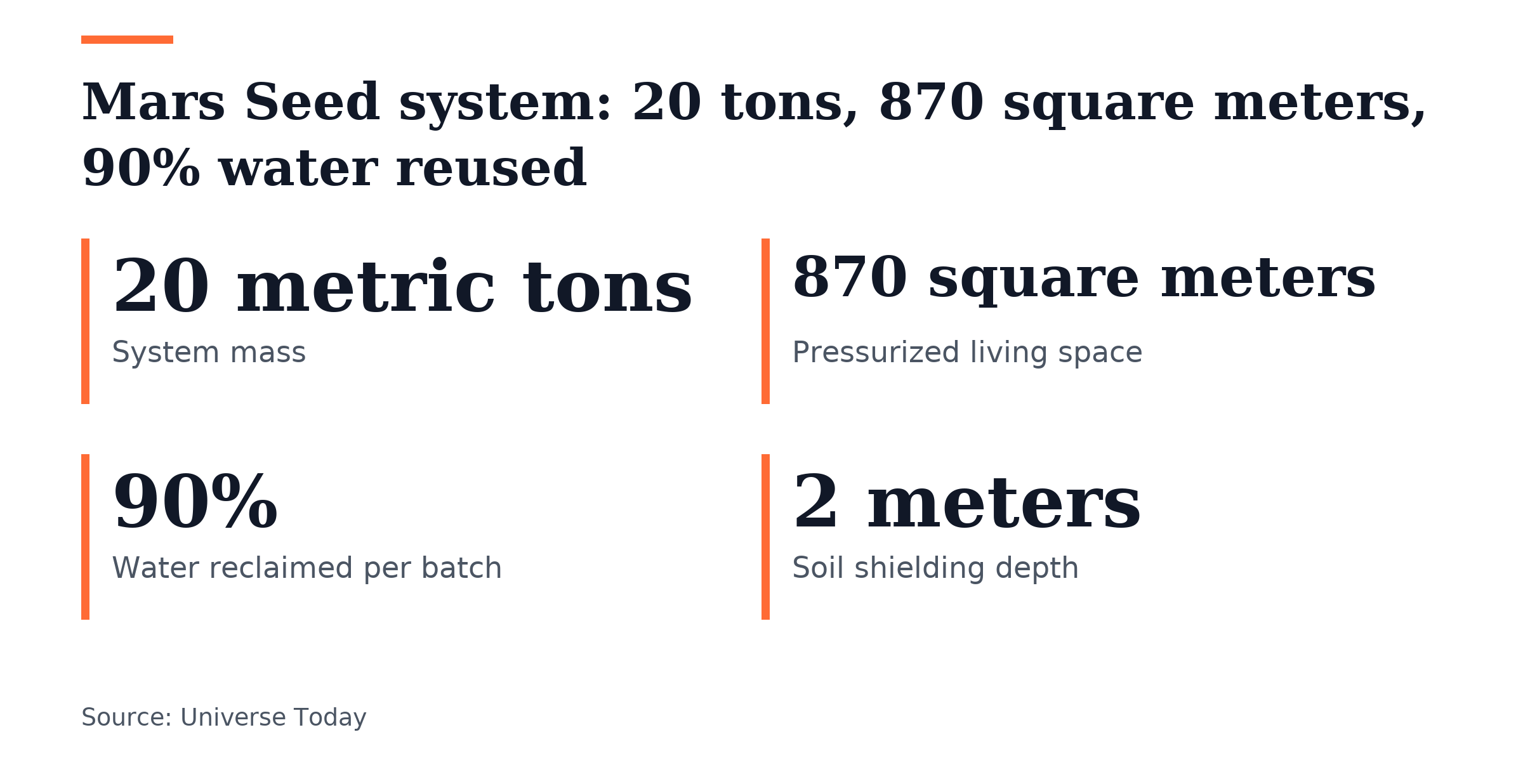
The paper says the full Mars Seed system has a mass of 20 metric tons, under the mass limits for Starship and the 25-ton Mars landers NASA has proposed. Payload is the maximum mass a vehicle can carry to its destination. Universe Today casts the 20-metric-ton mass as an answer to the mass problem of building from local resources. The paper says that once built on Mars, the system needs nothing more from Earth.
The mission begins by landing at a mid-latitude location on Mars that has flat terrain and underground water ice. Mid-latitude means the middle bands of the planet, between the equator and the poles. Flat terrain and accessible subsurface ice are conditions the landing site must meet to support the architecture. A self-driving rover unloads the equipment and puts together a 40-kilowatt nuclear fission reactor based on compact reactor designs that NASA is developing for missions to Mars and the Moon; fission splits atoms to release energy.
About one month after landing, the reactor is running at full power and provides electricity along with waste heat to manage habitat temperatures; climate control keeps the habitat livable for people. Heat left over from the reactor runs a Rodriguez well, also called a Rodwell, that melts ice below the surface and pumps the water upward. This melting method has already been proven in Antarctica.
Following water extraction, the architecture relies on an enlarged International Space Station urine-recycling system to recover about 90 percent of the water in each batch, part of a design built to operate without additional shipments from Earth. Urine-recycling systems turn crew urine into usable water. The article links this water recovery step to the wider goal of avoiding resupply from Earth.
Roughly four tons of Martian soil go into the system’s hoppers each day. Hoppers are funnels that feed material into a machine. Universe Today identifies regolith as a second major Martian input alongside water and atmosphere. Autonomous mining machines similar to NASA’s RASSOR could collect the daily regolith, and roughly 800 kilograms of that soil goes into water-filled mixing tanks to pull nutrients such as phosphorus and nitrogen out of the soil.
The article frames nutrient leaching as a necessary preparatory step despite the hazardous chemistry of Martian dirt.
Martian regolith contains perchlorates, chemical compounds that kill normal microorganisms, so Pioneer Labs developed a version of the Cupriavidus necator bacterium, called sPL.001, that grows well in broth made from perchlorate-laced imitation Martian soil on Earth. Pioneer Labs focuses on biological systems for space exploration, and Universe Today says that focus made the perchlorate-tolerant microbe possible. Engineers call sPL.001 the key engine for making bioplastics that 3D printers use to build radiation-shielded habitats.
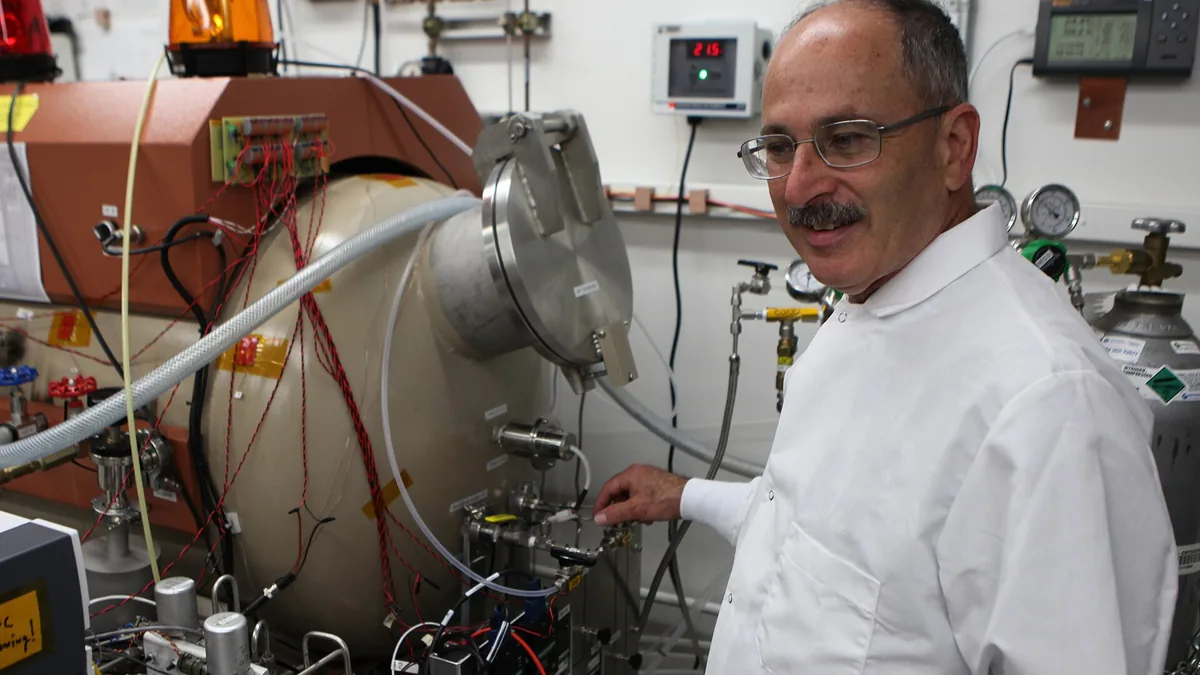
The plan depends on an improved MOXIE system shown to split carbon dioxide from the Martian atmosphere into carbon monoxide and oxygen. Universe Today says MOXIE had already shown the basic idea of splitting carbon dioxide from the Martian atmosphere. For Mars Seed, operators treat carbon monoxide as the product they want instead of a waste gas. The article contrasts this design with normal MOXIE work, where operators throw away carbon monoxide to save oxygen for rocket fuel.
The process applies an electro-agriculture-inspired method to combine waste carbon monoxide with water and make liquid acetic acid, the main ingredient in vinegar. Electro-agriculture is an emerging field that uses electrical methods to drive chemical production, and Universe Today describes it as an influence on the vinegar-production step.
Engineered microbes work inside four separate fermentation tanks, each holding 1,000 liters, consuming acetic acid with oxygen and accumulating polyhydroxybutyrate, a polymer they store inside their cells until the polymer reaches 70 percent of the microbes’ body weight. Fermentation tanks are vats where microbes grow and multiply. Centrifugation spins broth to separate cells, collects the cells from the broth and divides the paste into two manufacturing streams.
One portion of the bacterial paste is combined with Martian soil and loaded into a large gantry 3D printer that prints a ridged, arched exterior shell. A gantry printer moves along an overhead frame to build large structures. Universe Today describes the shell as the first product made from the harvested bacterial paste. Rovers then pile about 2 meters of soil on top of the outer shell to shield against cosmic rays and micrometeorites, forms of radiation and tiny space particles.
The remaining bacteria portion is placed in a pressurized bath of carbon dioxide taken directly from the Martian atmosphere. Pressurized means kept at above-normal air pressure. Workers melt the pure bioplastic and spin it into a reinforced inner tent that seals tightly and holds breathable air. The article calls the inner tent a pressure-retaining liner inside the shielded exterior.
The 20-ton setup arrives on Mars with two rovers and keeps building airtight shelters at about 75 square meters per 130 days. The paper identifies continuous production as a clear benefit over single-delivery alternatives because the facility never stops producing safe habitats. Airtight means the shelters keep their inside air from escaping.
The paper figures a break-even point at close to 1,400 Martian days, measuring the biological facility against a one-way trip launching 20 tons of finished plastic building material from Earth. A break-even point is where the cost of one approach equals the cost of the other. A Martian day is slightly longer than an Earth day. That timeline lines up with the orbital alignment windows NASA has planned for future crewed missions, which are periods when planetary positions favor travel between the two worlds.
The authors say many engineering challenges still stand before Mars Seed is anywhere near ready to launch. Universe Today concludes that mission planners would welcome the habitat option despite those remaining engineering hurdles, given the system’s ability to build shelters without new shipments from Earth.




Join the discussion