
Key facts
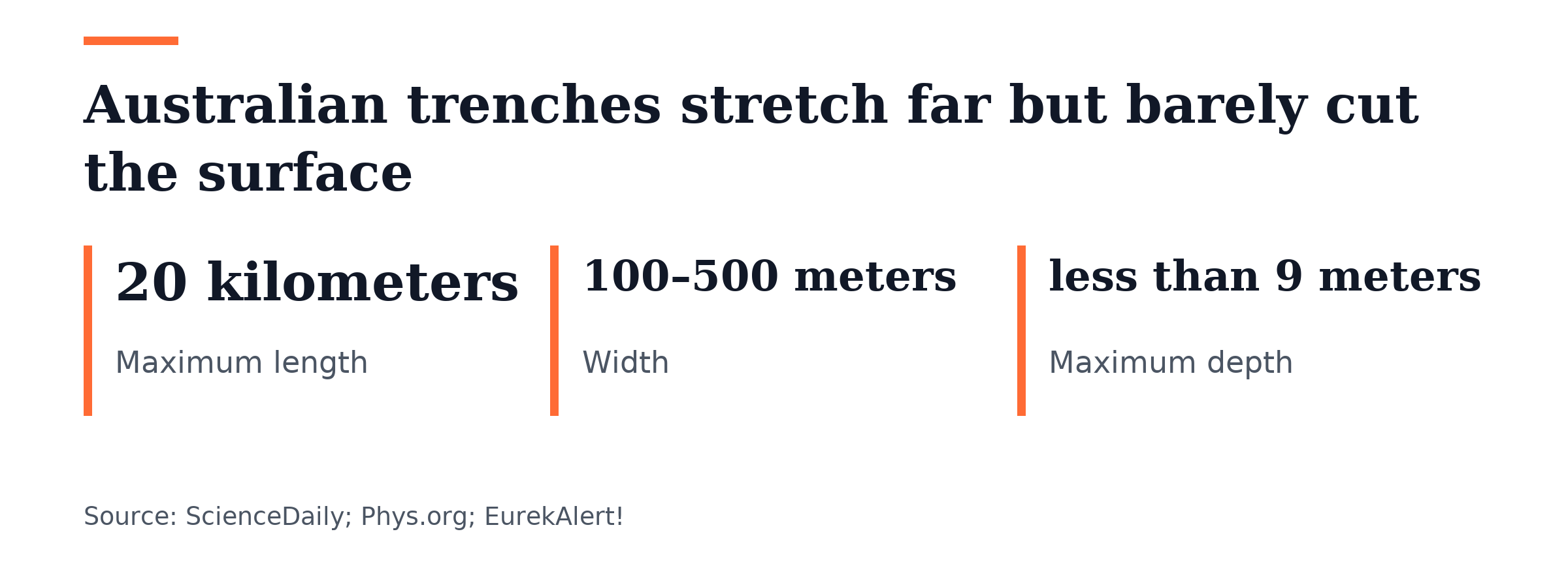
- The trenches run up to 20 kilometers long and 100–500 meters wide but less than 9 meters deep, trend roughly north-south, begin and end abruptly, and lack connected streams or water-deposited sediments.
- Researchers writing in The Conversation on Nov. 26, 2026 said the limestone of the Nullarbor came into being as an ancient shallow sea withdrew about 14 million years ago.
- Researchers writing in The Conversation on Nov. 26, 2026 said the Mirning People observed sea levels rise and fall as the last ice age built up and collapsed around 20,000 years ago.
- Researchers writing in The Conversation on Nov. 26, 2026 said water has worn away the limestone of the Nullarbor over millions of years, forming complicated cave systems that may run for kilometers below ground.
Researchers have found that long shallow trenches across Australia’s Nullarbor Plain are surface signs of buried cave systems falling inward over millions of years, not valleys cut by rivers, according to work published Sept. 17, 2026 in Communications Earth & Environment.
Communications Earth & Environment published the study Subdued surface expression of deep cave collapse on Sept. 17, 2026. The lead researcher, Dr. Matej Lipar, had been an adjunct research fellow at Curtin University’s School of Earth and Planetary Sciences and now works at the Anton Melik Geographical Institute in Slovenia, part of ZRC SAZU. Researchers from The University of Western Australia, La Trobe University, the University of Ljubljana and The University of Queensland took part in the work. The work received support from the Slovenian Research and Innovation Agency.
The trenches run up to 20 kilometers long and 100–500 meters wide but less than 9 meters deep. They trend roughly north-south and begin and end abruptly, with no connected streams or water-deposited sediments. Researchers writing in The Conversation on Nov. 26, 2026 said the long shallow trenches are almost invisible from the ground but clearly visible in modern digital landscape models.
The scientists say the trenches show where underground cave systems fell inward over millions of years. Dr. Matej Lipar explained that cave roofs fell in piece by piece over time, letting material above them droop until shallow hollows formed at the surface. These trenches lie above deep zones of fractured rock and line up in places with documented caves and sinkholes.
Researchers used imaging analysis along with drone and aerial photos and satellite-based digital landscape models to map the trenches. The team also measured rock layers inside boreholes and caves and used geophysical surveys to picture underground cavities as X-rays would. Dr. Matej Lipar said the team built exaggerated digital terrain models, which made the trenches far easier to spot and identify. Geophysical surveys found deep underground cavities, and several trenches lined up with known caves and places where the ground has collapsed.
Going from west to east across the plain, clear cave-linked zones give way to broader trenches that are harder to spot. The scientists say the thickness of the rock decides if collapse breaks through to the surface, so features farther east are weaker and harder to see as the rock layer above the caves gets thicker. Researchers writing in The Conversation on Nov. 26, 2026 said the Nullarbor Plain covers more than 200,000 square kilometers across southern Australia and ranks among the world’s largest limestone regions.
The limestone of the Nullarbor formed when an ancient shallow sea pulled back about 14 million years ago. Water has eaten away the limestone across millions of years, building complex cave systems that may stretch for kilometers beneath the ground. Researchers writing in The Conversation on Nov. 26, 2026 said the Nullarbor’s caves remain poorly understood in part because people know and reach them only where they open to the surface.
The Mirning People of the Great Australian Bight and the Nullarbor have occupied the southern edge for tens of thousands of years. Researchers writing in The Conversation on Nov. 26, 2026 said the Mirning People watched sea levels go up and down while the last ice age grew and fell apart around 20,000 years ago.
Researchers writing in The Conversation on Nov. 26, 2026 said the Nullarbor trenches begin and end abruptly, without ties to present-day rivers or drainage networks reaching nearby higher ground. The trenches do not show normal river branching patterns, and their sediments contain no signs of deposition by flowing water.
Associate Professor Milo Barham said the dry, stable Nullarbor landscape cuts out much of the background noise that hides subtle land features. Colonial Victorian-era explorers described the Nullarbor Plain as a place one gets into in bad dreams, according to researchers writing in The Conversation on Nov. 26, 2026.
Researchers writing in The Conversation on Nov. 26, 2026 said the findings will change how scientists read cave landscapes around the world, showing they must look below the surface more than expected to explain what they see at ground level. Pockmarked karst landscapes spread across 15% of Earth’s ice-free surface and supply drinking water to 10–25% of the world’s people. Understanding where underground voids sit helps planners design surface and subsurface engineering work, lower geological hazards, and reach and protect groundwater supplies.
Caves serve as important archives because shelter from surface weathering and erosion lets them keep snapshots of ancient environments and ecosystems lost to time. Caves may be home to strange and vulnerable life-forms that evolved in isolation, and these organisms rank among the least studied on Earth. Researchers have to find cave structures before they can learn more about them.
These caves offer steady conditions and shielding from harmful space radiation, making them good sites for exploring other planets. Surveys of planetary surfaces across the Solar System have found many possible caves, including some believed tied to karst on Mars. The dry, stable surface of the Nullarbor serves as an excellent analogue for finding hidden cave systems on planets without an active water cycle, such as Mars. Researchers writing in The Conversation on Nov. 26, 2026 said the research provides a new method to trace buried cave systems and locate hidden caves elsewhere, even beyond Earth.
Even caves with no life could still work as attractive bases for future human explorers. The trenches studied are probably not the only ones, and similar subtle landforms are likely missed elsewhere around the world or on other planets.

Join the discussion