Key facts
- NWA 8171 is one of 18 fragments from the same Martian meteorite fall, and the best-known piece from that fall is nicknamed Black Beauty (NWA 7034).
- The mineral is andradite, an iron-rich form of garnet that is often yellowy-green rather than deep red.
- Researchers initially assumed the odd chemistry indicated pyroxene, a common mineral, before follow-up analyses confirmed andradite.
- Tanya Kizovski, planetary geologist at Brock University in Canada, said the chemistry was a bit odd and that the discovery expands knowledge of geologic processes possible on Mars.
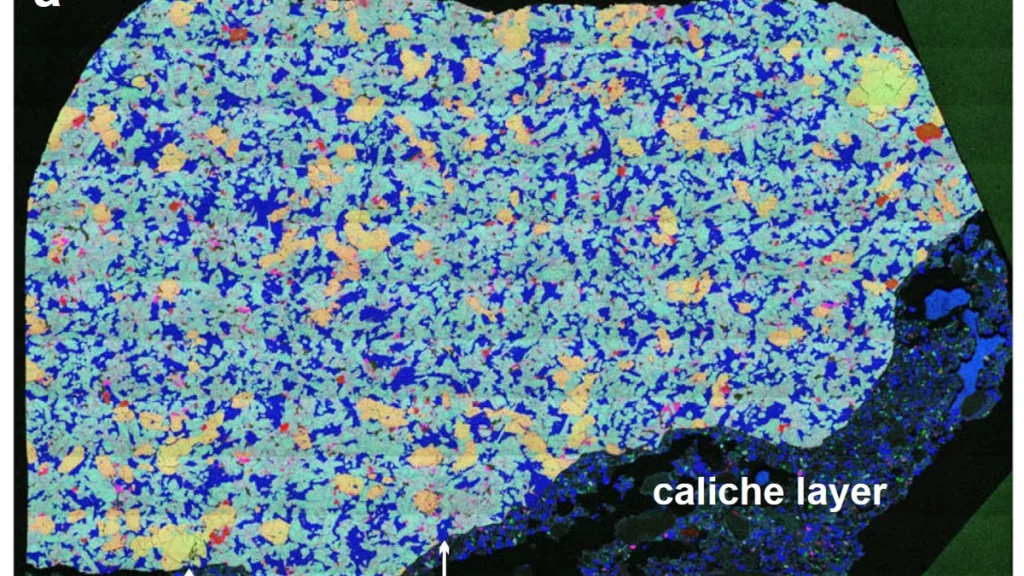
Researchers found grains of andradite, an iron-rich garnet never before identified in a Martian sample, inside a fragment of the meteorite NWA 8171 held in the Royal Ontario Museum’s collection. ScienceAlert reported the discovery.
The fragment measures roughly 0.8 by 0.5 millimeters, smaller than a poppy seed. Tanya Kizovski, a planetary geologist at Brock University in Canada, said the section looked interesting and the chemistry seemed odd, prompting a second look.
The team first assumed the odd chemistry indicated pyroxene, a common mineral, before follow-up analyses confirmed andradite. Andradite is an iron-rich form of garnet that is often yellowy-green rather than deep red. That yellowy-green shade resembles other minerals commonly found in meteorites and does not stand out, which helps explain why the grains stayed hidden.
NWA 8171 is one of 18 fragments from the same Martian meteorite fall whose best-known piece is nicknamed Black Beauty, or NWA 7034. The Royal Ontario Museum’s fragment is part of that same fall. The rock consists of basaltic breccia, created when magma hardens around embedded mineral masses. Researchers compare its structure to a fruitcake, with basalt forming the doughy cake and mineral inclusions acting as fruits and nuts.
Garnets preserve records of past geological processes, including temperature and pressure conditions, and can be used to date those conditions and reveal formation chemistry. Like many minerals, garnet does not always look as expected. The grains often contain traces of other minerals that reveal the chemistry of the environment in which they formed.
The discovery raises questions about whether the garnet formed on Mars. It also raises questions about what process produced it. On Earth, garnet forms under intense heat, pressure, or chemical alteration, but the right conditions for garnet have never been identified on Mars.
Kizovski said garnet is a mineral typical of metamorphic rocks on Earth, and she described metamorphism as a process that changes igneous or sedimentary rock using extreme heat, high pressure, or hot fluids.
The heat and pressure needed to produce Martian garnet through metamorphism could have come from a meteorite impact. It could also have come from rising magma, or from both. The formation environment remains unknown. The researchers still do not know the exact formation environment or whether an unusual magma was involved.
She also said the find expands knowledge of the geologic processes possible on Mars.
Researchers cannot rule out that the garnet did not form on Mars. It may have arrived in the breccia after originating elsewhere. Because NWA 8171 is a breccia made of multiple materials, the fragment could theoretically have originated elsewhere, landed on Mars, and later become incorporated into the breccia.
The next investigative step is to examine isotope ratios in the mineral to determine whether they match other Mars minerals. If the ratios match, the garnet would be confirmed as Martian and could shed new light on the planet’s deep geological history.
The researchers currently do not know whether the garnet formed in an unusual magma not yet found on Mars. It might have formed through a metamorphic process instead. They plan to examine isotope ratios next, and matching ratios with other Mars minerals would indicate a Martian origin.
The findings were published in Geochemical Perspectives Letters. The publication describes garnets as superb storytellers of Martian geology, from ancient magma flows to information locked inside grains. James Darling, a planetary scientist at the University of Portsmouth in the UK, said the findings add a new dimension to understanding of Martian geology. Darling described the discovery as opening an exciting new window into the evolution of the planetary neighbor.
“This discovery is going to expand our knowledge of the geologic processes that are possible on this planet,” Kizovski said.

Join the discussion