Key facts
- FNRS Ph.D. students Maria Groyne and Cedric Baijot study at the University of Liège under Michaël De Becker, who is an astrophysicist and heads the MEGA Laboratory at ULiège.
- Kinetic models bridge observational, laboratory, and theoretical branches of astrochemistry by calculating how molecular quantities change over time according to the rates at which processes create or destroy them.
- Infrared spectra recently obtained by the James Webb Space Telescope confirm that grain-surface chemistry and resulting species populations are extremely complex, requiring more realistic incorporation into models.
- Deterministic models published to date describe these mechanisms but rely on two significant approximations identified by the researchers.
University of Liège astrophysicists developed DESTINY, a deterministic model of molecular chemistry on icy, irregular interstellar dust grains, using absorbing-state Markov chains, according to research published in Astronomy & Astrophysics in 2026. The team includes FNRS Ph.D. students Maria Groyne and Cedric Baijot, who study under astrophysicist Michaël De Becker, director of the MEGA Laboratory at ULiège. The University of Liège team says the mathematical technique had not yet been used in astrochemistry. DESTINY addresses chemistry on tiny ice-covered dust grains in interstellar space, where molecules form both in the gas and on surfaces.
Kinetic models bridge observational, laboratory, and theoretical branches of astrochemistry by calculating how molecular quantities change over time according to the rates at which processes create or destroy molecules. Astrochemistry research splits into astronomical measurements, laboratory replication of interstellar conditions, and theoretical work on specific molecules or reactions. Kinetic models connect these by using experimental and calculated parameters to predict abundances that observers can check against telescope data. Observers then compare these predicted abundances with telescope measurements of molecular abundances.
Recent infrared spectra obtained by the James Webb Space Telescope confirm that grain-surface chemistry and resulting species populations are extremely complex, requiring more realistic incorporation into models. This observational evidence motivates the need for more realistic surface chemistry in astrochemical models.
According to Maria Groyne and Cedric Baijot, grain-surface chemistry results from a balance between adsorption of gas molecules, surface processes such as diffusion and encounters, and desorption back into the gaseous phase. The students describe adsorption as gas molecules settling on the surface, desorption as molecules leaving to return to the gas phase, and surface processes as diffusion and encounters between reaction partners. Deterministic models published to date describe these mechanisms but rely on two significant approximations identified by the researchers.
The first approximation gives just one binding energy per chemical species. Interstellar ice is amorphous rather than crystalline in extremely cold conditions, so its disordered surface presents binding sites whose strength varies with the local environment. Most existing models assign just one binding energy per chemical species, which the researchers identify as the first simplification. In these conditions, the disordered surface of amorphous ice offers binding sites of differing strength based on where a molecule lands, and the local environment determines how tightly a species adheres to the grain.
In the second approximation, two surface species affect one another solely upon reacting. Yet even a basic meeting can change how tightly a molecule sticks to the surface. Under the standard formalism, two species on a surface affect each other only when they react, but the researchers say a simple encounter can change how strongly a molecule binds to the surface. This interaction effect is the second approximation that current models miss.
The binding strength can shift even when no chemical reaction takes place.
DESTINY overcomes both simplifications by classifying surface sites according to binding energy and deterministically tracking each adsorbed species through stages where it remains, diffuses, reacts, or leaves. Cedric Baijot explains that the model was built entirely from scratch to remove both simplifications. The model sorts surface sites by binding energy and follows each adsorbed species deterministically through stages where it stays, moves, reacts, or desorbs. By removing these assumptions, DESTINY treats the grain surface as a more realistic, uneven environment where every site has its own character.
Markov chains with absorbing states enable DESTINY to handle competing outcomes consistently, as explained by Cedric Baijot. A Markov chain transitions randomly between states where the probability of the next step depends only on the current state, not the path taken, a property called memorylessness. An absorbing state is one from which escape is impossible, like the finishing square in the Game of the Goose, and these chains calculate final-outcome probabilities and average steps to reach them. The model uses absorbing-state Markov chains to manage the possible outcomes for each adsorbed species at every stage of its path across the grain surface.
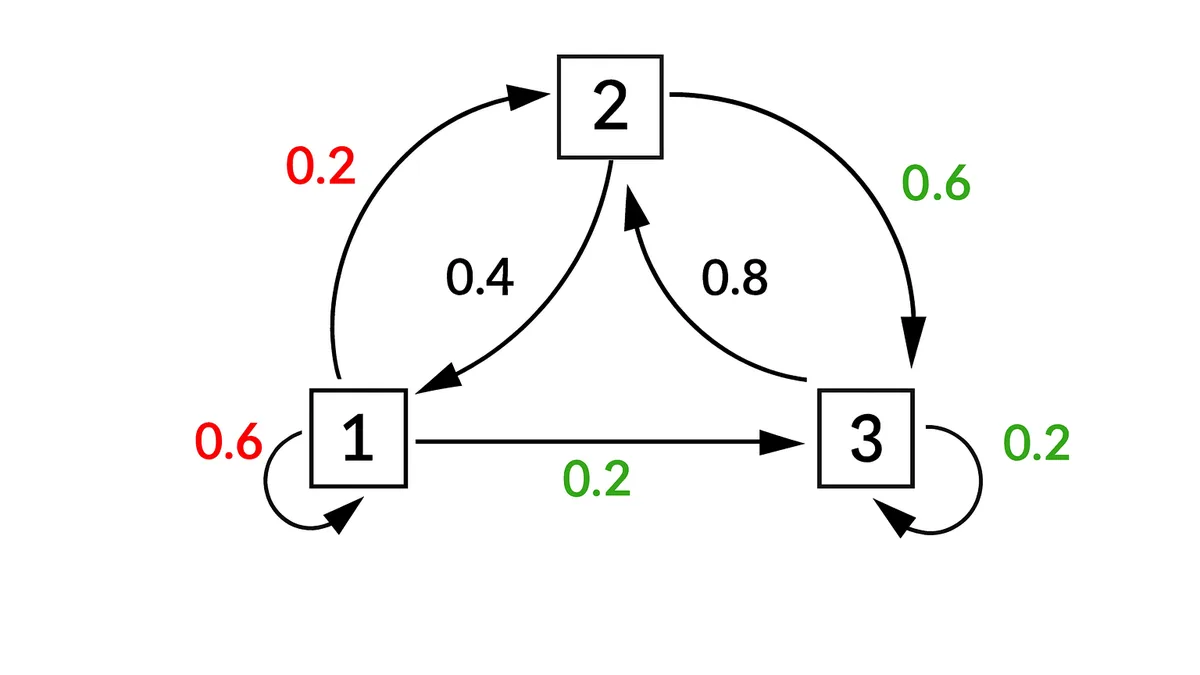
In the researchers’ dance-floor analogy, classical models treat all tiles as identical with molecules behaving the same everywhere, while two dancers meeting and dancing together represent a chemical reaction. With DESTINY the dance floor becomes uneven with sticky and slippery tiles, so identical molecules may meet different fates depending on location, and another molecule’s presence can alter movements without a reaction. “With DESTINY, the dance floor becomes uneven,” Maria Groyne said. The analogy captures how location and the presence of neighbors shape molecular fate in the new model.
The researchers’ example shows that for dihydrogen, a meeting of two H2 molecules may set one molecule moving or throw it into the gas phase. This illustrates how an encounter between two molecules can alter movement without a chemical reaction. The presence of another molecule can change movement without triggering a reaction, as shown by the dihydrogen case. One H2 molecule may begin to move across the surface, or it may be ejected into the gas phase after meeting another H2 molecule.
Initial analyses show a single species distributes across sites with varying energy levels, influencing surface chemistry. The team finds methane trends encouraging compared with previous models but says further investigation is needed before firmer conclusions can be drawn.
Michaël De Becker says this work opens fresh avenues for deterministic astrochemical modeling of solid-phase materials, with such prospects only now starting to be explored. “This opens a new door to deterministic astrochemical modeling in the solid phase,” De Becker said. The MEGA Laboratory director supervised the students and emphasizes that the work opens a new door to deterministic solid-phase astrochemical modeling. He says the prospects are only beginning to be explored.
The work is primarily fundamental research aiming to improve understanding of interstellar-medium chemistry. Longer term, the team hopes to shed light on the origin of life-associated molecules and molecular complexity elsewhere in the universe. This goal connects grain-surface chemistry to broader questions about how complex molecules arise in space. The researchers seek to explain how molecular complexity develops in the interstellar medium.
The study’s authors say the model could in the long term apply to other environments such as natural aerosols in Earth’s atmosphere or Mars’s atmosphere, though this avenue remains to be explored. DESTINY describes chemistry on solid and irregular surfaces, which supports this possible extension. The authors note this application remains to be explored and has not yet been demonstrated. Natural aerosols and planetary atmospheres present other solid, irregular surfaces where the model might eventually prove useful.
The paper, titled DESTINY: A new binding-energy-resolved astrochemical model by Maria Groyne et al., appeared in Astronomy & Astrophysics in 2026. The study emerged from the University of Liège’s MEGA Laboratory under De Becker’s supervision, and FNRS supports the doctoral work of Groyne and Baijot.



Join the discussion