Key facts
- Exponent can reach a launch mass of 300 kg, carries 100 kg of payload, supplies 1.5 kW of orbit-average power, lasts at least three years, delivers 500 m/s of delta-V, and fits any launch vehicle in a stackable layout.
- Its factory is arranged for autonomous assembly and runs lights out on a 24/7 basis to reach those costs.
- Inflection Space Systems has secured its first orbital mission, named Pax, with launch targeted no earlier than 2028, arranged as a rideshare through Exolaunch.
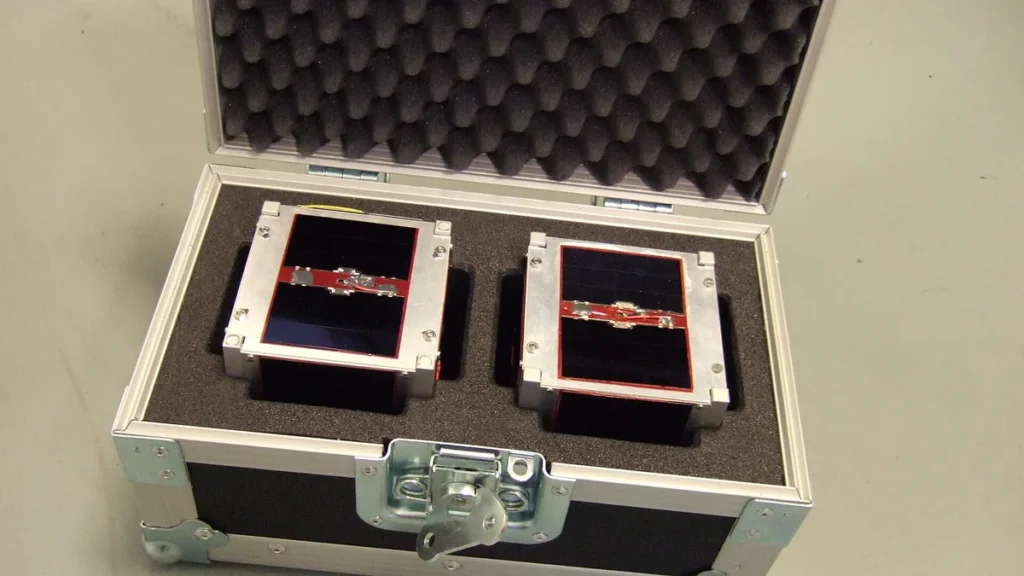
- Pax is a 16U cubesat weighing 36 kg, flying to validate avionics, sensor, power, and structural hardware meant for Exponent.
Payload reported that Inflection Space Systems has secured its first orbital mission, Pax, targeting launch no earlier than 2028 on a rideshare arranged through Exolaunch.
Pax is a 16U cubesat—a type of small satellite—weighing 36 kg, and it will fly to validate avionics, sensor, power and structural hardware meant for Exponent. The spacecraft serves as the pathfinder for Inflection’s Exponent bus, Payload reported on Nov. 18, 2026, and the outlet describes Exponent as substantially larger than the pathfinder. Exponent can reach a launch mass of 300 kg, carry 100 kg of payload, supply 1.5 kW of orbit-average power, last at least three years and deliver 500 m/s of delta-V, a measure of change in spacecraft velocity, in a stackable layout that fits any launch vehicle.
Inflection’s website, published Jan. 1, 2026, describes Exponent as standardized rather than modular, with full vertical integration from the start and a self-compatible hardware stack. The bus supports data infrastructure, telecommunications, imaging and mission types. The company designs and builds all hardware in-house, made from the ground up for affordability, scalability and reliability. Inflection says reducing unique parts across spacecraft leads to stronger supply chains, simpler logistics and quicker manufacturing, and that it designs everything it makes for autonomous assembly.
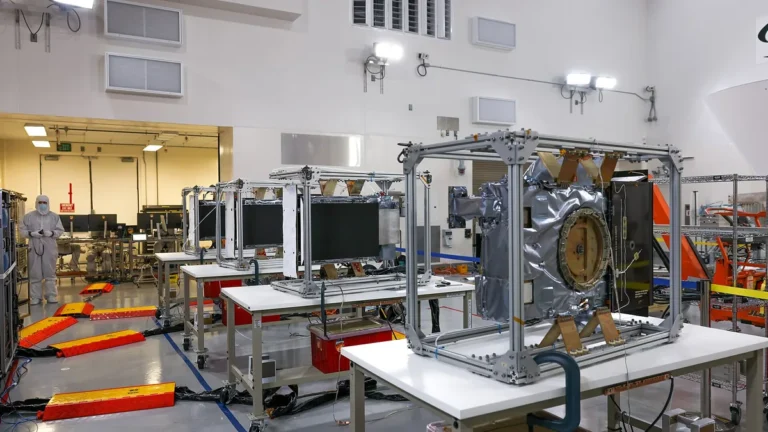
The company’s website says all of its processes are AI-native and built for automation, covering supply chain management, part conveyance, and electrical and software testing. Fungible tooling—equipment that can be repurposed quickly—allows production line changes in hours rather than weeks. The factory is arranged for autonomous assembly and runs lights out on a 24/7 basis to reach those costs.
On Nov. 18, 2026, Payload reported that Inflection builds its own hardware and flight software, so it designs each part for mass production, part of what the outlet calls an aggressively vertically integrated approach. Inflection lists Exponent at $1.5M for one unit and cuts the price to $700K each for orders of 100 or more. Volume discounts are central to the business model, which Payload characterizes as a Costco model in which buying more satellite buses brings a bigger bargain.
Payload reports that Inflection aims to complete critical design on Exponent and produce a first unit before 2027 ends, followed by a production ramp-up in 2028. The outlet says the Pax flight runs in parallel with that schedule and will test manufacturing readiness level as well as technology readiness level. Lisso said on Nov. 18, 2026 that Inflection plans to build a single satellite design in volume, betting that orbital data center, Golden Dome and satcom constellations will demand far more spacecraft than the industry has ever produced.
Payload reports that Pax will carry a radiation testbed from The Radiation Team and Indiana University’s Center for Reliable & Trusted Electronics. The testbed will stay energized for the remainder of the three-year mission after commissioning, and Lisso said its customers benefit from having it operate as long as possible. It is one of two customer payloads planned for the three-year mission. The same mission will also fly a second customer tech-demo payload whose name has not yet been announced.
On Nov. 18, 2026, Alex Lisso, Inflection’s chief executive and cofounder, said space manufacturing is structurally high-mix and low-volume, while his firm wants low-mix, high-volume manufacturing instead. “Manufacturing is structurally, in our experience in the space sector, high-mix, low-volume,” Lisso told Payload. He said most satellite makers still build only a handful of each design, often tailoring the design to one customer. Lisso also said 30,000 satellites is trivial compared with the number of drones, boats, cars or iPhones people have built.
Y Combinator backs Inflection, whose founders Alex and Matt built and operated spacecraft at Rocket Lab, Millennium Space Systems, Planet Labs and Loft Orbital. On Oct. 13, 2026, Y Combinator said the founders had conducted classified government missions, facilitated in-space manufacturing with Varda, and sent something to the Moon on Lunar Photon. The founders say they have first-hand experience that space manufacturing is slow, expensive and antiquated, and they intend to fix it.
Next-generation constellations for orbital data centers, Golden Dome, lunar infrastructure and global direct-to-device connectivity will require hundreds of thousands of spacecraft, according to Y Combinator. Inflection is building industrial capacity to produce tens of thousands of spacecraft annually, envisioning a factory resembling an Amazon fulfillment center rather than a NASA-style clean room.


Join the discussion