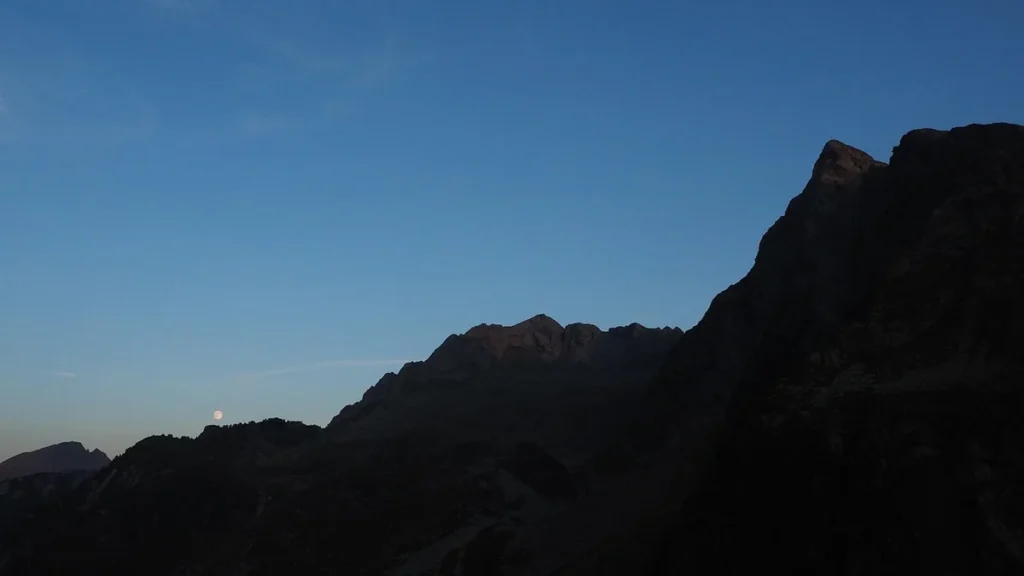
Key facts
- Neptune is 4° south, below the Moon, while Saturn is 8° to the Moon's southeast, to its left.
- Saturn alone is visible to the naked eye, but Neptune is too faint and needs binoculars or a telescope, preferably a telescope because the nearby bright Moon favors higher magnification.
- Saturn's disk is 19" across while its rings run some 44" from end to end.
- Titan sits just northeast of Saturn. Around midnight CDT, Rhea and Tethys appear east of the planet while Dione stands to the west.
The Moon passes five degrees north of Neptune at 11 P.M. EDT on Oct. 23, 2026, appearing with Saturn in a celestial triangle above the southeastern horizon.
Astronomy Magazine‘s Friday, Oct. 23, 2026, sky column places the Moon-Neptune approach at 11 P.M. EDT among that night’s events, following a note that Iapetus was at superior conjunction on Oct. 22, 2026.
By early evening on Oct. 23, 2026, the Moon, Neptune and Saturn stand above the southeastern horizon at an observing site at 40° N 90° W, and by local midnight the trio is high in the south after rising in the southeast at dusk, as the column describes its path through the night. The column gives sunset at 6:09 P.M., sunrise at 7:19 A.M., moonrise at 4:41 P.M. and moonset at 4:26 A.M. for that site, outlining the daily cycle for observers.
The waxing gibbous Moon (more than half illuminated) is 95% illuminated at 10 P.M. local time at that site, and the column lists this phase and illumination for the October 23, 2026, observing site while noting that the nearby bright Moon favors higher magnification.
The column gives the angular separation of each planet from the Moon for the October 23, 2026, evening, placing Neptune four degrees south beneath the Moon and Saturn eight degrees to the Moon’s southeast, to its left, so the three objects together form a celestial triangle. Saturn alone is visible to the naked eye, but Neptune is too faint to see without optical aid, making optical assistance necessary for the distant planet.
Astronomy Magazine contrasts naked-eye Saturn with faint Neptune on the night of Oct. 23, 2026, and recommends binoculars or a telescope for Neptune, preferring a telescope over binoculars because the nearby bright Moon favors higher magnification for that observing session. ScienceDaily, citing NASA’s Jet Propulsion Laboratory, notes Neptune shines at about magnitude 8.
Through a scope Neptune appears as a flat, bluish-gray star, and its disk extends two arcseconds across. Astronomy Magazine describes the telescopic view on Oct. 23, 2026 as a very small disk, and the bright Moon makes higher magnification the better option for viewing the distant planet.
Saturn’s disk is 19 arcseconds across, and the column gives Saturn’s size on Oct. 23, 2026, contrasting the planet’s disk with a ring system that runs some 44 arcseconds from end to end. Titan sits just northeast of Saturn, and around midnight CDT Rhea and Tethys appear east of the planet while Dione stands to the west, as the column lists positions of Saturn moons around midnight Central time on the night of Oct. 23, 2026.
Iapetus, about 11th magnitude, remains relatively nearby around two arcminutes southeast of Saturn, and Astronomy Magazine calls it a good chance to see many of Saturn’s moons close together on Oct. 23, 2026. The column notes Iapetus was at superior conjunction on Oct. 22, 2026, placing it in the same evening’s observing notes.
ScienceDaily, citing NASA’s Jet Propulsion Laboratory, describes a similar gathering on Sept. 26, 2026, when the Harvest Moon rose near Saturn and Neptune, forming a broad triangle.


Join the discussion