Key facts
- NASA Administrator Jared Isaacman told employees in an internal email that Artemis III is about 90 days behind schedule, making a summer 2027 launch a best-case scenario.
- NASA has assigned Randy Bresnik as commander, with Andre Douglas, Frank Rubio and European Space Agency pilot Luca Parmitano as the Artemis III crew members.
- Artemis IV and Artemis V are the program's first two crewed lunar landing missions and are targeted to launch in 2028.
- Blue Origin's lunar lander would launch on New Glenn, and SpaceX's lunar lander would launch on Starship, each on the company's own rocket.
NASA Administrator Jared Isaacman told employees in an internal email that Artemis III is about 90 days behind schedule, making a summer 2027 launch a best-case scenario. Isaacman wrote that many decisions and problems remain and that the schedule still has opportunities to recover. NASA Watch published the email after Isaacman confirmed its authenticity to Mashable.
In the best case, Artemis III could launch in the summer of 2027 while preserving up to two lunar landing attempts in 2028. If Artemis III continues to lag, NASA might have only one chance to put astronauts on the moon in late 2028, Isaacman said in the email. Artemis IV and Artemis V are the program’s first two crewed lunar landing missions, and NASA targets them for launch in 2028.
NASA will hold a news conference on Oct. 23, 2026, at 2 p.m. ET at Kennedy Space Center in Florida, led by Administrator Jared Isaacman, to provide an update on the Artemis lunar campaign, including progress toward returning astronauts to the moon by 2028.
NASA has assigned Randy Bresnik as commander, with Andre Douglas, Frank Rubio and European Space Agency pilot Luca Parmitano as the Artemis III crew members. The four will fly to Earth orbit in the Orion spacecraft atop the Space Launch System rocket. The crew announcement followed NASA’s February architecture overhaul that placed Artemis III between Artemis II and the first landing.
Unlike Artemis II, a 10-day mission around the moon without landing flown in 2026 by NASA astronauts Reid Wiseman, Victor Glover and Christina Koch and Canadian Space Agency astronaut Jeremy Hansen, Artemis III is a crewed Earth-orbit flight to rehearse docking Orion with lunar landers built by SpaceX and Blue Origin. NASA does not plan to put astronauts on the moon during Artemis III.
In an Oct. 7 blog post, NASA said it uploaded more than 800 gigabytes of unreleased Artemis II lunar science data, including 11,000 full-resolution images and video, to the Planetary Data System public archive. The release included some Artemis II lunar science material that had not appeared publicly before.
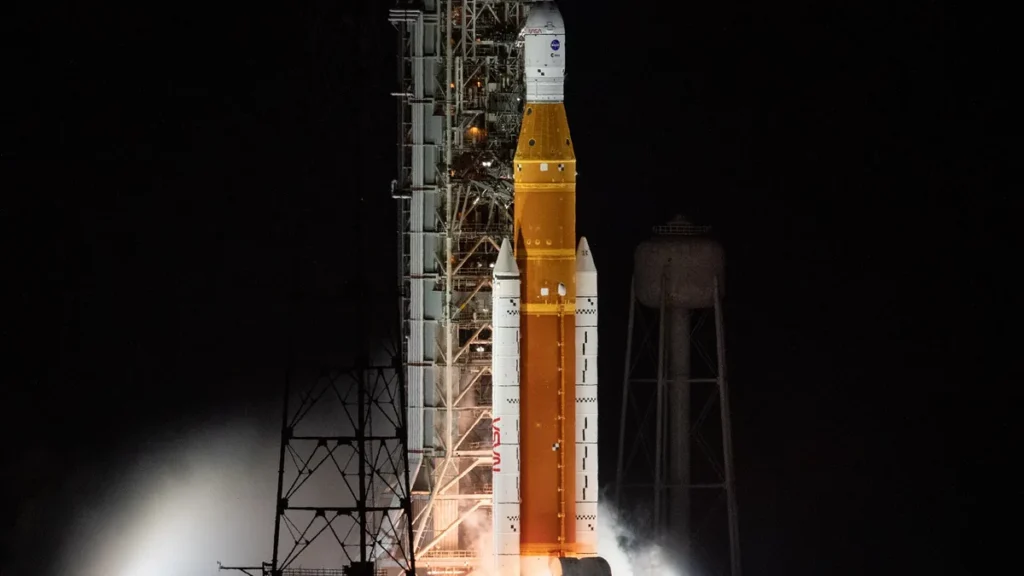
Teams at Kennedy Space Center in Florida are continuing to assemble the Space Launch System rocket for the Artemis III crewed flight, according to NASA’s Oct. 13 blog post. The agency describes the Space Launch System as the most powerful rocket it has ever developed, and it will carry the crewed Orion capsule and the Artemis III astronauts to orbit from Kennedy Space Center.
Blue Origin’s lunar lander would launch on New Glenn, and SpaceX’s lunar lander would launch on Starship, each on the company’s own rocket. Artemis III will attempt to dock with and test these two commercial lunar landers in Earth orbit as part of the crewed flight test. Both the SpaceX and Blue Origin human landers must work properly before astronauts can walk on the lunar surface again.
The Artemis program seeks to return American astronauts to the moon for the first time since Apollo ended in 1972 and to build a $20 billion outpost called Moon Base where astronauts can live and work long term. The Moon Base would sit at the lunar south pole in an area roughly the size of Virginia, where deep shadowed craters may hold ancient ice and other frozen material. NASA says harnessing those resources for water and fuel could let astronauts avoid constant resupplies from Earth and become more self-sufficient.

In February, NASA overhauled the Artemis architecture, inserting Artemis III between Artemis II’s lunar flyby and the first crewed landing and setting aside the Gateway orbiting lunar station for a surface moon base instead. Isaacman said staying with Gateway would have let China advance landers with rovers and hopper drones and potentially deny access to desirable lunar locations.
Isaacman told employees that continuing the current approach cannot succeed in the competition with China because too much is at stake. “Perpetuating the status quo is not an achievable strategy in this race,” Isaacman said.
NASA is coordinating directly with suppliers and subcontractors to fix delayed components such as valves and rocket-steering parts, and the agency is building some hardware in-house to speed production. Isaacman made these points in the same Sunday email to employees in which he discussed the Artemis III schedule delay.
NASA officials emphasized that the agency will not hurry the Artemis III launch and will fly only once fully ready amid growing competition with China. The contest with China is heating up and may resolve in months rather than years.
NASA said the Artemis program aims to put astronauts, technology and vehicles on the moon, so the agency can prepare for crewed expeditions to Mars. The agency called the Artemis campaign a multibillion-dollar effort to return American astronauts to the lunar surface for the first time in more than 50 years.
The story draws on an internal workforce memo from Administrator Jared Isaacman published by NASA Watch editor Keith Cowing. Cowing shared a copy of the memo with FOX 35 reporter Esther Bower on Thursday and discussed its significance. NASA did not respond to FOX 35’s request for comment on the internal memo before publication.
Cowing said everybody from the top to the bottom, including contractors, received the memo, and that memos like this come from Jared Isaacman. Cowing said, “when you get memos like this, they’re from Jared”.
Keith Cowing said the aspirational goal for NASA is to launch Artemis III in 2027, calling it a push. Cowing said there is a question about whether the SpaceX and Blue Origin vehicles work, that contractors could be contributing to the delays, and that NASA is probably the best prepared of the three parties because it has a working spacecraft and is stacking the rocket.




Join the discussion