Key facts
- Mercury reaches its stationary point in the constellation Libra at 8 A.M. EDT on October 24, 2026, according to Astronomy Magazine.
- Observers with a clear horizon can view Mercury briefly after sunset in the western sky on October 24, 2026, Astronomy Magazine reports.
- Astronomy Magazine noted a Neptune and Moon pairing on October 23, 2026.
- EarthSky reports that Mercury reached its greatest elongation on October 12, 2026, at 10 UTC.
Mercury reaches its stationary point in the constellation Libra at 8 A.M. EDT on Oct. 24, 2026, Astronomy Magazine reported, and the planet is briefly visible after sunset low in the western sky. The standstill indicates the end of the planet’s eastward or prograde movement. Following this event, Mercury will move in a retrograde or westward direction.
Astronomy Magazine said observers with a clear horizon can spot Mercury as a magnitude 0.5 point of light roughly 20 to 30 minutes after sunset on Oct. 24, 2026. The planet will stand 2.5° high in the southwest 20 minutes after the sun sets, then drop to 1° high in the west 10 minutes later.
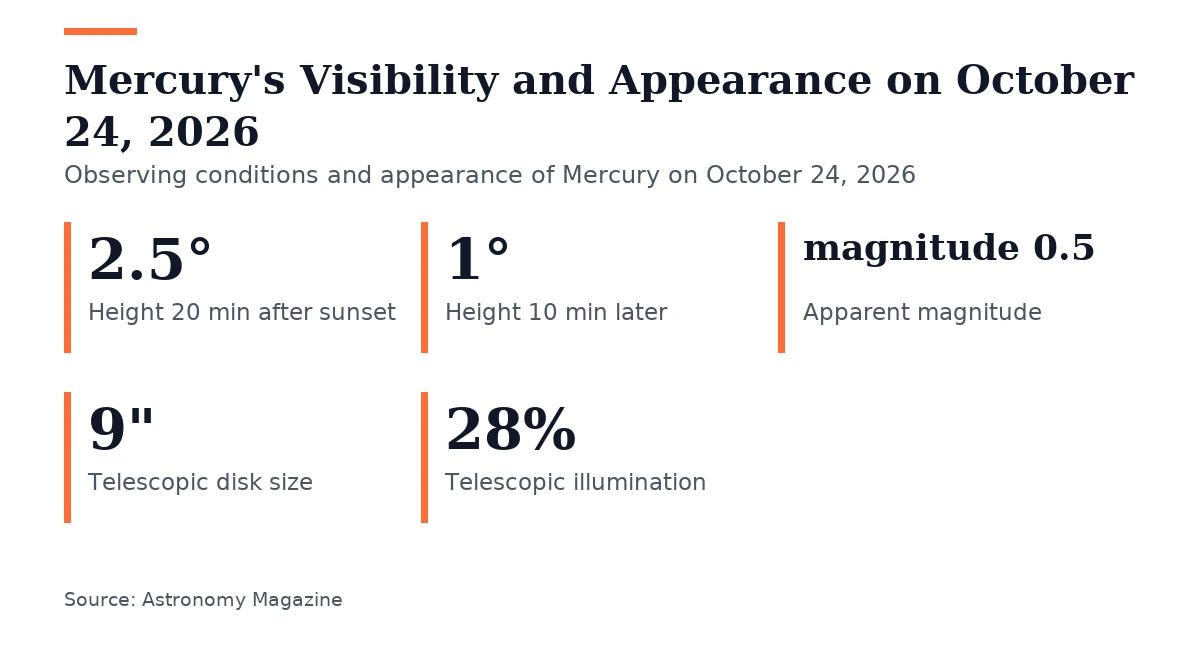
Through a telescope on Oct. 24, 2026, Mercury’s disk will measure 9″ across and show 28 percent illumination, according to Astronomy Magazine. The magazine’s Sky This Week column for Saturday, Oct. 24, 2026, describes Mercury as only briefly visible after sunset and recommends a clear horizon for the attempt.
Astronomy Magazine suggests sweeping the area slowly with binoculars on Oct. 24, 2026, but only once the Sun is fully below the horizon. The same column pairs the binocular suggestion with a safety warning, telling readers not to use optical aid until the Sun is below the horizon.
For its reference location of 40° N 90° W, Astronomy Magazine listed sunrise at 7:21 A.M. and sunset at 6:07 P.M. local time on Oct. 24, 2026. Moonrise came at 5:05 P.M. and moonset at 5:35 A.M., with the waxing gibbous Moon at 98 percent illumination at 10 P.M. local time. All of those sun and Moon times are calculated from 40° N 90° W.
Astronomy Magazine explained that the standstill marks the end of Mercury’s eastward, or prograde, movement. After Oct. 24, 2026, the planet begins westward retrograde motion, which carries it back past Alpha Librae and into Virgo by early November. The planet’s movement into Virgo will occur alongside Venus.
EarthSky stated that Mercury will reach inferior conjunction on Nov. 4, 2026, at 14:00 UTC. At inferior conjunction, the planet passes between Earth and the sun, which will cause Mercury to disappear late in October.
EarthSky reported that Mercury reached greatest elongation on Oct. 12, 2026, at 10 UTC, or 5 a.m. CDT, when it stood 25 degrees from the sun. This represented the best evening apparition of the year for observers in the Southern Hemisphere. At its Oct. 12, 2026 greatest elongation, Mercury lay in front of Libra the Scales, though twilight would obscure the constellation’s stars.
Through a telescope at greatest elongation, the planet appeared about 60 percent illuminated and measured 6.75 arcseconds across, EarthSky said. EarthSky tracked Mercury’s brightness as it emerged in the evening sky in September 2026, when it shone around magnitude -0.2. At greatest elongation, it was around magnitude -0.1, brighter than most stars.
The planet drops toward the horizon for the rest of October before disappearing, EarthSky noted. EarthSky says Mercury stays low above the horizon after sunset, so viewing begins as soon as the Sun drops below the horizon. The planet stays close to the Sun in the sky, so its evening appearance is brief and tied directly to sunset.
EarthSky said Mercury’s October 2026 evening apparition is best for the Southern Hemisphere, while Northern Hemisphere viewers will most likely find it too low to spot because of the low ecliptic angle. EarthSky compares 2026 evening apparitions by hemisphere, naming February 2026 as best for the Northern Hemisphere and October as best for the Southern Hemisphere.
EarthSky explained that in autumn the ecliptic sits at a narrow angle to the evening horizon but a steep slant in the morning. That geometry makes morning elongations easiest and evening elongations hardest.

EarthSky gave Mercury’s greatest possible elongation as about 28 degrees and its least distance from the sun as around 18 degrees, framing the October 12 value of 25 degrees.
Vito Technology defined elongation as the angular distance between a planet and the sun as seen from Earth, measured in degrees. The company also said greatest eastern elongation is best after sunset. StarWalk noted that Mercury’s maximum elongation is about 28 degrees while Venus can reach about 48 degrees, explaining why Mercury stays closer to the sun and is harder to see.
Vito Technology warned that a bigger separation from the sun does not guarantee an easier view, since twilight altitude, brightness, and the ecliptic angle also matter.
Vito Technology reports that Mercury will reach its next greatest elongation on Nov. 20, 2026, at 23:29 GMT, or 18:29 EST. At this western elongation, the planet at magnitude -0.5 will appear 19°37′ from the sun in Libra before sunrise. Venus will shine nearby in Virgo.
StarWalk advised looking 30 to 60 minutes after sunset for an eastern elongation and never sweeping binoculars near the Sun until it is fully below the horizon. StarWalk said Mercury is seen in twilight near the horizon rather than late at night. Inferior planets such as Mercury stay close to the sun and appear low in the sky.
StarWalk explained that inferior planets cycle from new phase at inferior conjunction to quarter phases near greatest elongation and full phase at superior conjunction. Full and new phases are hard to observe because of solar glare, leaving crescent to gibbous phases visible.
On Oct. 23, 2026, Astronomy Magazine noted a Neptune and Moon pairing.
Alison Klesman of Astronomy Magazine offered this encouragement for the attempt. “The tiny planet is only briefly visible after sunset, but if you’ve got a clear horizon, give it a try.”
Background from the sources explains that greatest elongation is the angular distance between a planet and the sun as seen from Earth. Mercury is an inferior planet, meaning its orbit lies closer to the sun than Earth’s orbit.
At greatest eastern elongation, an inferior planet is best viewed after sunset. At greatest western elongation, an inferior planet is best viewed before sunrise.



Join the discussion