Key facts
- The Fengshan section record spans 3.75 million years from about 262.5 to 258.75 million years ago and contains 29 distinct magnetic polarity zones.
- The peer-reviewed paper is titled "Geomagnetic instability as a potential deep-Earth forcing factor in the Permian environmental and biotic crisis" and appeared in National Science Review.
- Large Igneous Provinces are tied to mantle plumes, coincide with extinctions and rapid climate change, and differ wholly from modern volcanism, supporting the view that they can drive extinctions.
- The Laschamps researchers relied heavily on hypotheses, what happened 42,000 years ago remains unknown, and the work could inspire further research into mass extinction principles.
A research team led by Min Zhang at the Institute of Geology and Geophysics, Chinese Academy of Sciences in Beijing published a study Oct. 23, 2026 in National Science Review titled Geomagnetic instability as a potential deep-Earth forcing factor in the Permian environmental and biotic crisis, proposing that geomagnetic instability may have contributed to the Permian biotic crisis.C
The Fengshan section record in South China spans 3.75 million years from about 262.5 to 258.75 million years ago, covering the Guadalupian-Lopingian transition and containing 29 distinct magnetic polarity zones. Researchers collected more than 870 oriented specimens from continuous shallow-water limestones near the paleo-equator (the equator’s position at that time), and 309 produced stable, dual-polarity magnetic directions that passed rigorous demagnetization and reliability tests. In the roughly 1.7 million years immediately before the end-Guadalupian extinction, around 261 million years ago, the reversal rate reached about 11 reversals per million years, an order of magnitude above the long-term average.
The reversal spike followed the Kiaman Superchron, a tens-of-millions-of-years interval during the late Carboniferous and much of the Permian when the field held a single reversed polarity; that quiet period ended near 265 million years ago. The authors suggest descending lithospheric slabs tied to final Pangea assembly may have reached the core-mantle boundary (the border between Earth’s mantle and core) near 265 million years ago, increasing heat extraction from the core and introducing lateral heat-flux variations. Geodynamo simulations (computer models of how Earth’s core generates its magnetic field) indicate such heterogeneity can promote frequent reversals, though the models operate far from fully Earth-like conditions and remain sensitive to parameter choices.
The end-Guadalupian extinction was severe, with collapsed reef systems, sharp declines among marine invertebrates, and clear disruption to terrestrial ecosystems. It is overshadowed by the end-Permian mass extinction roughly ten million years later. Conventional explanations focus on the Emeishan large igneous province, Pangea-related sea-level fall, and resulting ocean and climate stress.
Large igneous provinces link to mantle plumes, coincide with extinctions and rapid climate change, and differ wholly from modern volcanism, supporting the view that they can drive extinctions. Universe Today states LIPs altered Earth’s atmosphere alongside the frequent reversals and extinction in the late Permian.
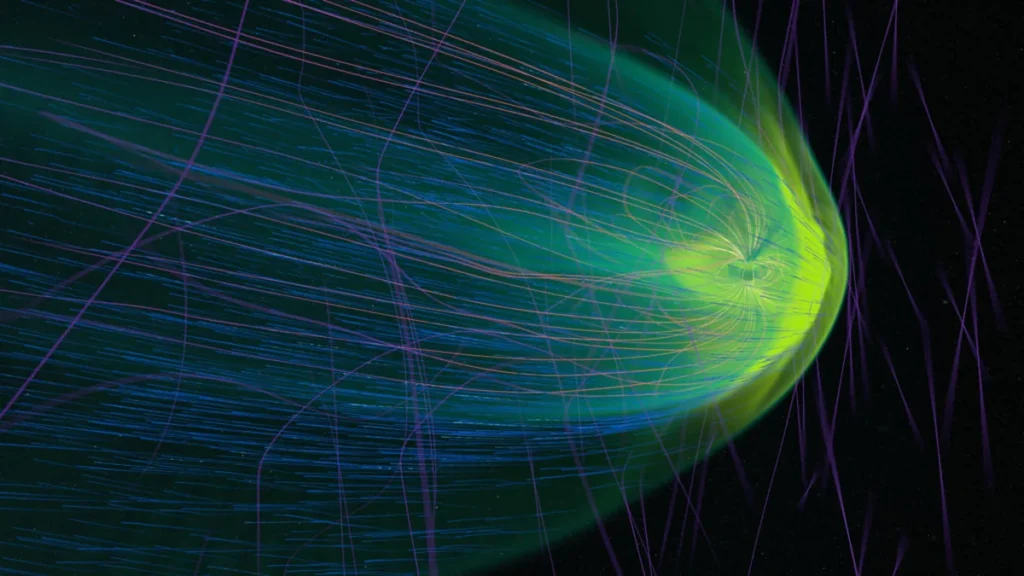
Convection of liquid iron in the outer core generates Earth’s magnetic field and forms a shield that deflects most solar wind and galactic cosmic rays, helping maintain the ozone layer. The authors say a weaker or more disordered field would reduce the ability of the magnetosphere (Earth’s magnetic shield) to deflect those particles, increasing upper-atmosphere ionization that can erode ozone and raise surface ultraviolet flux.
Scienmag and EurekAlert report that direct evidence for ozone loss at the end-Guadalupian remains limited. They note that volcanic halogens tied to large igneous provinces could have driven or contributed to any ozone loss at the end-Guadalupian boundary.
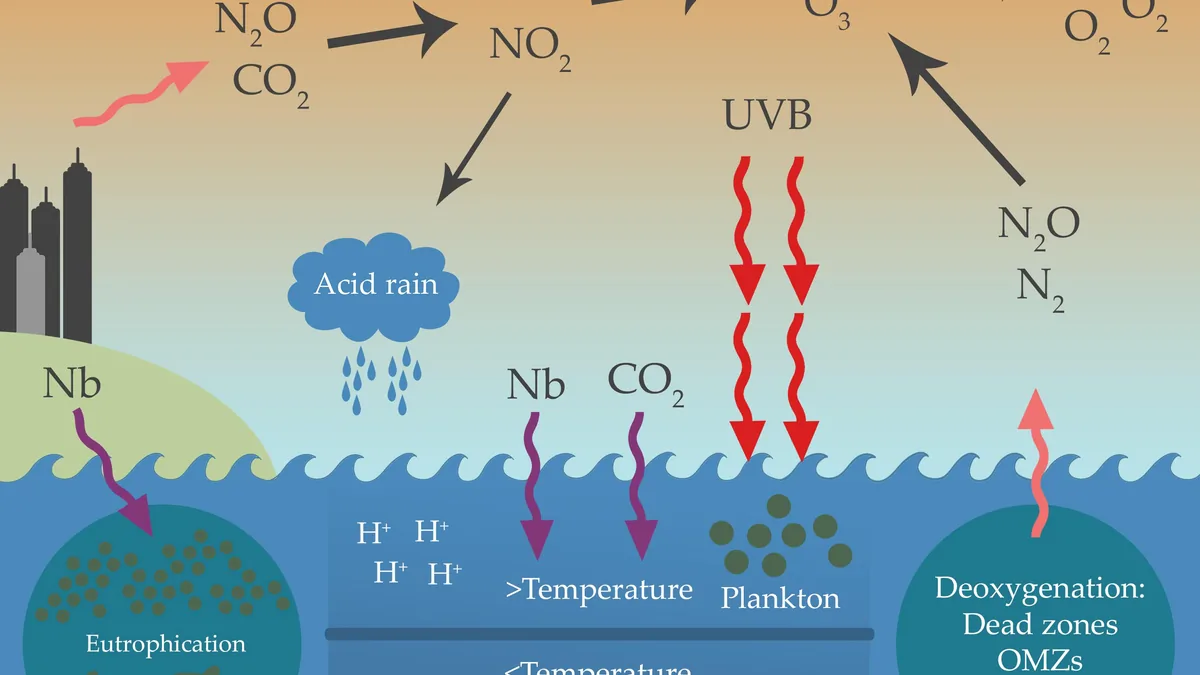
The paper does not argue that magnetic-field instability drove the extinction; instead, it frames the timing as a meaningful overlap and sketches a physically plausible mechanism through which deep-Earth processes might have worsened surface environmental stress. The authors, Min Zhang et al., say “though the causation remains unproven.”
A 2024 Science study examined the Laschamps excursion, a magnetic pole reversal about 41,000 years ago, using radiocarbon dating from New Zealand swamp kauri trees and concluded the geomagnetic field minimum caused substantial atmospheric ozone changes. The team built a precise radiocarbon record from four ancient trees at Ngāwhā Springs in northern New Zealand, showing a substantial carbon-14 increase during the field weakening before the polarity switch. The researchers relied heavily on hypotheses, and what happened 42,000 years ago remains unknown.
Reversals appear about once every 450,000 years, with 183 recorded in the last 83 million years; the last reversal occurred about 780,000 years ago, though scientists call the average a mathematical abstraction with no periodic cycle. Scientists detect reversals through paleomagnetism (the record of ancient magnetic fields in rock), because magnetic minerals in lava and ancient sediments record pole locations at the time those materials solidified or accumulated. Determining when a reversal occurred and how long it took are both difficult, and predicting a reversal is next to impossible; reversals are chaotic events that arise in long stable periods punctuated by short bursts of rapid flipping.
The authors’ composite figure in National Science Review, nwag647, displays reversal frequency and paleointensity alongside volcanic activity marked by a dark-red large igneous province phase, sea-level changes with Pangaea configuration, an atmospheric carbon profile, and species diversity spanning both the end-Guadalupian and end-Permian extinctions. The authors say the elevated reversal rate indicates geodynamo instability possibly tied to deep Earth processes, and that the temporal association of deep-Earth processes, geomagnetic instability and major environmental and biotic changes is intriguing.
The Institute of Geology and Geophysics, Chinese Academy of Sciences, led the work, with collaborators from Utrecht University, BOKU University, Nanjing University and other institutions, and the National Natural Science Foundation of China supported the work. Testing the pathway will demand better paleointensity records (ancient records of the field’s strength) across that interval, tighter age constraints, and atmospheric models that couple the processes together.




Join the discussion