
Key facts
- Japan's Hayabusa2 spacecraft is en route to 1998 KY26 for a meeting scheduled in July 2031 under its extended mission to gather dust and rock directly from the object.
- The body spans 11 meters (36 feet) and spins once every 5.35 minutes.
- The Georgia Institute of Technology research team concludes 1998 KY26 is probably a largely dry asteroid, not an active dark comet, because it is too warm to retain buried ice.
- Astronomers in a 2023 study detected an odd acceleration pushing 1998 KY26 out of its orbital plane, beyond what the Sun's gravity or planetary gravity can explain.
Researchers at the Georgia Institute of Technology concluded on Nov. 11, 2026, in a temperature model published in Icarus that 1998 KY26 is probably a largely dry asteroid, not an active dark comet, because it is too warm to retain buried ice. Japan’s Hayabusa2 spacecraft is en route to the object for a rendezvous scheduled in July 2031 under its extended mission to gather dust and rock directly from it.
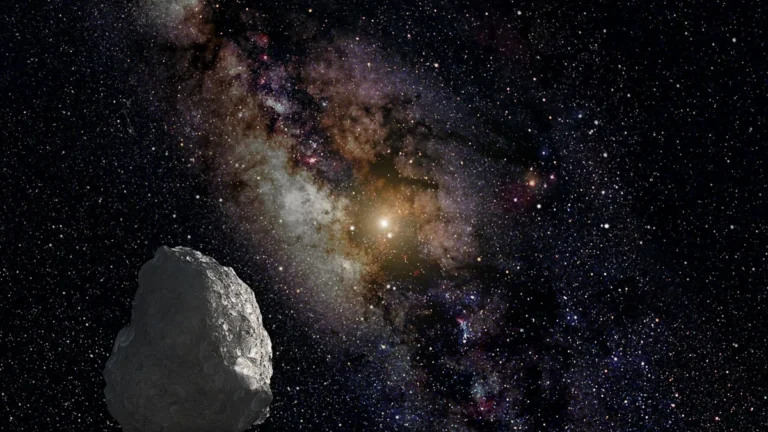
The object measures 11 meters (36 feet) across and completes one spin every 5.35 minutes. Observations from September 2025 showed it measures three times less across and rotates twice as quickly as earlier estimates had indicated. Toni Santana-Ros said the object’s true nature differs entirely from past characterizations, complicating the spacecraft’s planned approach.
Dark comets exhibit anomalous non-gravitational acceleration similar to comets but lack visible tails or comas. Researchers originally thought hidden ice might vent gas to push the object, but the new model indicates temperatures rule out that ice reservoir.
A 2023 study found an odd acceleration pushing the object out of its orbital plane, beyond what the Sun’s gravity or planetary gravity can explain. The outlet calls it a tiny asteroid behaving as if powered by a rocket engine, prompting researchers to look for gas jets from ice inside the rock.
The 2023 study suggested gas escaping from water vapor might account for the motion, comparing the effect to a rocket engine as subsurface ice warms and sublimates. A 2023 Planetary Science Journal paper said the acceleration strength exceeds typical Yarkovsky-effect levels, with authors stating no radiation-based non-radial force could be that large.
Aerospace engineers Korbin Hansen and Masatoshi Hirabayashi constructed a detailed computer model to assess internal and surface temperatures across 1998 KY26. The team executed 260 simulations across 13 assumption sets involving various compositions and orientations to map temperatures throughout the body’s surface and interior. Input parameters included shape, dimensions, reflectivity, trajectory and material traits, and treating the body as rubble insulation still failed to preserve subsurface ice.
The model found the object’s average temperature is approximately minus 47 degrees Celsius, and its coldest locations average at least minus 61 degrees Celsius over an orbit. Buried ice generally needs temperatures below roughly minus 128 degrees Celsius to survive over long periods in the vacuum of space, so KY26 is not cold enough to maintain it. Temperature modeling showed KY26’s coldest zones average no less than 212 Kelvin (-61 degrees Celsius), whereas buried ice preservation would demand temperatures below roughly 145 Kelvin (-128 degrees Celsius).
Calculations show ice making up 1 percent of KY26’s mass would vanish in roughly 2,065 years, while outgassing-driven acceleration (gas released as ice warms) would exhaust it in just 62 years. The team says the calculated lifespan is too brief for an object that may have migrated from the main asteroid belt to its current near-Earth path over millions of years.
Research published in 2025 determined that pressure from sunlight and heat re-emission can account for KY26’s anomalous acceleration without any gas release. Due to its tiny size, solar and thermal forces may strongly affect the body’s trajectory, while the duration of its current orbit remains unknown.
Japan’s Hayabusa2 spacecraft is en route to 1998 KY26 for a meeting scheduled in July 2031 under its extended mission to gather dust and rock directly from the object. The probe dropped Ryugu samples in the Australian outback on December 6, 2020, then began an extended mission to a smaller rock. Hayabusa2 first touched down on Ryugu on February 22, 2019, fired a copper impactor in April 2019, and returned in July 2019 for a second touch-and-go to gather subsurface material. It executed a successful flyby of asteroid Torifune in July 2026 before continuing its journey toward KY26.
The rock is barely twice the span of Hayabusa2’s solar panels, while Ryugu is approximately 900 meters wide, making the new target far more difficult to approach. Santana-Ros stated the object’s true nature differs entirely from past characterizations, complicating the spacecraft’s planned approach.
Without ice to vent, the reason for KY26’s unusual acceleration is once again a mystery, but Hayabusa2 may finally get answers when it arrives at 1998 KY26 in 2031. Gizmodo reported that scientists are still learning whether dark comets may have delivered the building blocks of life to Earth. Researchers propose the object fits a category of asteroids that contain little or no water.
"We found that the reality of the object is completely different from what it was previously described as,"
Toni Santana-Ros, ZME Science
"It moved like a comet, but didn't have the classic coma, or tail, of a comet."
Darryl Seligman, astrophysicist, Wikimedia Foundation, Inc.


Join the discussion