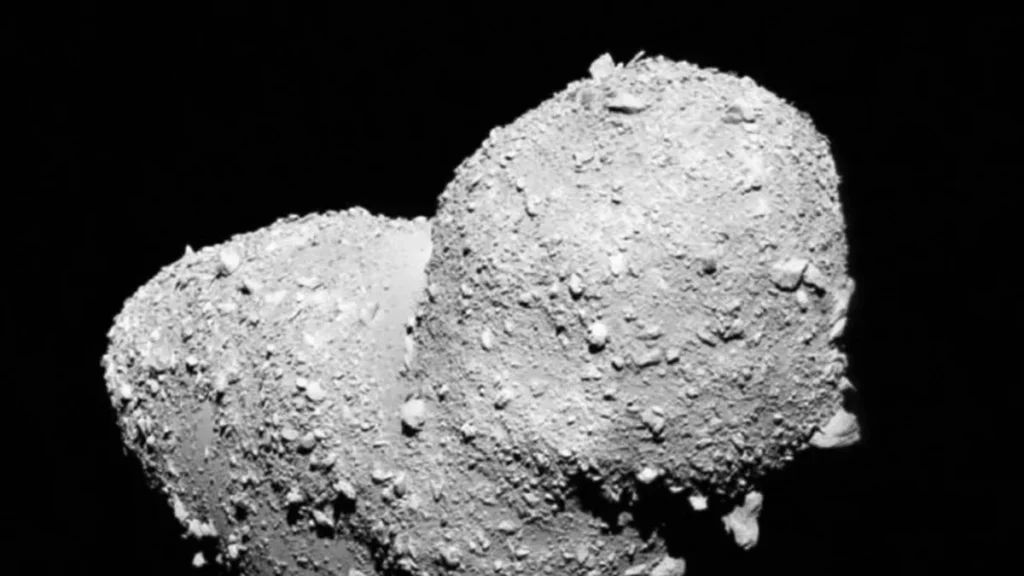
Aerospace engineers Korbin Hansen and Masatoshi Hirabayashi of the Georgia Institute of Technology ran new simulations showing that near-Earth asteroid 1998 KY26 is too warm to retain buried ice, weakening the proposal that escaping water vapor drives the body’s anomalous acceleration. Hansen and Hirabayashi built a three-dimensional computer model of the asteroid to calculate how heat from the Sun flows through its surface and deep into its interior. They compared temperatures across the body’s entire orbit and varied size, reflectivity, heat conductivity and spin-axis direction across 13 runs. The team then used the modeled temperatures to estimate how quickly buried ice would turn to vapor and escape. Ice would have to remain below about minus 128 degrees Celsius, or minus 198 degrees Fahrenheit, equal to 145 Kelvin, to survive over long periods. The coldest parts of 1998 KY26 averaged around minus 47 degrees Celsius, or minus 53 degrees Fahrenheit, in one account and at least 212 Kelvin, or minus 61 degrees Celsius, in the other.
No point on or inside the body stayed cold enough to preserve ice long term. The researchers estimate that even if water made up 1% of 1998 KY26’s mass, it would all vanish in roughly 2,000 years per one account and just over 2,000 years per the other. If that ice powered the acceleration, it would vanish in just 62 years. The results show the asteroid is strongly depleted in ice. Korbin Hansen and Masatoshi Hirabayashi said, “Our temperature model results indicate that the water outgassing rate on 1998 KY26 would be too high to maintain buried ice”. Scientists do not know how long 1998 KY26 has occupied its current orbit, and the asteroid may be billions of years old.
Residual ice cannot be ruled out entirely even though the thermal model argues against long-term retention. Japan’s Hayabusa2 spacecraft is slated to rendezvous with 1998 KY26 in 2031, or in July 2031 according to one account. Because researchers do not know how long 1998 KY26 has stayed on its present orbit, they say only Hayabusa2’s arrival can confirm what the body really is. Astronomers have proposed that 1998 KY26 could be a dark comet, an asteroid-like body pushed by escaping gas that never forms a visible coma or tail, to account for its nongravitational acceleration. The dark-comet idea remains as-yet theoretical for this asteroid. Comets contain ice that sublimates into gas and escapes into space, giving the comet an additional push beyond gravity as it orbits the Sun. Dark comets are so named because their cometary activity is effectively invisible, without the spectacular visible tails normally associated with ordinary comets.
Icy composition is a defining characteristic of comets, giving scientists a way to check a body’s cometary identity by measuring its temperature. Before the simulations, it had remained unclear whether 1998 KY26’s interior could stay cold enough to keep ice frozen long enough for outgassing to occur. Earlier studies have described 1998 KY26 as a theoretical dark comet driven by water venting as gas. The non-outgassing explanation in the studies says sunlight could supply a small but strong enough push to account for the asteroid’s anomalous acceleration. Other studies have argued that pressure from sunlight combined with heat radiating away from the surface could explain the motion without any escaping gas. Measurements of light reflected from the asteroid’s surface suggest a bright, rocky asteroid of a type thought to contain little water. Those readings support the no-outgassing explanation, backing the idea that sunlight and heat radiation drive the motion rather than escaping gas. At 11 m (36 feet) across, 1998 KY26 ranks among the fastest-spinning asteroids ever found.
It spins once in just under five and a half minutes, or every 5.35 minutes according to one account, while circling the Sun with a small unexpected push out of its orbital plane. An earlier paper traced 1998 KY26 to a potential asteroid-belt origin. Together with the thermal result, that possibility of the body retaining ice is shrinking. Hansen and Hirabayashi published “Thermally unfavorable conditions of volatile existence in near-Earth asteroid 1998 KY26, the Hayabusa extended mission’s target” in Icarus in 2027 under DOI 10.1016/j.icarus.2026.117361. The citation identifies 1998 KY26 as the target of the Hayabusa extended mission.




Join the discussion