Key facts
- According to sources, Ladislaus Weinek captured the first successful meteor photograph in the November 27, 1885 Andromedid storm. EarthSky calls him Austrian; Space.com and Around Prague call him Austro-Hungarian.
- French astronomer Jacques Montaigne spotted the comet in 1772, and observers saw it again in 1805 and 1826.
- When Biela's Comet returned in 1846 it appeared distinctly pear-shaped, then split in two about 10 days later.
- By 1852 the two comets had separated by almost a million miles (1.6 million km) into different orbits, with one finishing about 15 days before the other, and neither has been seen since.
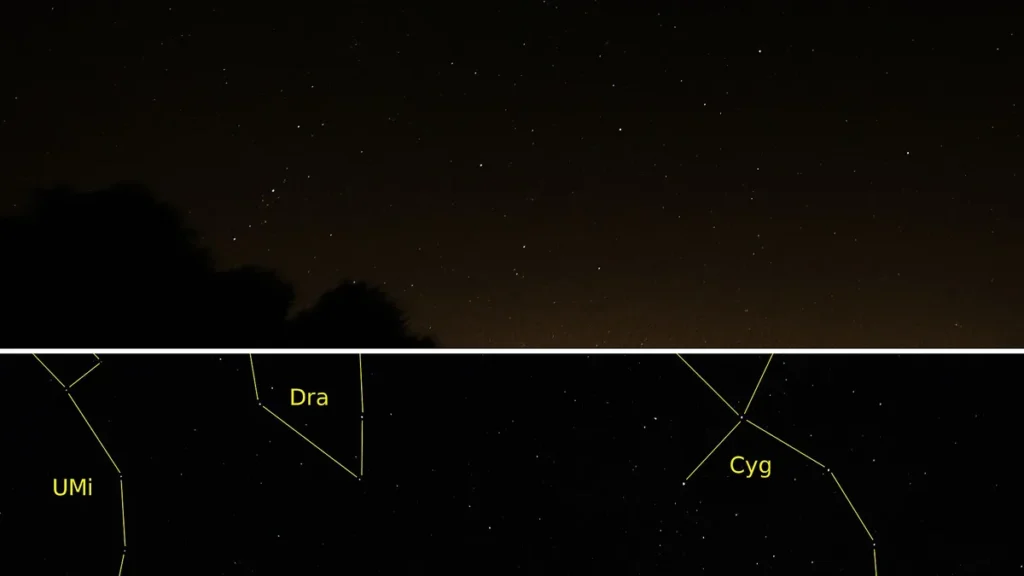
Late November brings the annual Andromedid meteor shower, which radiates from Andromeda the Chained Lady, and today’s meteors are too dim for the unaided eye, EarthSky says.
Space.com and Around Prague say astronomers need special tracking equipment to capture images of the now-faint Andromedids rather than using plates or digital cameras. Space.com notes that cameras have improved enormously since 1885.
Space.com and Around Prague cite expected activity upticks in 2018 and 2023 as the latest predicted revivals. EarthSky concludes that the November shower comes from the ghost of Biela’s Comet.
Around Prague says meteor showers are not fixed features because they rely on cometary debris, and notes that a display once drawing thousands of meteors per hour can fade to almost nothing.
EarthSky says the meteoroid stream behind the Andromedids is a trail of debris that hits Earth‘s atmosphere and vaporizes to form meteors. The stream shares Biela’s Comet’s orbit, which is why EarthSky ties the shower to the ghost comet.
Sources disagree on when Biela’s Comet broke apart. EarthSky says the comet split in 1846, while Space.com and Around Prague say it broke apart in the 1850s and left debris that feeds the Andromedid shower.
EarthSky says French astronomer Jacques Montaigne spotted the comet in 1772, and observers saw it again in 1805 and 1826. It calls Biela an Austrian astronomer, while Space.com and Around Prague say German astronomer Wilhelm von Biela made the third recorded sighting in 1826.
In 1826, Wilhelm von Biela calculated that the comet returned every 6.6 years. That calculation set up the 1832 appearance, and the comet’s arrival as scheduled led observers to call it Biela’s Comet.
When Biela’s Comet returned in 1846 it appeared distinctly pear-shaped, then split in two about 10 days later. The two halves kept nearly the same orbit, with one trailing roughly 170,000 miles (274,000 km) behind the other, and each half’s brightness fluctuated wildly.
By 1852 the two comets had separated by almost a million miles (1.6 million km) into different orbits, with one finishing about 15 days before the other. Neither has been seen since. The International Meteor Organization provides the separation figure, and EarthSky says the split happened at the 1846 return.
In 1867, astronomers Edmond Weiss, Heinrich d’Arrest and Johann Galle independently linked the Andromedid shower, first reported in 1741, to Biela’s Comet. The three compared the comet’s orbit with the meteor stream’s path and said Earth might pass through the stream again in 1872. The predicted encounter produced one of the 19th century’s most spectacular meteor storms.
European astronomers saw one of the 19th century’s most spectacular meteor storms on the evening of November 27, 1872, with meteors pouring from Andromeda at estimated rates of several thousand per hour. Observers struggled to count the meteors as they fell from the constellation.
Contemporary reports called the November 27, 1872, Andromedid display unlike anything most astronomers alive at the time had witnessed before or since. The storm came as Biela’s Comet failed to return as expected around that time, and astronomers realized Earth was passing through material linked to the missing comet.
Biela’s Comet had been expected back around 1872 but had not been seen since 1852; astronomers identified material from the missing comet in Earth’s path. Astronomers treated the 1872 link as proof that comets shed debris streams capable of creating meteor showers, and the storm proved them right.
Thirteen years after the 1872 storm, the Andromedids produced another spectacular display on November 27, 1885, as European observers watched for a predicted dense debris concentration. EarthSky says the two spectacular storms fell on nearly the same calendar date, November 27, thirteen years apart, in 1872 and 1885, and connects both to Biela’s Comet debris.
Ahead of the November 27, 1885, storm, forecasts pointed to another dense debris concentration, leaving astronomers ready and European observers prepared to watch. Skywatchers in 1885 hoped to see the comet’s remains. Skywatchers had waited for Biela’s Comet to come back, but instead witnessed the storm.
At Guildown, England, J. Rand Capron put peak activity at 40 to 50 meteors per minute during the 1885 storm. He called the brightest meteors white, with long trails of yellow or reddish-yellow light, and EarthSky says certain meteors shone three or four times brighter than Jupiter.
In Scotland, J. Smieton began observing the 1885 storm at 5:30 p.m., counting about 25 meteors per minute before the rate reached 100 per minute by 6 p.m. Activity rose again after a brief lull during this second spectacular Andromedid display.
On November 27, 1885, EarthSky, Space.com and Around Prague say astronomer Ladislaus Weinek photographed the meteor’s trail using a plate in the Czech Republic. EarthSky calls him Austrian, while Space.com and Around Prague call him Austro-Hungarian. Space.com identifies the meteor as part of the Andromedid shower tied to Biela’s Comet.
The November 27, 1885, storm holds a special place in astronomy history because it yielded the first generally accepted photograph of a meteor. Around Prague calls the image the first known image of its kind, showing plates could record meteors rather than only fixed objects, and the image recorded a single streak from the burst.
Space.com and Around Prague call the November 27, 1885 Andromedids a meteor storm, a burst far above the normal rate when observers could see thousands of meteors per hour. Around Prague explains that a storm means activity far beyond the shower’s usual rate. EarthSky notes that observers counted meteors by the tens per minute during the storm.
In 2011, astronomers said the Andromedid shower appeared to be enjoying renewed activity around 50 meteors per hour. Both sources present the announcement as a hint of revival for the now-faint shower, and Around Prague says a shower’s activity depends on debris left by its comet.



Join the discussion