Key facts
- Hera will move closer still, to just 12 miles (20 kilometers) from the asteroids, in a step described as next month.
- Hera launched on Oct 7, 2024, aboard a SpaceX Falcon 9 rocket from Cape Canaveral Space Force Station in Florida.
- Cheng et al. measured DART's momentum-transfer efficiency, beta, at 3.61 in Nature in 2023; ejecta amplified momentum transfer roughly 3.6 times and contributed about 2.6 times the impactor's momentum.
- For a pure kinetic impact beta equals 1; DART's measured beta of 3.61 carries a full range of 2.2 to 4.9 depending on Dimorphos's actual mass.
ESA’s Hera spacecraft arrived at the Didymos binary asteroid system on Nov. 5, 2026, and began close-range inspections of Dimorphos, the moonlet altered by NASA’s DART impact in 2022.
The European Space Agency announced on Wednesday that Hera is now studying Didymos and Dimorphos from 15 to 18 miles (25 to 30 kilometers) away, and will move closer still, to just 12 miles (20 kilometers), next month.
DART drove itself into Dimorphos on Sept. 26, 2022, at 6.6 kilometers per second in the first deliberate kinetic-impactor planetary-defense test. The impact shortened Dimorphos’s orbital period around Didymos by about 33 minutes, from 11 hours and 55 minutes to 11 hours and 23 minutes, clearing the 73-second minimum success threshold.
Hera launched on Oct. 7, 2024, aboard a SpaceX Falcon 9 rocket from Cape Canaveral Space Force Station in Florida. On March 12, 2025, the spacecraft flew a Mars gravity-assist flyby, passing within 5,000 kilometers of Mars and about 300 kilometers of Deimos. Hera executed braking maneuvers, including one on Oct. 15, 2026, to match the system’s speed. The Didymos system is about 196.8 million kilometers from Earth, requiring a one-way communication delay of roughly 11 minutes.
ESA’s Asteroid Framing Camera took the first science image from about 37 miles (60 kilometers), showing the face of Didymos that DART’s camera never photographed—a rugged, boulder-strewn hemisphere that prompted questions about whether debris from the 2022 impact altered the larger asteroid. ESA has described the close-up work as a crime-scene investigation of a system changed by human action.
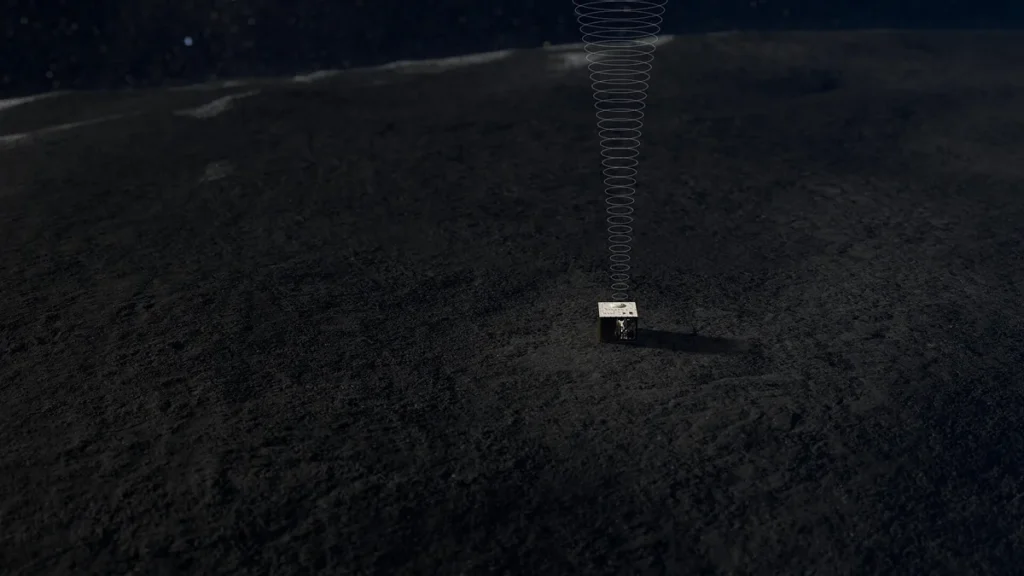
The craft is small-car sized and carries two shoebox-sized CubeSats, Milani and Juventas, to survey Dimorphos more closely and attempt landings; the CubeSats are the first ESA CubeSats to operate beyond Earth orbit. ESA reporting cites 25 science instruments plus two CubeSats aboard Hera, while mission documentation describes 12 instruments on the main spacecraft.
Hera’s Asteroid Framing Camera, a visible-light camera with two redundant units, can resolve features as small as about one meter at close distances. HyperScout-H is a hyperspectral imager covering 650 to 950 nanometers in 25 wavelength bands that maps surface composition through mineral absorption signatures. PALT, a micro-lidar laser altimeter with 0.5-meter vertical accuracy, will build a topographic map and measure the depth and volume of DART’s impact crater.
TIRI, provided by JAXA, covers 8 to 14 micrometers to measure surface temperatures, revealing thermal properties, roughness, and whether the surface is solid rock or loose regolith. The Radio Science Experiment uses X-band Doppler tracking to measure the masses and gravity fields of both asteroids directly.
Milani carries the ASPECT spectral imager and VISTA dust and volatile sensor to characterize minerals and dust at the DART impact site. Juventas carries the GRASS gravimeter and JuRa, the first ground-penetrating radar flown to an asteroid, operating at 50 to 70 megahertz and probing up to about 100 meters below the surface. No asteroid mission has ever flown a ground-penetrating radar, which will reveal whether Dimorphos’s interior is solid rock or a loose, porous rubble pile.
Phase 1 is underway, keeping Hera at 25 to 30 kilometers for six weeks to refine shape models, map surface texture and boulders, and check instruments. Phase 2 deploys the CubeSats after two weeks, and Phase 3 spends four weeks on meter-scale mapping, composition and thermal surveys, and Juventas radar soundings.
Phase 4 gives the laser altimeter six weeks at close range for crater depth measurements that complete the beta calculation DART began. Phase 5 pushes the CubeSats to extremely close distances before controlled touchdowns on Dimorphos; the formal mission is planned to last at least through June 2027.
Hera will deploy the shoebox-sized CubeSats in January 2027 and is expected to spend at least six months surveying the Didymos system. Hera will measure Dimorphos’s mass directly by tracking its trajectory through the binary system’s gravity field with X-band Doppler radio-science tracking, narrowing the beta range of 2.2 to 4.9 to a precise value. Dimorphos’s mass has never been directly measured, and ground-based estimates carry large uncertainty because density is nearly impossible to infer reliably from Earth.
Cheng et al. measured DART’s momentum-transfer efficiency, beta, at 3.61 in Nature in 2023; ejecta amplified momentum transfer roughly 3.6 times and contributed about 2.6 times the impactor’s momentum. If beta reliably exceeds 2 across asteroid types and sizes, a single planned spacecraft could deflect most near-Earth asteroids under 300 meters given sufficient warning, without a nuclear option or multiple impactors.
ESA states that Hera’s discoveries will help turn the kinetic-impact method from a one-off experiment into a well-understood, potentially repeatable technique if Earth ever comes under threat. About 15 percent of known asteroids are binary systems, but none have ever been studied up close and their origins remain mysterious. Hera will determine whether Dimorphos and Didymos are made of the same material, which would hint that rapidly spinning Didymos once threw off debris that later formed the moonlet.
Size estimates conflict across sources: Dimorphos is listed at 500 feet or 558 feet, and Didymos at roughly 2,560 feet, 2,625 feet, or 780 meters. The impactor itself weighed 1,340 pounds, and DART’s camera returned surface imagery at centimeter-scale resolution during its final approach before the spacecraft was destroyed on impact.
Patrick Michel, Hera’s principal investigator, said, “The first thing we said was wow!” Michael Küppers, Hera mission scientist and ESA’s project scientist, said, “We look forward to seeing much more of both bodies and systemically mapping all the changes we identify.”
The Didymos system poses no hazard to Earth; it was chosen because its orbit is reachable while keeping it safely away from any Earth-crossing risk. Hera is an ESA-NASA collaboration coordinated through the Asteroid Impact and Deflection Assessment framework established in 2013, the first formal international bilateral collaboration in planetary defense science. The mission costs €363 million, about $409 million.
NASA estimates about 25,000 near-Earth asteroids wider than 140 meters exist, but only about 40 percent are catalogued, leaving roughly 15,000 city-destroying or larger objects never observed. As of 2026, no spare planetary defense spacecraft is ready to deploy against a newly discovered threat, according to Nancy Chabot, who coordinated DART at Johns Hopkins Applied Physics Laboratory.
ESA will release the first detailed, full-resolution images of both Didymos and Dimorphos publicly on Nov. 25, 2026, potentially showing DART’s impact site for the first time since the collision.



Join the discussion