Key facts
- Ian Carnelli, Hera mission manager, says the team is seeing the double asteroid system through Hera's own eyes for the first time, and views will grow sharper as the spacecraft comes closer.
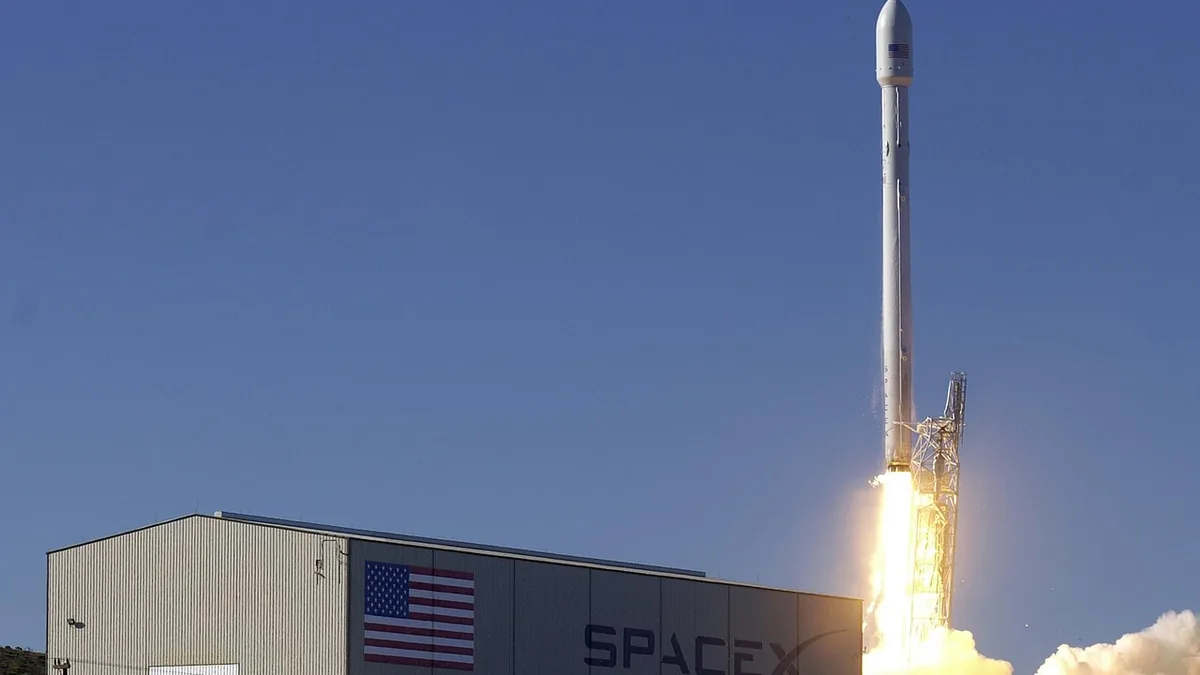
- SpaceX's Falcon 9 rocket launched Hera from Space Launch Complex 40 at Cape Canaveral Space Force Station at 10:52 a.m. ET on October 7, 2024, according to Kennedy Space Center and SpaceX.
- The launch used Falcon 9 first-stage booster B1061 on its 23rd and final mission; SpaceX did not recover the booster because the interplanetary transfer orbit required all performance.
- Hera will deploy the shoebox-sized CubeSats Milani and Juventas in January 2027 after settling in at the asteroid system.
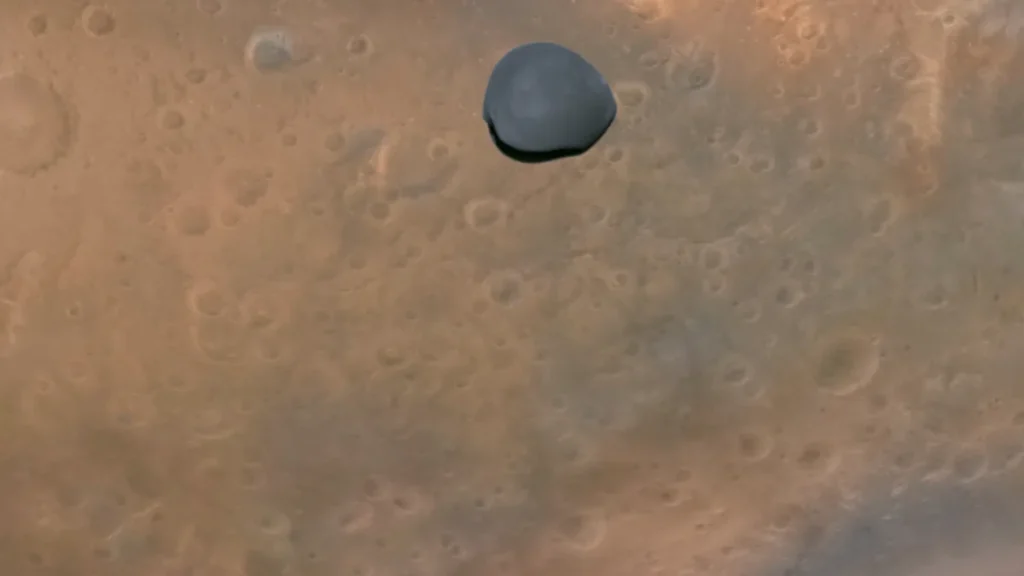
ESA’s Hera spacecraft resolved the Didymos binary asteroid into two separate objects on Oct. 18 while flying about 197 million km from Earth.s
The monochromatic Asteroid Framing Camera took the picture on the evening of Oct. 18 from 1,280 km away. Two thruster firings spaced one week apart had slowed Hera to 20 m/s (45 miles per hour) relative to the asteroid pair, allowing a gradual, fine-tuned approach. Mission managers say sharper views will follow as the spacecraft draws nearer.
The smaller Dimorphos asteroid becomes visible for the first time in the new view. “With this image the smaller Dimorphos asteroid becomes visible for the first time,” explains Michael Kueppers. The moonlet covers only around one pixel yet stands apart from its parent body.
Ian Carnelli, Hera mission manager, says the team is seeing the double asteroid system through Hera’s own eyes for the first time. He adds that views will grow sharper as the spacecraft comes closer. Carnelli notes this is the first view through Hera’s own instruments of the system the mission was designed for.
On Nov. 25, the team will release its first close-up pictures of Dimorphos, calling the moonlet the first body in the solar system whose orbit was measurably changed by human action. Over the coming months Hera will carry out a close-up crash site investigation using instruments and two shoebox-sized CubeSats, eventually progressing to landing.
NASA‘s DART spacecraft hit Dimorphos at 6.1 km/s on Sept. 26, 2022, in humanity’s first planetary defense test. The 1,340-pound spacecraft struck a 558-foot-wide moonlet orbiting the 2,625-foot-wide Didymos. DART was the first test of deliberately striking a small asteroid to change its path.
The DART collision sent a debris plume across 10,000 km (6,200 miles) of space and slowed Dimorphos’s orbit around Didymos by around 33 minutes. Ground-based observations showed the orbital period dropping from 11 hours and 55 minutes to 11 hours and 23 minutes after impact.
Dimorphos measures about 151 m (495 feet) across, roughly the size of the Great Pyramid of Giza, while Didymos measures 780 m (2,560 feet) in diameter, slightly smaller than Dubai’s Burj Khalifa. The two bodies orbit an average 1.15 km apart, with Dimorphos traveling around its parent at roughly 18 cm/s.
ESA launched Hera on October 7, 2024, as a follow-up to NASA’s DART mission after a two-year journey. A SpaceX Falcon 9 rocket sent Hera toward the asteroids from Cape Canaveral Space Force Station on October 7, 2024. The rocket lifted off from Space Launch Complex 40 at 10:52 a.m. ET, according to Kennedy Space Center and SpaceX. SpaceX flew first-stage booster B1061 on its 23rd mission, the last for that vehicle, and did not recover it because the interplanetary transfer orbit required all performance.
The spacecraft is roughly the size of a small car, measuring about 5 feet across on each side. Its solar arrays stretch about 38 feet when opened all the way. The 363-million-euro ($400 million) mission carries 12 scientific instruments and two nanosatellites. Much of its equipment comes from private European companies and Japan’s space agency, JAXA.
Hera will release two shoebox-sized CubeSats named Milani and Juventas in January 2027 after reaching the asteroid system. Juventas will carry out the first radar sounding of an asteroid’s interior, scanning about 328 feet deep into Dimorphos before landing on the moonlet. Milani will use cameras and other instruments to study Dimorphos’s composition and assess the DART impact, and the small satellite may also attempt a landing.
In early November, Hera will draw to within 20 miles of the asteroids and begin gathering data. The spacecraft carried out a braking maneuver on October 15 to adjust its trajectory and nearly match the asteroids’ velocity. Hera is expected to survey the Didymos asteroid system for at least six months and will keep operating at least through September 2027.
According to ESA, ground-based measurements have roughly 10% residual uncertainty, and current impact models cannot calculate Dimorphos’s mass and makeup. Hints suggest Dimorphos is now tumbling, and material may have moved between it and the larger Didymos. Scientists remain unsure of the crater’s size or whether the impact shifted every boulder, and they are searching for any surviving pieces of the DART spacecraft.
Patrick Michel, Hera’s principal investigator, said Hera should be thought of as a detective returning to the crash scene, like Inspector Colombo. Michel said humanity now has the advantage of being able to protect itself from asteroid threats. He said he is not worried about the spacecraft’s arrival and that excitement is all he feels now.
Members of the public can track Hera’s trip through the Hera Space Companion, an interactive communication platform linked to the mission. It is meant to open ESA’s first planetary defense mission to everyone, and ScienceDaily describes it as more than a conventional AI chatbot.
Binary asteroids make up roughly 15% of known asteroids, though none have been studied up close before. An asteroid wider than a kilometer is estimated to strike Earth once every 500,000 years, while a 140-meter asteroid hits the planet about every 20,000 years. Only 40% of 140-meter space rocks are thought to have been identified, and none of the known ones are on a collision course with Earth.



Join the discussion