This is a new development in a story we reported earlier: Astrobiologist Dale Andersen waits out storm delay before Antarctic flight.
Key facts
- Dale Andersen departed the U.S. on 19 October 2026, arrived on "The Ice" around 25 October 2026, and would reach Lake Untersee a few days later via overland traverse, pending logistics and weather.
- On 29 October 2026, Dale Andersen and his team were digging out their logistics tent, checking equipment inventories, and readying vehicles for the journey from Ultima Airbase to Lake Untersee.
- A live webcam at Ultima Airbase captured images on 29 October 2026 at 17:00:09 UTC, five minutes later, and at 22:05 UTC as the sun started to set.
- As of mid-October 2026, two crates bound for Cape Town, South Africa [CPT] had departed and arrived that morning, while three more crates were scheduled to fly to Cape Town on Saturday.
Astrobiologist Dale Andersen reported from Antarctica on Oct. 29, 2026, saying his team had spent a breezy day with blowing snow inventorying and organizing gear inside their new hut at Ultima Airbase ahead of the overland traverse to Lake Untersee.
The report covers Andersen’s second expedition to Lake Untersee in 2026, after the first field season ran from January to March 2026. The Carl Sagan Center within the SETI Institute coordinates the research. He departed the U.S. on Oct. 19 and arrived on “The Ice” around Oct. 25, with the lake reachable a few days later by overland traverse, pending logistics and weather.
Andersen’s research cargo moved from Newark to Dulles before proceeding to Cape Town, South Africa. As of mid-October 2026, two crates bound for Cape Town had departed and arrived that morning, while three more were scheduled to fly there on Saturday.
On Oct. 29, the team dug out its logistics tent, checked equipment inventories, and readied vehicles for the journey from Ultima Airbase to Lake Untersee. A live webcam at the airbase captured images at 17:00:09 UTC, five minutes later, and at 22:05 UTC as the sun started to set.
Andersen said, “It has been pretty breezy all day with blowing snow.” The report came at 6:00 p.m. EDT (22:00 UTC).
The fall 2026 field season’s joint investigations center on recovering sediment cores two to three meters long from Lake Untersee for dating and geochemical analysis. Researchers also hoped to collect samples from local moraines to more precisely pin down glacial movement over time.
Radiocarbon alone cannot provide a reliable chronology of the lake’s sediments, because melting glacial ice releases ancient CO2 and the perennial ice cover limits exchange with the modern atmosphere. Existing radiocarbon dates show living microbial surface mats returning apparent ages of about 10,000 years, so researchers will date the collected samples in Japan using independent methods such as luminescence dating.
The 2026 team includes two postdocs, a PhD student, and two researchers from Birgit Sattler’s lab at the University of Innsbruck. Postdoc Jessica Todd, from Caltech, is working with Andersen on ROV, or remotely operated vehicle, and possibly diving operations.
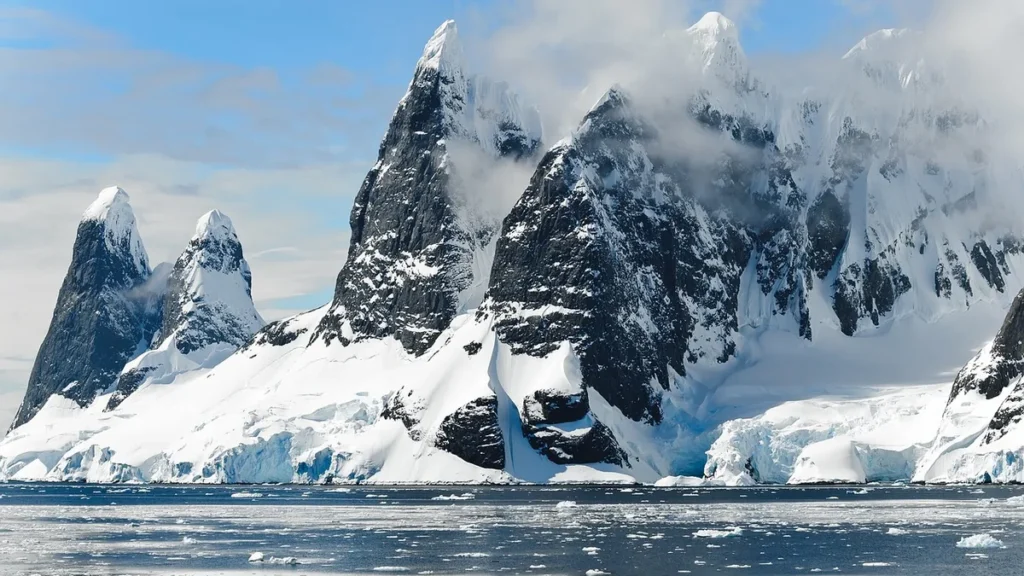
Lake Untersee sits at 71.342° S, 13.473° E in Queen Maud Land, where the Anuchin Glacier flows gently from the north and halts at the lake’s edge. Winds and blinding snow can reach 110 mph, and four months of darkness bring cracking ice and howling winds.
Beneath the lake’s thick perennial ice cover, cyanobacterial mats grow undisturbed as they did billions of years ago, offering a window into Earth’s earliest biosphere. The microbes harness sunlight, split water, and combine the resulting electrons and hydrogen with carbon dioxide to weave complex organic molecules, releasing oxygen as a metabolic leftover.
Research at Lake Untersee helps guide the search for evidence of life on Mars and the outer moons of Jupiter and Saturn. It also illustrates how astronauts will work at NASA’s new Moon Base and eventually on Mars, with Antarctic expeditionary activity directly relevant to the off-world exploration Artemis crews will conduct.
The expedition begins at Ultima Airbase, approximately 70.823° S, 11.641° E, operated by Ultima Antarctic Logistics out of Cape Town. Nearby research stations at Schirmacher Oasis include Maitri, managed by India’s National Centre for Polar and Ocean Research, and Novolazarevskaya, operated by the Russian Antarctic Expedition. The airbase webcam often shows low clouds, flat light, and windy conditions, and its view looks west.
Once loaded with gear, Andersen’s team will turn south in a small convoy of snowmobiles and tractors toward Lake Untersee. The convoy departs from Ultima Airbase after loading equipment for the overland traverse.
The Explorers Club honored Andersen earlier in 2026 with the Finn Ronne Memorial Award. Keith Cowing and Dale Andersen are both Fellow Members of The Explorers Club. Andersen and Cowing first met in 1987 at the old NASA Headquarters Life Science Division and have reported on this research together ever since, with previous field reports going back to 1996.
The 2026 season gives Andersen, Japanese colleagues, and the Indian team an opportunity for joint research at the lake. Andersen last worked with the Indian team in 2012, when logistics were unexpectedly constrained, and he worked with Japanese team members in 2018 at Syowa Station and along the Sôya Coast.
Andersen said, “the coring work is the most exciting for me right now.” He also made a short film titled “Whispers Beneath the Ice: Discovering the Hidden Life of Lake Untersee.” The film offers a first look at the lake and hints at discoveries that may lie ahead.
Join the discussion