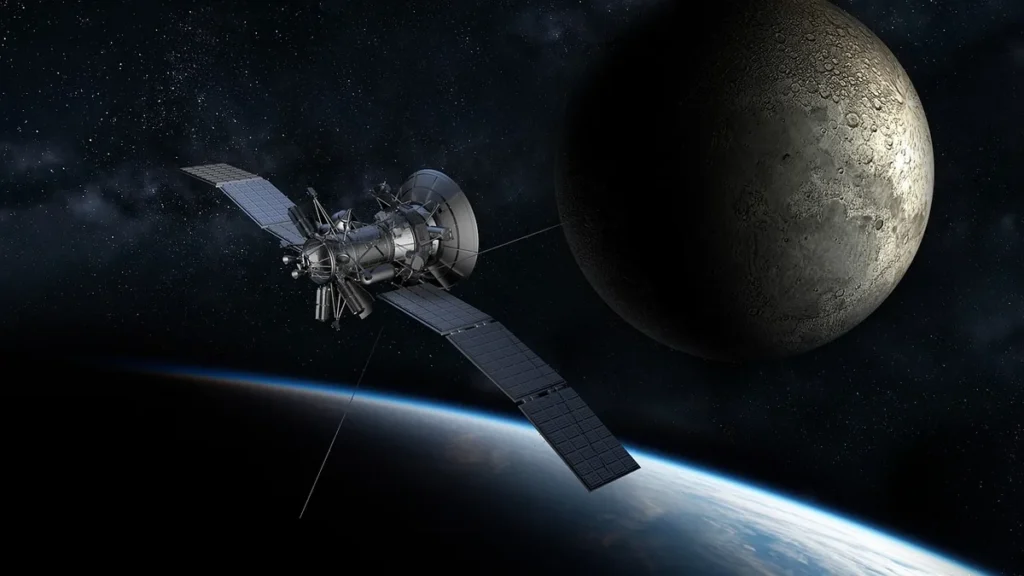
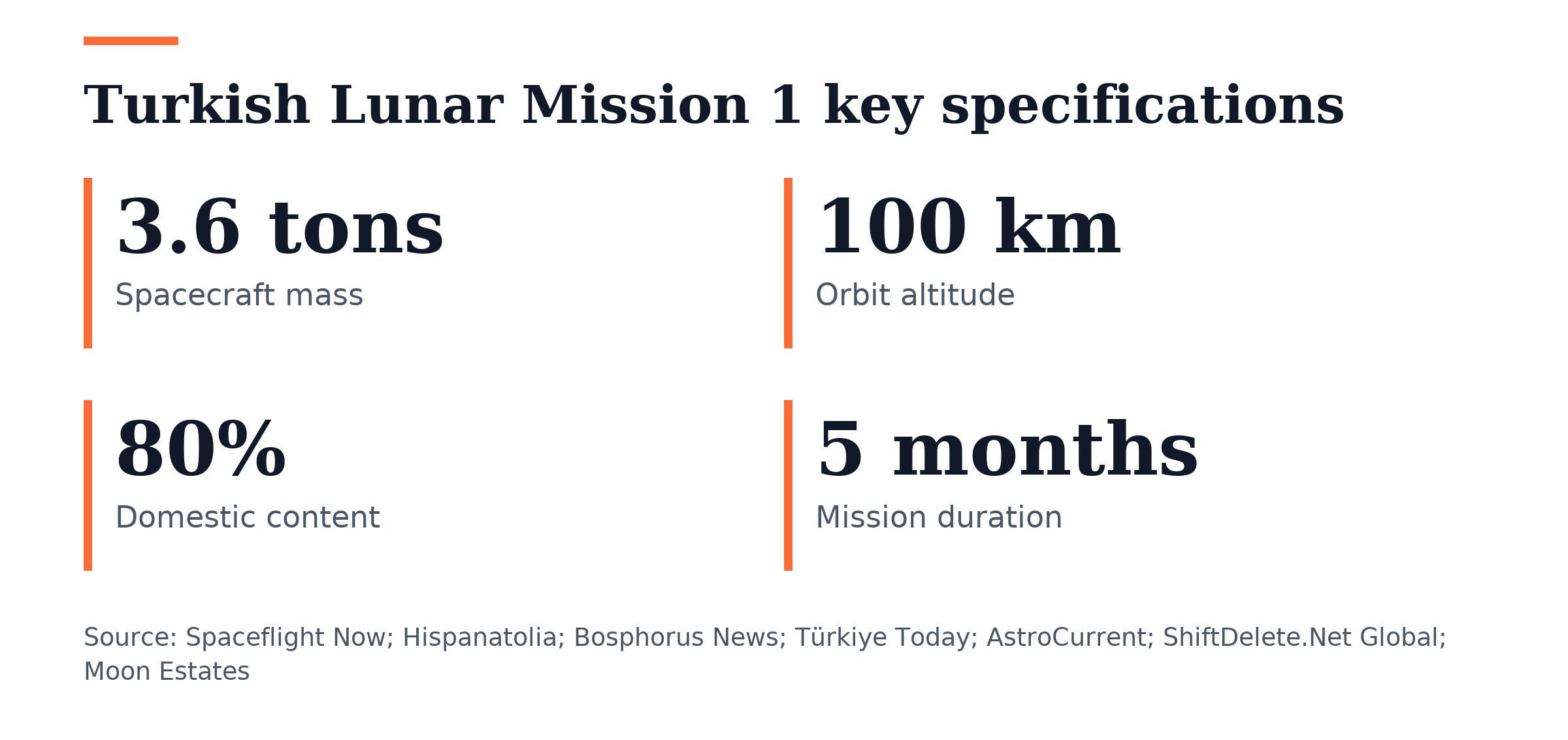
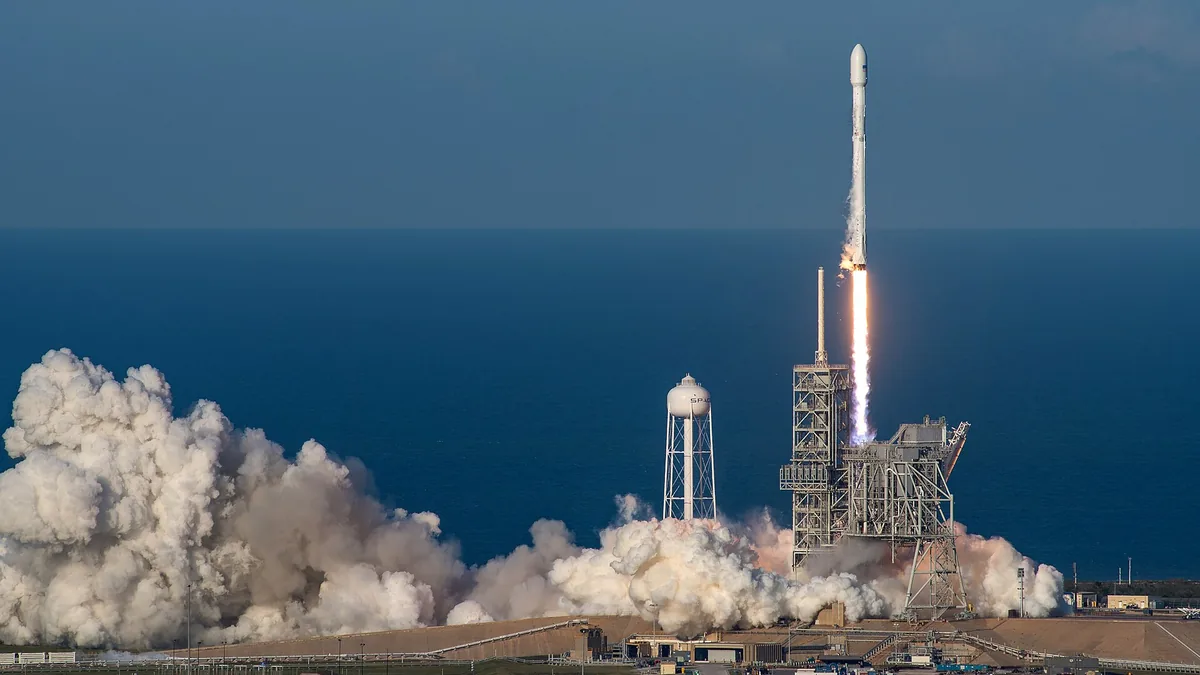
Turkey is preparing to send its first lunar orbiter, the Turkish Lunar Mission 1 (TLM-1), into space between April and June 2027, using a SpaceX Falcon 9 rocket. Turkish manufacturers produced more than 80% of the spacecraft’s components, including propulsion, flight software, and navigation systems that Tübitak Uzay, DeltaV, and Turkish startups developed. A successful mission would make Turkey the ninth sovereign entity to operate a payload in the lunar environment, alongside nations like China, India, Japan, Russia, South Korea, the U.S., and the European Space Agency. The seven payloads study lunar radiation, solar wind impacts, and surface temperatures, contributing to global lunar science.
Turkey’s lunar ambitions are part of a broader National Space Program established after the creation of the Turkish Space Agency (TUA) in 2018. The country has steadily built its space capabilities, launching its first astronaut, Alper Gezeravcı, to the International Space Station in 2024 and deploying successful satellites like Türksat 6A. The Lunar Research Program (AYAP), announced in 2022 as part of this national effort, originally targeted TLM-1 for a 2023 launch before delaying the mission to the current 2027 window. This timeline reflects the complexities of developing deep-space capabilities, but the program’s progress underscores Turkey’s commitment to building a domestic satellite and rocket industry.
The Turkish Lunar Mission 1 relies on a hybrid propulsion system developed by DeltaV, which utilizes nitrous oxide as an oxidizer alongside polymeric solid fuel. This system represents a first for Turkey’s space program and is designed to fire in Earth orbit for translunar injection and again for lunar insertion. Remaining fuel from these burns will enable a controlled hard landing on the lunar surface, which will serve as a rehearsal for the TLM-2 lander mission. This controlled impact is designed to demonstrate Turkey’s ability to guide spacecraft to specific lunar targets, a critical capability for future lander missions and surface operations, while validating the country’s deep-space propulsion capabilities.
Mission planners designed the spacecraft to operate in a 100-kilometer circular polar lunar orbit for at least five months, though mission managers could extend it to 1.5 years depending on spacecraft performance. It carries four scientific instruments: the Lunar Neutrals Telescope, the Lunar Narrow Field of View Radiometer, the Radiation Calorimeter, and the Radiation Dosimeter. Three tools—the High Resolution Camera, the Wide Angle Video Camera, and the Vision Based Navigation System—will support imaging and navigation. These instruments will measure solar wind interactions, meteoroid impacts, radiation levels, and magnetic anomalies, while Turkish scientists analyze data on lunar surface characteristics and radiation environments using domestically developed instruments.
Before shipment to the Kennedy Space Center for launch, TLM-1 is undergoing environmental tests at Turkish Aerospace Industries, including thermal vacuum, structural, and electromagnetic compatibility checks. These tests simulate solar radiation, thermal vacuums, and launch vibrations to certify the spacecraft for deep-space conditions. The mission’s timeline remains flexible within the April–June 2027 window. In a parallel effort, Turkey is constructing a spaceport in Somalia to achieve independent access to space for domestic satellites and spacecraft, aiming to create a self-sustaining ecosystem for the country’s aerospace industry.
Turkey formally joined the Artemis Accords on August 31, 2026, aligning its lunar program with U.S.-led principles for civil space exploration. The Accords establish a framework for future collaboration, though they do not guarantee NASA participation in TLM-1. Turkey’s accession coincided with its hosting of the 77th International Astronautical Congress in Antalya from October 5 to October 9, 2026, where its lunar ambitions and Artemis alignment were central topics. Turkey submitted 1,810 abstracts to the congress, the most of any participating country, reflecting its growing role in global space discourse.
Meanwhile, Turkey’s second lunar mission, TLM-2, will feature a lander and rover, building on TLM-1’s propulsion and navigation systems, though its development is in early stages with no confirmed timeline.
To support its space ambitions, Turkey plans to establish a space technology park in collaboration with the Middle East Technical University to combine research and development efforts across institutions and companies. The park will support joint research and development, accelerating Turkey’s transition to a self-reliant spacefaring nation with capabilities in satellite and deep-space missions. The Lunar Research Program (AYAP), which encompasses TLM-1, is 77% complete and has leveraged experience from the İmece and Türksat 6A satellite projects, involving over 2,000 engineers and researchers. Program leaders expect the program’s success to enhance Turkey’s reputation in system development and deep-space missions, paving the way for future lunar lander and rover missions.



Join the discussion